
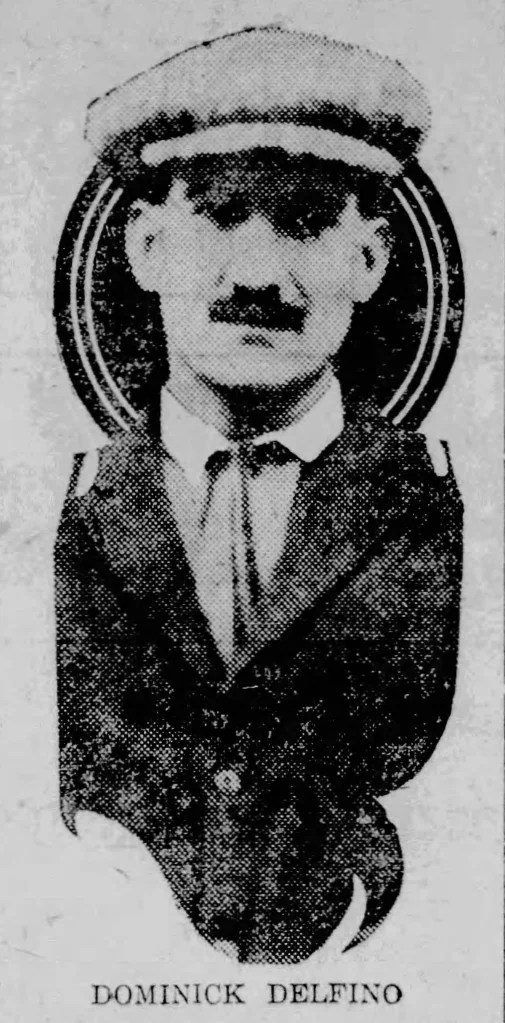
On April 25, 1916, Demetrio “Daniel” Morabito was drinking with several others. The men were at Mellow’s Saloon near the corner of Monroe & Main Street in Archbald. Shortly after 8:00 pm, Morabito left the saloon and headed for home.
It was a short walk to his place on Chestnut Street. He was supposed to get ready to go to work that evening. As he passed under the Wayne Ave railroad, then known as a “subway”, a man jumped out from the brush. The attacker fired two shots at the unsuspecting husband and father of four. Morabito stumbled for about 100 feet before passing out. He lay in the street just blocks from his home until another man found him, barely conscious.

Morabito was quickly brought to a nearby Barbershop owned by Robert McHale. McHale was the brother of the town’s Police Chief, James N. McHale. Dr. Patrick McDonald was called to attend to the victim. Upon arrival, the doctor called for an ambulance to move the man to the hospital. Morabito had severe injuries. He was conscious long enough to state that “Dominick Delfino shot me,” a statement heard by a couple of people.
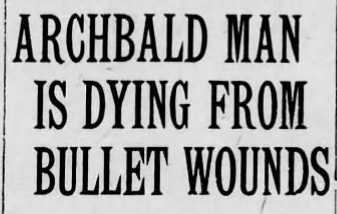
April 26, 1916
While at the hospital, Lackawanna County Detective Thomas Reese interviewed Morabito, who repeatedly exclaimed, “Delfino shot me for nothing”.
At 3:30 am on April 26, 1916, Morabito died with bullet wounds to his chest and neck.
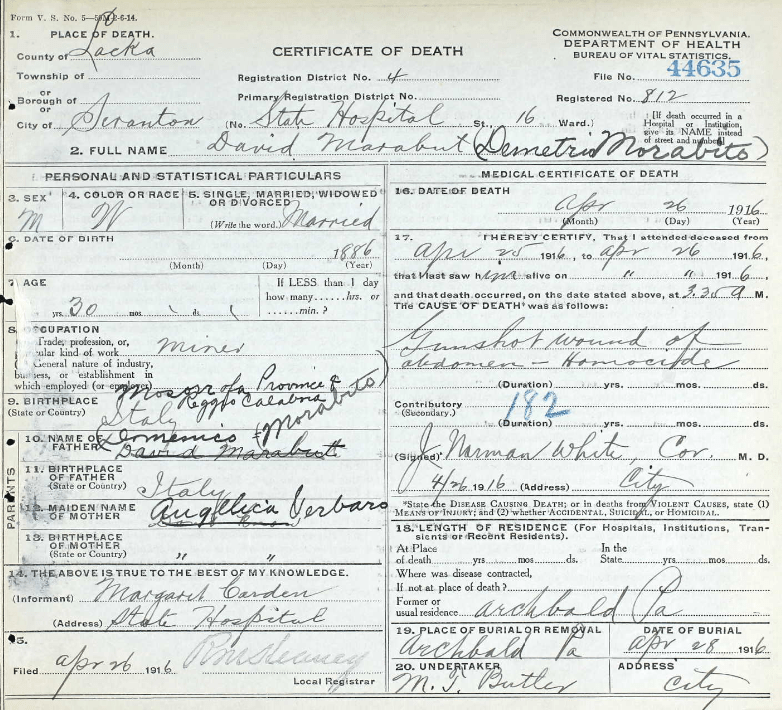
Demetrio Morabito
The 28-year-old had immigrated to the US from Mosoroffa, Italy. Mosoroffa is a small village located in the mountains, just east of Reggio Calabria, in the province of Calabria. The area is best described as the “toe of the boot”. He arrived here in April 1905, just shy of his 17th birthday. He returned to Italy to marry Carmela Monarchio in May 1910. The two returned to the US in September 1910.
Carmela got pregnant in the US and returned to Italy to have their first child. Their daughter Angelina was born in Italy in May 1911. On May 23, 1912, Carmela and Angelina returned to the US to be reunited with Demetrio in Archbald. There, they had two more daughters and a son before Demetrio’s tragic death.
Suspect Captured
The police quickly caught up to Dominick Delfino. He was the man Morabito claimed to be his assassin. They found him at a store owned by Tony Pitea and placed him under arrest. He initially denied any involvement in the shooting. But his story quickly changed, and he admitted to the killing.

Delfino had recently been treated for a gash on his face. The slice went from his upper lip to his chin. When asked about it at the time it had happened, he said he had fallen from a bike. This was a typical response for any incident where the victim was afraid to name their assailant.
Now, after being pressed during the investigation, he claimed that it was Morabito who had slashed him. He said Morabito had repeatedly requested money from him. He claimed the dead man was a member of the Black Hand Society. The Black Hand was an Italian extortion technique where the Society members would extort money from other Italians. Some say it was the precursor to what we more commonly know today as the Mafia.
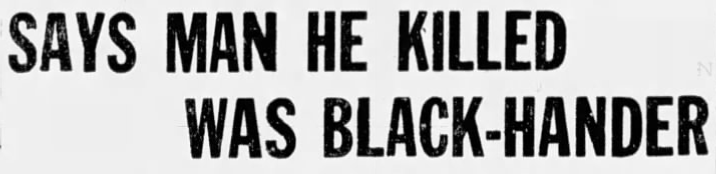
April 26, 1916
The two men had known each other and had been friends for about three years. In fact, Delfino boarded with Morabito before he was kicked out for being too friendly with the police.
Still, it didn’t matter why Delfino killed Morabito – he had just admitted to it. He was charged with 1st-degree murder due to the ambush-style killing. The 26-year-old killer was in this country for only four years. He lived along Salem Rd in a boarding house owned by Thomas Platico. Delfino came to this country with his cousins, Santo Delfino and Dominick Aricchi. They said they were going to another Delfino cousin in Archbald. Now, single with most of his family still in Italy, Delfino was facing the electric chair.
The Trial
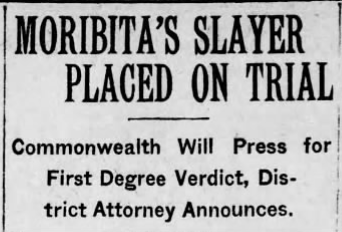
After securing an attorney, Delfino recanted his confession, and his attorneys, Clarence Balentine and Edward T. Philbin, pushed to have the confession stricken from the record.
During the trial, the prosecution relied heavily on Morabito’s dying words. They also used what was called a “train of circumstantial evidence.” First was the make of the bullets. They contended that they came from an empty box of the same brand that was found in Delfino’s apartment. They added that Delfino was “paying attentions” to Morabito’s wife. Prosecutors claimed that Delfino had recently emptied his bank account, hinting that he was preparing to make an escape.
November 28, 1916
District Attorney George Maxey urged the jury to convict Delfino. He asked them to rid the city of this “assassin” and “guilty wretch.” He said this would help “end the reign of blood that is drenching Lackawanna County”.
The defense countered with the fact that there were no witnesses to the actual shooting. They painted Morabito as the villain. They countered that the timing could not work. They had witnesses testify that Delfino was in Pitea’s Store around the alleged time of the shooting. They also called Morabito’s reputation into question, claiming he had a “troublesome disposition.”
The prosecution wasn’t buying it. In fact, in cross-examining one witness who testified that the timing supported Delfino’s defense, the prosecutor blew a hole through his credibility. The witness was asked how long he had been on the stand to testify. The man responded with, “About four minutes.” Later, the prosecutor, Detective Mitchell, called another witness. He was asked to confirm the amount of time the prior witness had testified. Mitchell confirmed that it was actually fifteen minutes, proving that witnesses aren’t good judges of time.
The Defense Rests
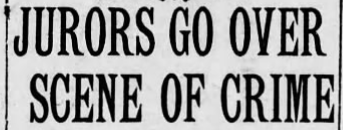
As the defense rested and the case was handed to the jury, the panel made a request. They wanted to go to the scene of the crime. They were accompanied by the DA and Delfino’s attorney. They wanted to see, first-hand, if Delfino could have made the trip in the allotted time.
December 1, 1916
They walked from Pitea’s store on Main St over to the D&H “subway,” then back to the store. They wanted to know if it was possible to do this within 12 minutes, the estimated time that was unaccounted.

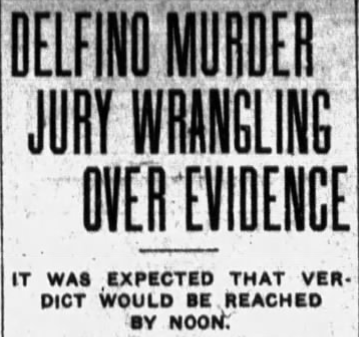
The only options for the jury were either guilty of 1st-degree murder or full acquittal. With no in-between, the group of 12 men was challenged. Throughout the process, it was reported that loud yelling and screaming were heard from the jury room.
Adding to the urgency to come to a decision was the fact that it was approaching Thanksgiving. The Judge had already granted evening hours for testimony. He hoped that the deliberations would end in time to allow the men to have Thanksgiving at home. Instead, arrangements were now being made to have dinner at the nearby Holland Hotel. Since this was before the recent change in date, Thanksgiving was actually held on November 30th.
November 30, 1916
The Verdict Is In!
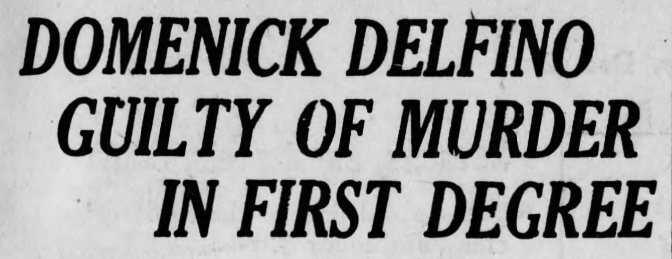
After deliberating for two days, the verdict came back on the evening of December 1, 1916. Guilty! Delfino will pay the ultimate price for his crime.
December 2, 1916
Lackawanna County was established in 1878. Since that time, only six men have been sentenced to death. All of them hung from the gallows. The last man to hang for his crime was John Chimelewski of Dickson City in 1914. He was convicted of killing Carbondale Police Officer William McAndrew. If the Delfino verdict doesn’t get overturned in an appeal, he will be electrocuted at Rockview in Centre County, Pa.
A bright spot came for Mrs. Morabito when District Attorney George Maxey gave the widow $200 to help her now fatherless family. The money was raised from the community based on a suggestion from the DA. He recommended creating the fund for the widow and mother of four.
Chief McHale Supports Delfino
Shortly after the verdict was returned, all hell broke loose.
A request for a new trial was made. It was supported by Chief McHale. Many more details about the murder investigation and the history of these men came into view. McHale went on to say that he believed that Delfino was an innocent man. He was afraid that an innocent man was about to be executed.
McHale claimed the case was based largely on circumstantial evidence that doesn’t support the verdict. He said many details were held back during the trial. He believed that the prosecution led the witnesses to make statements that supported the conviction of Delfino. For example, he pointed to the owners of Pitea’s store. Chief McHale said the DA had asked them to exaggerate the truth. He wanted them to say that Delfino was out of the store longer than they had originally stated. Mrs. Pitea pushed back on McHale, saying, “I tell the truth. When I die, I go to God, not to you.”
McHale also said that Delfino had emptied his bank account on multiple occasions. He said it was something that many Italians would do. The wary immigrants did it to make sure the money was actually there. On that specific day, he withdrew all his money, about $200, and sent $51.50 to Italy. Delfino said his brother-in-law had been wounded in the war, and the family needed the money.
Oh, and that empty box of shells that matched the bullets used in the shooting that was allegedly found in Delfino’s room? Prosecutors claimed the box was found by Tony Tedesco. But it wasn’t. It was “found” by Daniel Tradesco. And it wasn’t discovered in Delfino’s room either. Tony Tedesco is the court interpreter, and Daniel Tradesco was helping detectives with the investigation. DA Maxey later claimed he simply mixed up the two individuals and didn’t call Tradesco to testify. Clearly, there is more to this story.
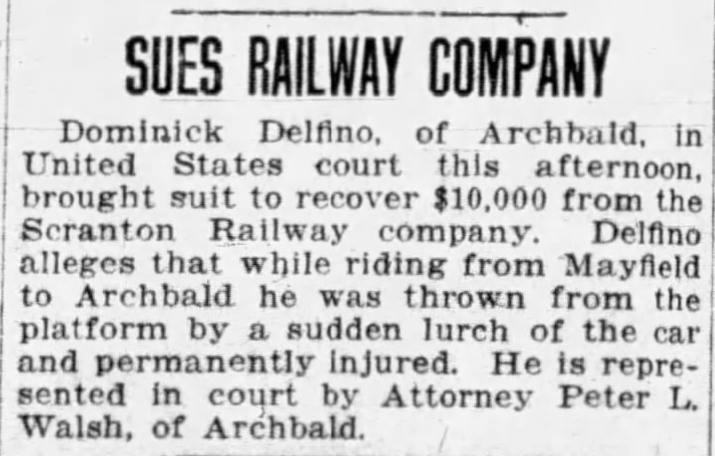
It was also learned that Delfino had been a target before. There was the slashing that was already known, but about nine months prior, his home was burned to the ground. The house was built using money from a lawsuit he won against the railway company for an accident.
March 30, 1916
In another instance, he was attacked in the mines. All of these instances were supposed to have happened because he was known to be friendly with McHale. He was known to share information with him about the secretive Black Hand.
Chief McHale’s Story
Not only were Delfino and McHale friendly, but they were working together to combat the Black Hand. They were set to meet at Pitea’s store the evening of the murder. Delfino was ordered to join a meeting of the Black Hand that night. He was supposed to pay the $100 “fee” to join the notorious gang.
The meeting with McHale was scheduled so that Delfino would give the $100 to McHale. McHale would mark the money before Delfino gave the extortion payment to the Black Hand. After the money was exchanged, McHale had planned to raid the meeting to arrest the individuals. He would then return the marked money to Delfino. The plan was set in motion.
McHale arrived at Pitea’s store on Main St at 7:20 pm to meet with Delfino. Before the two met, McHale was distracted. A couple of Italian men across the street looked suspicious to him. He was watching the men, then followed them down the street and into Mellow’s Saloon.
McHale confronted the men and searched them for weapons. Finding nothing, he returned to Pitea’s store, arriving at about 8:15 pm.
That’s when he heard that a man had been shot near the subway. He rushed to the scene, and that’s when Morabito told him that he thought the shooter was Delfino. The keyword being he “thought” it was Delfino.
Mellow’s Saloon was located at 379 Main St, and Pitea’s store was just up the street at 419 Main St. This would be on the route that Morabito would take to get to his home on Chestnut St.
It was alleged by the prosecution that as Delfino saw Morabito coming, he made his way to the subway and waited. They claimed he shot Morabito twice, then placed the gun on a train that was parked on the tracks. They believed his thinking was that the train would leave, and the weapon would never be found.
Delfino then made his way back to Pitea’s store. That’s where McHale caught up with a calm Delfino. He was smoking a cigarette and gave no indication that he had ever left.

Pitea’s Store is the first building on the left

The arrow marks the subway
Because McHale was distracted by the two other men, he couldn’t confirm that Delfino was at Pitea’s the entire time. Even so, others testified that Delfino did leave the store for a short period. The focus became the estimated 12 minutes he was gone. Could he make it to the subway, shoot Morabito, and return to the store without anyone seeing him?
One of the witnesses for the prosecution, Thomas Platico, with whom Delfino resided, testified. He said he saw Delfino on the street between 7:30 and 7:45 pm. He was headed for the footbridge on Salem St. That helped to paint Delfino in the area at the time of the shooting. Prosecutors believed he was on his way home to get his gun.
After the trial, McHale approached Platico on the street. He shook his fist and threatened to punch him. He said that he wanted Platico to tell the Judge that the DA Maxey coerced him into making that statement. Platico did not back down. He filed an affidavit in court that Maxey had asked him to only tell the truth.
Maxey was not happy with McHale. The two argued violently over the verdict.
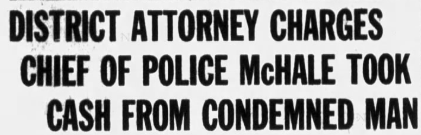
Maxey later charged that McHale accepted $300 from Delfino as a bribe to help exonerate him. McHale had stated he was going to arrest Maxey for slander.
December 13, 1916
McHale had used Delfino in the past in the fight against the Black Hand, but Delfino wasn’t always innocent. In fact, three years earlier, McHale had prosecuted Delfino for carrying a concealed weapon.
Delfino Awaits His Appeal
Delfino was sitting in jail, waiting for his attorneys to work their magic. In late December, news surfaced that he was seriously ill. He was said to have incurred several epileptic fits throughout the day. Both the Sheriff and the Warden confirmed his status. The Sheriff was willing to bet that “he will never live to be seated in the electric chair.” They added that he has taken the conviction very hard and maintains his innocence.

December 29, 1916
The very next day, it was determined that Delfino was not dying. Instead, his fits were due to hysteria over his impending death.
After months of legal battles, on May 18, 1917, a judge upheld the verdict and sentenced Delfino to death. In his ruling, Judge Mosher of Sunbury stated, “You, Dominick Delfino, be taken to the Western Penitentiary in Centre County, and there suffer death by the proper authorities, causing to pass through your body a sufficient number of currents of electricity to cause your death. And may God have mercy on your soul.”

May 18, 1917
State Supreme Court
However, the fight is not over yet for Delfino. His team vows to take the matter to the Supreme Court.
The State Supreme Court agreed to hear the case within a month. A ruling was expected by the end of the year.
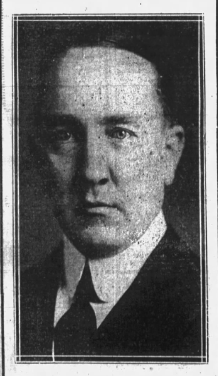
District Attorney George Maxey
Around the same time, George Maxey is seeking re-election for the County DA. He takes out a full-page ad in the Scranton Republic touting his successes, including the Delfino conviction. Judge Mosher submitted a testimonial letter of support that was printed in the ad.

September 13, 1917
The ad opens up by stating, “The Scranton Times, the notorious Democratic party organ, in its malignant zeal to keep me off the Republican ticket because its editor and owner know that I will defeat the Democratic candidate this November as I did in November 1913, attacks me in yesterday’s issue for the political advertisement I had in the August number of the Argus, the publication of the Young Men’s Hebrew Association, in which I declared that there would be no Captain Dreyfuss, or Leo Frank, or Florence Maybrick convictions in this county while I was public prosecutor. This is about the third or fourth attack this discredited newspaper has made on me in this campaign.”
September 16, 1919
The references to Dreyfuss, Frank, and Maybrick refer to high-profile cases around the globe that were wrongful convictions.
Supreme Court Decision
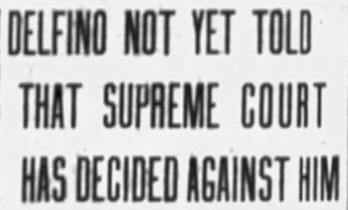
On January 7, 1918, the Supreme Court upheld the verdict, and the end is near for Delfino. His only hope now is a pardon. With the Court dismissing all challenges, it’s unlikely there’s room for a pardon. Oddly, days pass before Delfino is informed of the Court’s decision. Imagine that.
Passing Time
While waiting on his fate, Delfino becomes a “wizard” at Checkers. He’s constantly playing the game and taking on the guards through the bars of his cell. The guards promise to set up a few matches with Herman Bonnert from the County Recorder’s office. Bonnert is widely regarded as the best Checkers player in the area.
January 8, 1918
The Escape!
Three weeks after finally learning of his fate, it is reported that Delfino speaks to fellow prisoners. He says, “They are going to write a new history about me.”
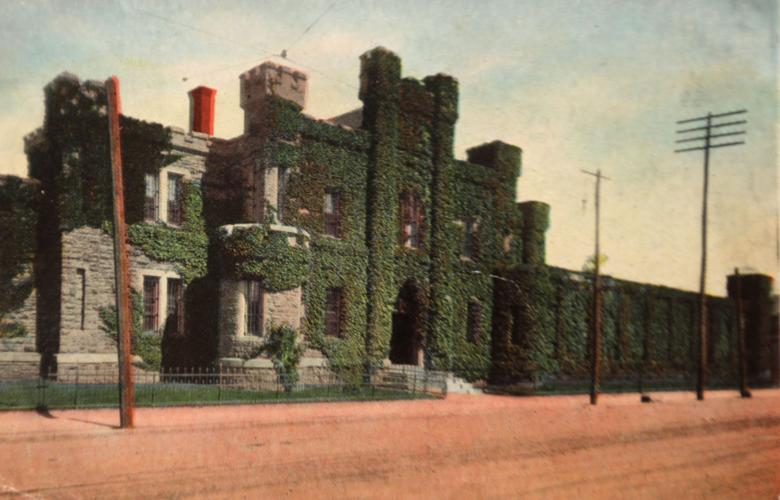
On February 4, 1918, at 3:00 am in the dead of winter, Delfino escaped from the Lackawanna County Jail! He used a saw to cut his way through the bars of his cell. Then he beat jail keeper Thomas Josephs into submission with a wooden leg from a rocking chair. He fired two shots into Robert “Bob” Proudlock, another jailer. Then he held off a third jailer, Isaac “Ike” Steinberg, as he made his escape.

February 4, 1918
The escape was daring and dramatic. The keepers all put up a valiant fight, but Delfino was on a mission. He extricated himself from the cell through an 8 1/2 x 11 opening in the bars. He then picked up the rocking chair leg. The prisoners used it to stir the soap and water when washing the floors. A cell at the end of the hall was vacant, so he waited there until the keeper came through. As soon as he did, Delfino pounced by striking Josephs in the head. Josephs fought back until Delfino pulled a revolver and demanded the keys.
As Delfino was opening the door to the corridor, Josephs started to yell to Proudlock. Proudlock didn’t think much of the disturbance. He came out without his weapon and was met by Delfino and his revolver. The escapee ordered Proudlock through the first iron gate on their way to the main corridor. There, they came upon Steinberg. Delfino now ordered Steinberg to give him the keys to the main corridor. Keeper Steinberg didn’t have them, nor did he know where they were. Delfino then turned to Proudlock and demanded the same.
Proudlock had the key on him, but he told Delfino that it was in the main office drawer. Little did Delfino know that this was where Proudlock’s gun was stored. Proudlock opened the drawer, grabbed his weapon, and started to fire. Delfino returned fire and retreated to an office.

February 4, 1918
In the firestorm, Proudlock was hit twice. At least five other bullets were found embedded in the walls and doors of the jail.

February 4, 1918
With Delfino cornered in an office, Proudlock tossed his weapon to Josephs, who was bleeding profusely from his head. Delfino’s gun was out of bullets. He saw the dazed Josephs and bull-rushed him. As he did, Josephs took aim and pulled the trigger – only to hear a click. The revolver was empty.
Delfino yelled, “Now I’ve got you, you son of [a bitch].” Delfino pulled out a box of bullets and started to reload. He shouted at Josephs, “I’ll kill you.” Delfino made his escape as he opened fire at the keeper, but Josephs miraculously avoided getting hit.
He headed north on Washington Ave and, before long, disappeared.
Proudlock gave chase on foot while bleeding and without a weapon. He became too weak and cut into Kelly’s Saloon on New York Street. There, he called the police and other county authorities. He shouted to Delfino, who turned and fired another shot at the exhausted keeper.
A neighbor living across the street from the jail heard the commotion. James Pretheroe, was too ill to go outside, but he heard someone screaming, “Murder! Help! Police!” Pretheroe called the city police and told them to send many men to the area.

Scranton Times
February 4, 1918
During the investigation into the escape, it was learned that Delfino had visitors earlier in the day. Delfino’s brother, Tony, and a cousin, Mary Cretilla, both from Archbald, visited Dominick. One of the keepers, Henry Daenemark, said they had searched Tony but not Mary. He claims he stood by while they visited and said nothing was passed to Dominick.

Scranton Times
March 23, 1949
A couple of days before that, Delfino had other visitors deliver him some pasta. One of the visitors claimed to be his brother from Pittsburgh. On that visit, they were turned away, but the pasta was passed on to him. However, not before it was checked for weapons by a maintenance man, Paul Koschinski. The authorities were stumped as to how he secured his gun and ammunition.
In the immediate aftermath, investigators thought that one of the guards on duty might have been in on the job. They pointed to either Josephs or Steinberg. Had one of them hit an emergency button, it would have alerted Proudlock to an issue in the jail. He would have locked down the facility and had a weapon ready. Josephs and Proudlock were brand new to the job. Both had been appointed just five weeks earlier when a new warden was named.
Investigators also questioned why the woman who visited Delfino wasn’t searched. There is supposed to be a matron on-site at all times for this purpose.
One theory is that the tools he needed were given to another inmate before they were passed to Delfino. With intense scrutiny over Dominick, it would be easier to get them to another inmate.
Authorities picked up Tony Delfino and Mary Critella in Archbald and arrested them in connection with the escape. It was learned that Tony had purchased a box of bullets a few days prior. During the investigation, Tony and Mary told conflicting stories of where they went after they left the jail.
He’s On The Run!
As soon as he escaped, law enforcement from up to 100 miles away was alerted. They were instructed to capture the escapee, dead or alive, with a $500 bounty on his head. They were warned that he was desperate, armed, and dangerous.

February 4, 1918
The investigation revealed that after leaving the jail, Delfino made his way to Throop Corners. There, he knocked on the door of Thomas Price – begging him to let him in because he was cold. Price refused, and Delfino asked for the nearest Italian family. His next stop was at the home of William Race, where Mrs. Race reluctantly let him in and offered him an overcoat. She told the police that he was shaking so much he could hardly speak. She added that his hands were blue and cold.
Delfino left the Race home and went a couple of more houses away. Then he came upon the home of Paul Mintick. My guess is he saw a light on in the home because Mintick was getting ready for work.
Delfino changed his story this time. He said he just arrived in the city from New Jersey and was headed to Jessup in a taxi. The cab was hijacked by men who demanded that they turn over all of their money. Delfino said he handed over $200. He said he begged the men to allow him to keep some, so they gave him $50 back. He told Mintick that he wanted to buy some clothes, but Mintick didn’t have any to sell. Mintick told officers that Delfino’s shirt and pants had blood stains on them. That was probably the reason for the request for new clothes.
Officers searched hundreds of homes that could potentially house the fugitive, including every Italian household in Archbald. They initially believed that he took a car or motorcycle from the jail. Now they think he left on foot. They believed he headed north on Washington Avenue before following the Dunmore Suburban Line tracks to Dunmore Corners. From there, he continued until he came to the Price home.
It was also learned that Delfino confided in one of his checker-playing inmate friends, Leo Cawley. Cawley, who was in jail for automobile theft, told investigators that Delfino had planned to “get” DA Maxey. When this was revealed, Maxey armed himself with a Colt revolver to fend off any potential attack. Delfino had also sold Cawley the suit he wore when he was arrested for $3. With the $50 he received from his brother on Sunday, Delfino had plenty of money to aid his run from the law.
Before his escape, Delfino was a model inmate. He was friendly with all of the other inmates. There were about 100 prisoners at the time. He was also friendly with many of the security guards. On the night of his escape, one of the jailers, Edward Wenzel, made his rounds and said goodnight to Delfino. When he did, Delfino insisted that they shake hands. Delfino told him, “You know, maybe I die in the night.”
Days later, and still no clue as to his whereabouts. While there were hundreds of leads, all of them were fruitless. Many volunteers, encouraged by the reward, signed up to aid in the search. Wanted fliers were sent through the newspapers and posted throughout the area. Law enforcement had run a fine-tooth comb through the entire valley. Still, no sightings of Delfino. It’s also widely reported that this is the most sensational escape in Lackawanna County history.

February 11, 1918
Meanwhile, at Farview State Hospital for the criminally insane, an inmate has just escaped. The convicted murderer broke out of the facility but was captured within 20 minutes. Officials there touted their escape response plans – seemingly taking a shot at the county prison.
Sightings
False reports and sightings continued to come in. In one instance, from as far away as Philadelphia. There, a man was brought into custody and believed to be Delfino. The man had two missing teeth. They thought it was Delfino since he had two gold teeth. They thought he might have had them extracted so he could sell them. When they compared descriptions with DA Maxey, they confirmed that it wasn’t the man they were looking for.
Dover, NJ
On February 15, 1918, it’s now believed that Delfino and two other men boarded a train to Dover, NJ. This happened on the Thursday after the escape. Train records confirmed that two round-trip tickets were used. They originated from Dover and arrived in Scranton the day before the escape. Another ticket was one-way from Scranton to Dover. A taxi cab driver in Dover recognized the picture that investigators showed him. He believed that he picked up the men at the train station and drove them to Mount Morris, NJ. This was another Italian settlement. Investigators searched over 50 homes in the town. While the search came up empty, they believed Delfino was, in fact, in this town. They believed that two men from the town helped aid the escape.
Christmas Party
As the investigation continued, it was determined that Delfino hosted quite a party on the prior Christmas Eve. He gathered some prisoners in the “tonsorial parlor”. It was listed as a “coming out” party and had about 12 other inmates as guests. One of the changes as a result of the escape? No more parties in the “tonsorial parlor”.

Scranton Times
February 18, 1918
Yeah, I had to look it up. A tonsorial parlor is what we now know as a barbershop. Additionally, there was to be no more fraternizing between inmates. They believed that the men became too friendly and didn’t alert the keepers to the plans.
Increased Reward
With the trail going cold, the reward is increased to $1,000 – about $18,000 in today’s dollars. Still, authorities believe he will be found, even though jokes were starting to pour in about his escape.

Appeal Brings New Evidence To Light
Yet, while Delfino is on the run, Delfino’s attorneys again appeal to the Supreme Court, asking for another hearing. It comes as no surprise that they declined to hear the case again. Uncovered in this appeal was an affidavit from Lewis Rudge. Rudge was a night watchman at a silk mill. He testified that he saw Delfino shoot Morabito. He didn’t originally come forward for fear of retribution from Delfino’s friends.
Additionally, DA Maxey convinced two witnesses whose testimony supported the defense to change their statements. Dominick Panzira and Santo Fierno originally said they saw Delfino in the store at the time of the shooting. Their new statements claimed the time wasn’t correct and that they weren’t even sure if it was the same day as the murder.
What’s a Gink?
Another development is that since Delfino didn’t complete his draft registration questionnaire, he is now officially listed as a deserter. A nationwide manhunt is now on.

February 23, 1918
What’s worse? Being called a deserter, a murderer, or a gink?
Proudlock resigns
On March 1, 1918, Robert “Bob” Proudlock resigned from his post as Jail Keeper. He recovered from his bullet wounds but would rather return to the mines as a Fireboss. This was despite leaving the mines due to asthma. His $90 per month pay as a Keeper equates to about $9.37 per hour today. An associate of Proudlock’s claimed that he felt there were many problems at the jail. He felt the warden had his hands full in dealing with them.
False Alarm Abounds

April 3, 1918
Two months after his escape, another false alarm. Police in Palmerton arrested a man said to fit the description of Delfino – minus the scar on his face. The Chief in Palmerton knew of the escape. He would visit the employment centers, monitoring the men who came in looking for work. This man matched the description to a tee. When questioned, he didn’t have any papers to identify himself. Like Delfino, he was not registered in the draft. He spoke English and Italian and was guarded and evasive when questioned. A dentist was brought in to check his teeth to see if there were any caps or replacements. Once the dentist confirmed they were all original, the man was set free.
First Anniversary of Escape
One year later, Delfino is nowhere to be found. It’s now believed that he left the country. One report claimed that police spotted him in Philadelphia. A man resembling him tried to collect a paycheck at the shipbuilding yards on Hog Island. He was able to evade the police because of the crowd gathered on payday.

February 4, 1919
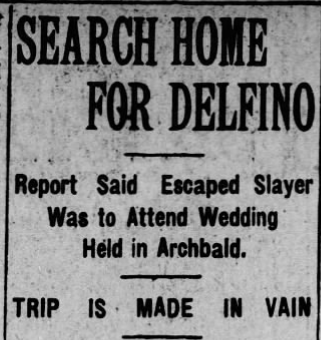
Eighteen months later, and yet another tip. Delfino is said to be attending a double wedding in Archbald. A man told investigators that he rode a streetcar with Delfino from Carbondale to Jermyn. He said he saw him enter the home of Anthony Defazio on Main St, Archbald. Defazio’s home was under surveillance last year as he and Delfino are said to be close friends. Authorities descended on the weddings and thoroughly searched, but did not find Dominick or his brother Tony.
August 5, 1919
In July 1922, there was still no sight of Dominick. His brother, Tony Delfino, was in front of Judge George Maxey for failing to pay child support to his wife. Judge Maxey, who was the DA who prosecuted Dominick, asks Tony about the whereabouts of his brother. Tony just smiled.
Tony tells the Judge that he makes $90 a week running a pool hall on Lackawanna Avenue in Scranton. Maxey orders him to pay $90 per month to his ex-wife. Tony would later disappear.
Still no sight of Delfino in December 1922, but that didn’t keep his name out of the papers.

December 8, 1922
Captured!
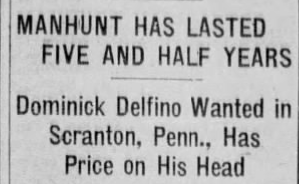
Finally, on November 12, 1923, after nearly six years on the run, Dominick Delfino was captured! He was found in the mining town of Nelson, British Columbia. The remote town sits about 400 miles east of Vancouver. It’s about 45 miles north of the US border with the state of Washington. Today, the population is only 10,000 people.
November 13, 1923
While on the run, Delfino worked under the aliases of George Renieri, Jack Lanieri, and Giacoma “Jack” Coveno/Cavena. The officials in Vancouver believed that Delfino was suspected of being in the area as early as 1922. They contacted the Scranton officials to confirm his identity.
On May 14, Canadian officials positively identified Delfino. But by this time, word had spread that he was close to being captured, and he had disappeared. Now, they had to uncover his whereabouts, checking every city and town in British Columbia.
The two Scranton men who received high praise from Judge Maxey were Superintendent of Police Michael J. McHugh and Captain of Detectives A.J. Reilly, who worked tirelessly in pursuit of Delfino. Maxey highlighted their “intelligence, skill, and persistent energy” in tracking down Delfino. A man he called “the most cold-blooded and crafty villain this commonwealth has ever known.”
But it wasn’t over just yet. Delfino finally admitted to his identity. But he would only waive extradition back to the US if he was granted a new trial.
The city officials made plans to travel to Vancouver to bring Delfino back. On the trip would be Captain Reilly, Captain Chris Rose, and Daniel Williams of the DA’s office. The extradition would be costly – over $1,200. It would be lengthy, too. Each way of the trip was expected to take four to five days. On top of that, the reward money of $1,000 was due to Chief Constable Anderson and his team in Canada.
Within a day, Delfino changes his demand for a new trial. He waived extradition, claiming he had new witnesses who would testify that it was not he who killed Morabito.
While detained and awaiting extradition, Delfino is said to be writing up his escapades. Meanwhile, rumors of his marksmanship swirled in Canada. He was characterized as a Western gunslinger. It was said that he could toss coins into the air and shoot the center out with each hand.
Later, it was determined that Delfino was fairly boastful, and he was the one who started these rumors with others while in Canada.
Delfino Tells His Side Of The Story
Delfino agreed to tell his side of the story to the Scranton Times.

November 19, 1923
“When I came from the old country to Scranton, the head of the Black Hand Society there wanted me to join the gang, but I had told him that I did not like to belong to such a gang. But a few months later, when I started to work, he came around again and wanted me to buy him a suit. I told him I would not do such a thing. Four other Italians working with me were paying monthly into the Black Hand, but I did not pay a nickel, and the Black Hand got after me and told me that if I didn’t pay, I was going to get killed. They came after me four times.”
“One day, I called the bluff and said that if they wanted anything, I would go with them and see who would shoot the best.”
He continued, “Four of the New York Black Hand came to Scranton sometime later. We went into the ‘bush.’ They had guns, and I had a gun and a knife. They threw a cap into the air, and we shot at it to see who was the best shot. I shot through the cap every time, as I was an expert shot. A week after we did this shooting at about 4:00 pm, I was told that I was to be killed on the following Saturday, and I had better look out.”
Delfino went on to add two instances of him being followed. He said he believed the men were going to kill him. He tells how he turned from hunted to the hunter and jumped the men and beat them up. He said that when he was going to sleep after the second incident, his fellow companions asked him why he didn’t just pay the Black Hand. He replied, “I am not afraid of any Black Hand.”
His story continued. “Shortly after this, I got caught, and they slashed my face with a razor, and I did not say anything to anybody as to who did it.” It wasn’t Morabito, it was another man.
“When Morabito was killed, they blamed it on me, and I was arrested on the 25th day of April 1916. All the Black Hand was against me until such time as I was convicted and sentenced to the electric chair.”
“After I was sentenced to the chair, the Black Hand came to my rescue because I did not give them away at my trial. I had my case three times appealed and three times dismissed. This Black Hand gang always paid for my attorney.”
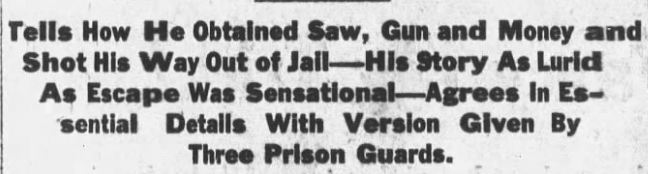
He added that when he was in jail, he had his own gang from Albany help him escape. It was them who supplied him with the saw, gun, ammunition, and money.
November 19, 1923
“There were two men who came to see me disguised as nuns, and it was from them I got the gun, bullets, and money. They had to pass through three cells to see me, but everybody thought they were nuns,” Defino claimed.
This statement was challenged by the current and previous Wardens. They said they don’t recall any nuns coming to see a prisoner. They did acknowledge that a man and a woman visited him. It was Delfino’s brother and female cousin who visited him the day before his escape.
He went on to say how he overpowered the guards before exiting the facility. Much of the story aligned with the account given by the guards, but Delfino definitely embellished some details.
He admitted that he walked about nine miles in the cold and snow. He said his ears and feet were freezing because he didn’t have a hat and wore just slippers. He wore just a thin cotton shirt and pants. Before long, he says, “I went to the home of an English family, and they gave me a coat but had no shoes. I gave them $5 for the coat.”
Then he headed to the home of one of his old boarding friends. When he was close, he ran into his Godfather on his way to work. “He thought I was a ghost and dropped on his knees and asked me not to kill him,” he stated. From there, he gathered $300 from his companions and went to a place “100 miles away.” He continued, “From there, I stole a ride on a freight, which took me to Niagara Falls and across into Canada.”
After making his way to Toronto, he thought he would settle in. He was living in a boarding house on London Street by the police precinct and worked in a nearby slaughterhouse. But there, too, his picture was plastered up on posters, so he knew he had to move again. Before he could, two detectives knocked on his door. “When asked if a man named Delfino lived there, I told them there was, and I would go get him. I was disguised. I went to the back of the house, and I saw that one of them went to watch the back door. I jumped out through a side window and went to another Italian home.”
He knew he had to leave quickly, so he said he made his way to Sault St. Marie and started to work in a mine near there. Before long, “two of the Scranton police followed me there and stopped a friend of mine and said that he was Delfino because he had a slash mark on his face like mine. I heard them talking to him and running behind a house. I got away as soon as possible.” He believes this was as far as the Scranton team followed him; however, the Scranton police said none of their officers ever traveled to this town.
Later, it was learned that Delfino was in Sudbury, Ontario. He worked at Spanish River Paper and Pulp, Ontario, which is between Sault St. Marie and Sudbury, so this might have been the location where police tracked him.

While there, he was walking along the railroad tracks when two military police picked him up. “I was carrying two automatic pistols at the time. They took me to the barracks, and I told the commanding officer that I was an Italian and willing to fight for Canada, for I hated the Germans as much as they did.” The commanding officer apparently believed the story and released the fugitive. Not before Delfino got him to write a letter in case he was stopped by any other police along the way. This gave him a “get out of jail card” that helped him get all the way to Calgary.
Delfino Returns to the States
After about six months, he returned to Scranton with the alleged intent to kill DA, now Judge Maxey. He was disguised as a woman and made his way to Maxey’s home, presumably at 910 Clay Ave.
Maxey was not at home, but his wife, Lillian, was there. Delfino had no grudge against her, so he left.
He met up with some of his Italian friends, many of whom didn’t recognize his new look. He collected “a considerable amount of money.” Then went to Albany, NY, where he met with one of the leaders of the Black Hand.

In a basement, “Fifteen feet below ground, where thirty members in a meeting were discussing my case. They were saying how clever I was to escape. They wanted me to stay with them, but I said that I had to leave right away. I went to New Jersey and then again came to Canada.”
Back to Canada
Back in Calgary, he says he stayed for a long time and became friends with the police. “I saw my own photo in the detective’s office and asked one of the officers why they did not get that man, and he told me that the man was not in these parts.” Now, he was confident that he was safe. He did not have fingerprints on file. And the photo was an old one before he disguised himself.
While in Canada, he became a successful bootlegger. He admitted to selling alcohol, so much so that from the proceeds, he bought an automobile.
He was eventually arrested in Calgary for his “rum-running,” and the officials confiscated over $13,000 of alcohol. He gave up the automobile and said he went back to St. Catherine’s, Ontario. There, he was arrested for carrying a concealed weapon. Again, he didn’t worry since there were no fingerprints on record.
His next stop was in Seattle, Washington. There, once again, he befriended the police, even “walking, talking, eating and drinking with some of them.” From there, he made his way to Spokane. Along the way, he stopped in various places in Idaho, including Bonners Ferry. It was there that his personal items remained after his capture.
When he entered Canada this last time, he was stopped by immigration authorities because he didn’t have any papers. He was fined $50 and sentenced to 60 days in the Nelson jail. Again, he was undeterred and confident that no one knew his past. He just planned to wait out his time in jail.
But he was wrong. Detectives Ricci and Sinclair knew who he was, and the two were actively tracking him.
Critical Mistake
It was uncovered that while he was in jail in Nelson, Delfino wrote to a friend of his, Giuseppe “Joe” Calderini of Vancouver. He asked the man to pay the $150 owed to him so he could hire a lawyer. This was before the police knew his true identity. The letter was likely an excuse to get his money sooner since he planned to wait out his time.
Calderini and Delfino met in about 1920 and became close friends. So much so that Delfino actually disclosed his real identity to his fellow countryman. Calderini was known to own a questionable “resort.” I believe it was the Grand Court Hotel on Main St. in Vancouver, which was a known speakeasy. When Calderini received the letter, he informed Detective Ricci that the man in the Nelson jail was a wanted fugitive.
Ricci and Sinclair notified the authorities in Nelson to be very careful with Delfino. They informed them of his past as they made their way to identify the wanted man.

When the two detectives arrived, Delfino told them, “I dreamed a lot while in there [jail], and one night I would dream that I should run away.” He added, “The night before you arrived, I dreamed of blood.” He said, “The day before your arrival, I was put in the Nelson jail ‘condemned cell’ on your wire, and I knew I was caught.”
“I heard of Ricci when in Vancouver, where I stayed two nights at the Greycourt Hotel, and I left intending to never return.” He added that if he could have gotten away from the Nelson jail, his next move was “to Mexico, where I knew I would be safe.”
He ended his statement to the detectives with, “I am all right where I am.”
“I am all right where I am” – Delfino’s closing statement
George Maxey Weighs In
After the capture, it was revealed that Judge Maxey had joined the hunt for Delfino. Maxey learned that Delfino had planned to kill him the Wednesday before he escaped from jail. Delfino invited Maxey to join him for a conversation at the jail. The only thing that saved Maxey was that a physician was murdered that night, and Maxey was called to duty. Since it’s believed that Delfino already had a revolver with him, it was deemed a credible threat. Even after Delfino’s escape, Maxey was told that Delfino returned to the city six months later. That’s when he would once again attempt to take his life.
Maxey took another shot at Chief McHale. He said McHale “would be wise to make no more statements about the alleged innocence of Delfino.” He continued, adding, “Morabito was a good citizen, industrious and law-abiding, and Delfino’s cowardly and cold-blooded crime made the woman a widow and four little children orphans. I raised the money to help clothe and feed these little children during the trial of their father’s assassin, and I have helped them since.”
The Return To Scranton

On Wednesday, November 21, 1923, Delfino is set to make the trip back to Scranton. He was escorted by Daniel Williams of the DA’s Office and Captains A.J. Reilly and Chris Rose of the police department. The arrival was expected to be Sunday night or Monday morning. Before his trip, Delfino stated, “I’ll never go back to Scranton alive.”
He told Detective Ricci that he would escape on the trip. He said he would escape handcuffs, and the only thing he feared was leg irons. He told Ricci to keep it quiet. He said if he escaped, it would make Ricci look better because he detained him for so long.
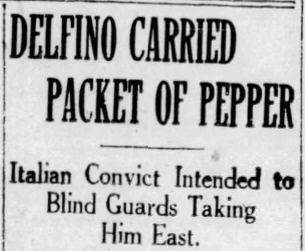
Before the trip began, Scranton officers searched Delfino once again for any weapons. They didn’t find any guns, knives, or other sharp instruments. But they did find a handkerchief in his pocket that was filled with red pepper. It seems that Delfino had planned to use the spice to temporarily blind the officers. Of course, Delfino denied the allegations of the plan and just smiled at the officers when questioned about it.
November 21, 1923
The trip took longer than expected, with the group arriving in Scranton on Tuesday afternoon. The officers stated that there was no trouble during the trip, and Delfino complied with all of their orders. After a quick photo on the steps of the jail, Delfino was led to his cell to await the date of his execution.

Scranton Times
November 28, 1923
Murderer’s Row
Back in the county jail, Delfino looked fit and healthy. He said his weight fluctuated over the last few years while on the run. He claims he weighed as much as 165 pounds before he got jailed in Nelson. Now, at 155, he blames the loss on the “mush for breakfast, lunch, and dinner” while in the Nelson jail. “This is a good jail, but Canada jails are a bad place,” he said after finishing his first meal back in Scranton.

Scranton Republican
November 28, 1928
How good can it be if you’re housed on “Murderer’s Row”? Delfino is held captive in Cell 217. In Cell 214 is John Myma, who is facing a death sentence for the murder of Wolf Glou. In Cell 215 is convicted murderer Pasquale Stallone. And in Cell 213 is Anthony Morella, who is expected to plead guilty to manslaughter. Quite a crew.
Now back in custody, the authorities have made several changes to ensure he doesn’t escape again. No visitors will be allowed in the jail while they wait for an execution date. He’s also put on “death watch” to ensure he doesn’t kill himself before the state executes him.
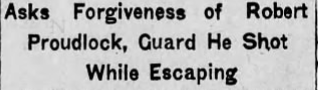
The one exception to the visitor policy was that of Keeper Bob Proudlock. He met with Delfino as soon as he was put in his cell. Now healed, Proudlock wanted to face Delfino one more time and talk about the escape.
Delfino was apologetic and asked for Bob’s forgiveness. He said, “You brave man, Bob, and that’s why I did not want to kill you the night I got out. I was desperate that night and would have done anything to get away.”
November 28, 1923
Proudlock offered his forgiveness.
More Details Come To Light
Delfino recanted a couple of statements that were published in his “first-hand account” to the Times. He claims he never did want to kill Maxey, stating, “Why should I want to kill Mr. Maxey? He is a gentleman.” He added that if he wanted to kill anyone, it would be the Archbald man who lied about him during the trial. I can’t confirm who this is.
He is also mad at Archbald Police Chief James McHale. He believes McHale let him down by arresting him and telling him to keep quiet. He also has negative words about his attorneys.
The other statement was that there were no nuns as originally claimed. He now says that it was two women who helped secure the tools for him. At this point, it’s hard to distinguish the truth from the lies, or at least the embellishments.
Delfino claims that at the time of his arrest, he was going by the alias Jack Caneva. He also says that he had used the name George Lanieri as well. Vancouver newspapers say he was using Kevin Munroe as an alias.
Other details of his escape came into view as well. He said that after he picked up the coat at the Englishman’s house, he went to a wash house near a mine. There, he put on a couple of pairs of overalls to help him look bigger. He painted his face with coal and dirt and topped his head with a cap to make him look like a miner.
On his way back to Archbald, he headed up the mountain near Mayfield to the old mines. There he camped out in a building and built a fire to keep warm. Later, he found a boy in town and gave him $5 to buy him some food. The boy returned with a bounty of food and received “four bits”, about 50 cents, for his efforts.
Later, he met an acquaintance. He convinced that person to get him some peroxide and ammonia to dye his hair and eyebrows.
Feeling like a new man, he made his way to Carbondale. There, he grabbed a taxi to take him to Forest City. The snow was too deep and forced them to stop in Richmondale, just short of his intended destination. Faced with a decision, Delfino decided to return to Carbondale. He spent a couple of days near Hospital Street. This was a largely Italian community, and his brother Tony might have lived there at that time.
It was there that he decided to hop a train to Oneonta, NY. With about $250 in his pocket, he boarded with an Italian family in town. He went to a clothing store and bought “a nice suit, a grey overcoat, and a cap.” He said, “When I got back to the boarding house and look in the looking glass, I didn’t know myself.”
While at the boarding house, one of the other boarders showed Delfino a newspaper article about the escape. The man was oblivious that he was showing the article to the wanted man. Delfino claimed the man said, “That Dominick must be a pretty clever guy.” To which Delfino replied, “Yes, that fellow is sure one smart fellow. Let’s have a drink on Dominick Delfino.”
He knew he had to get farther away since the local newspaper in Oneonta had shared the news of the escape. He boarded a passenger train to Albany, then transferred to one to Buffalo. On the ride, Delfino claims Detectives Ira Mitchell and Phil Rinsland passed him on the train while he was seated. They didn’t recognize Dominick, but Dominick said he didn’t even recognize himself with the changes he had made.
In Buffalo, Dominick spent a couple of days at a swank hotel before hopping a freight train to Niagara Falls. He claims he paid the conductor $10 to allow him to cross the border into Canada. He made his way to Toronto before continuing his freedom throughout Canada.
A Somber Thanksgiving
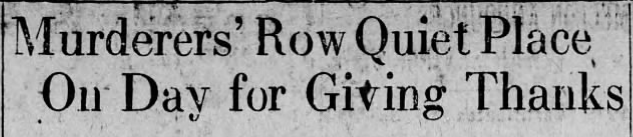
The last Thursday of November used to be celebrated as Thanksgiving Day (today, it’s the fourth Thursday). On this day, Murderer’s Row fell silent. With no visitors allowed, Delfino and his counterparts, Myma and Stallone (no mention of Morella), all remained stoic and silent.
November 30, 1923
The only break in the silence came from some small talk with the guards. They were assigned to watch over Delfino 24 hours a day. The prisoners received a Thanksgiving feast that consisted of roast pork, sauerkraut, mashed potatoes, bread, and coffee. The same meal was served twice that day, and you could eat as much as you wanted.
Two Guards And A Safety Razor
Something as simple as a shave takes on a new level of complexity when dealing with a desperate convicted murderer.

December 4, 1923
Execution Date Established
In early December, Governor Gifford Pinchot ordered Delfino’s execution to occur during the week of January 7, 1924. No exact date was decided nor shared with Delfino until Judge Maxey approved. In the meantime, friends of Delfino raised money. They hired a lawyer to represent their friend in front of the Board of Pardons. Delfino’s attorney asked the Governor for a delay so he could properly present to the Board.
Their efforts succeeded, and on December 21, Governor Pinchot issued a stay that will delay the execution for one month. This set a new date for the week of February 4 – coincidentally, six years from his escape.
In what was Delfino’s last Christmas dinner, he and his Murderer’s Row associates received fresh ham and mashed potatoes. They were offered sauerkraut, oranges, apples, bananas, grapes, coffee, and bread. They received the same meal as all of the other prisoners. The only difference is that the women got a box of candy and the men, cigars. The no-visitor policy continued.
Dominick still steadfastly denied that he killed Morabito. During the Board of Pardons hearing, it was expected that he would tell the Judge that two women had heard a deathbed confession from the actual killer.
He shared a story of how he saved a woman from drowning as justification for the pardon. He claimed that while he was on the run, she fell into a canal east of Calgary. He jumped in and pulled the woman to safety, demonstrating that he was not a bad person. “Do you think I’d work in the hospital during the flu?” That was a statement that was confirmed by officials at the Spanish River Pulp and Paper company. “Or that I would save a woman’s life if I was a bad man or if I had not a noble heart?”
He added that the Godfather of Morabito also believed he was innocent. Otherwise, he would have testified against him.
Deathbed Confession
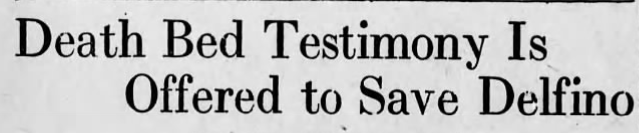
At a hearing in Philadelphia, affidavits were presented to the Supreme Court. The first asserts that Tony Cotronelli was the man who killed Morabito. Cotronelli died of the flu in October 1918. The document was signed by Mrs. Amelia Tunelli of Jermyn and Mrs. Sarah Semononi of Archbald.
The women state that Cotronelli was a boarder at the Tunelli home in Archbald. During his illness, Mrs. Tunelli acted as his nurse. At one point, Cotronelli called for Tunelli. He told her he had a confession to make and that she needed to summon another witness.
January 8, 1924
After Mrs. Semononi arrived, Cotronelli told the two that he was the one to kill Morabito. He asked that they keep it a secret as long as Delfino remained free. If Delfino were ever captured, they were encouraged to tell the truth.
Years passed, and Mrs. Tunelli lost her husband to the flu in 1921. That’s when she moved from Archbald to Jermyn. After Delfino was captured, Mrs. Tunelli told the story to one of Dominick’s friends, who, in turn, brought the information to Delfino’s attorney, Mr. Edward Philbin. That’s when the affidavits were secured.
Supporting the claim was the location where the murder weapon was found. It was found near the old White Oak breaker in Archbald. Cotronelli’s home is within a few blocks of the breaker. And on the direct route from the scene of the crime.
The evidence was enough to convince the Supreme Court to issue a new hearing. The date was scheduled for January 16th. It also states that the execution is halted until the new case is resolved.
Delfino says that he was aware of a rumor that it was Cotronelli. He initially heard the story from a barber in Rochester when he was on the run. Delfino says that Morabito got into an argument with Cotronelli over money due to Morabito. The argument escalated into a bar fight. He said two men from New York came to Archbald to meet with Morabito and Cotronelli. This was a few days before the murder. They were in town, but on the night of the murder, the men had disappeared. Delfino says he got his information from the brother of a man whom he believes was the killer. The man had told his brother that he and Cotronelli “finished Morabito.”
Confession Challenged
All was looking good for Delfino – until the court date.
January 16, 1924
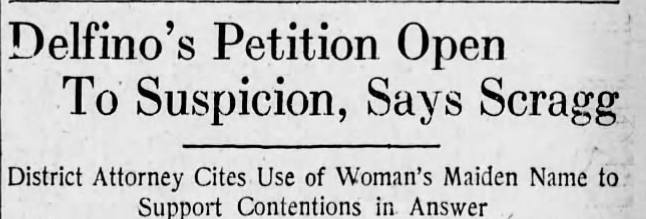
During the trial, the new District Attorney Harold A. Scragg argued vehemently that the affidavits were questionable at best. He shared with the Judge that Mrs. Tunelli’s now-deceased husband was Santo Fierno. The same Santo Fierno who filed an affidavit overturning his original statement on behalf of Delfino in the first trial. And Sarah Simioni, the woman who filed the second affidavit, is married to Dominic Panzira. The same Dominic Panzira, together with Fierno, changed his affidavit on Delfino’s behalf in the first trial.
It’s also no coincidence that Panzira came from Catona, the same town in Calabria as Delfino.
Supreme Court Denied Request
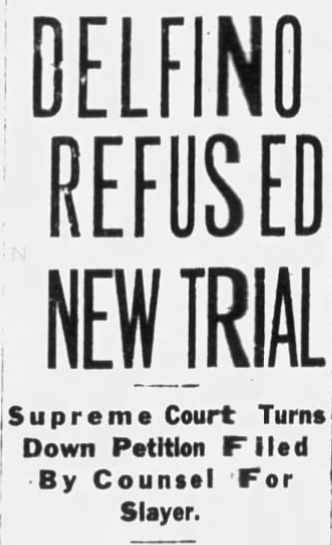
Scruggs’s work to discredit the affidavits, coupled with his extensive review of Delfino’s record while on the run, was enough. The Supreme Court ruled in favor of the State and denied the request for a new trial. Delfino’s final hope is to rely on a pardon from the State Pardon Board. In the meantime, Gov Pinchot granted another reprieve and pushed the execution date to the week of February 25th, 1924.
January 18, 1924
While Delfino awaited his execution, it was reported that there were eight murderers housed in the Lackawanna County Prison. This was the most in the history of the county, dating back to 1878.
Respite Granted
Yet again, Delfino got relief. The Board did not hear his case due to the absence of a key member. The date for the new hearing was pushed out to March 5th. With the delay, the new execution date was the week of March 10th, 1924. This gave Delfino more time to live.
Confession And A Plea For Mercy

March 5, 1924
When Delfino was captured at Pitea’s store, he initially denied any involvement in the murder. But before long, and under intense questioning, he admitted that he had killed Morabito. Once he secured his attorneys, he changed the story and said he never confessed to the murder.
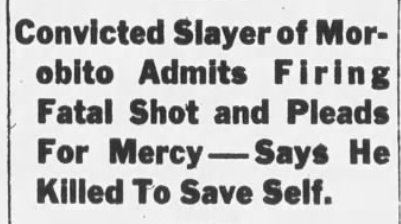
After denying it for eight years, Delfino flips again. He admitted to Detective Rose that it was he who fired the fatal shot into Morabito. But he did so in self-defense. He begged for mercy as the Board of Appeals was about to hear his final plea. He claimed that Chief McHale instructed him to stay quiet and not say a word. He said McHale gave him the feeling that he had his back.
March 5, 1924
Much of what he told Rose aligns with his original story. It was the same story he told the Times after he was caught in Vancouver. There was only one major difference. Now he says that one of the times the men attempted to kill him, he held his ground. And that’s when he fired the fatal shots into Morabito.
Detective Rose noted how his story had continuously changed and took the new confession with a grain of salt. It appeared that his confession and plea for mercy had no impact on the call for a pardon. In fact, neither attorney was even aware of his revised statement. The board had denied his appeal and upheld the sentencing, destroying his final hopes for salvation.
The End Is Near
The date of his execution was now set. It was scheduled for the following Monday, March 10, 1924, at 7:15 am. Six years after the murder of Demetrio Morabito, the man responsible for his death will pay the ultimate price.

March 7, 1924
The events are still not 100% clear. It seemed that if Delfino had claimed self-defense earlier, he might have been spared like so many before him.
Officials have not yet told Delfino of his date, but it’s believed that he has heard through others. He had called for Father Clement Cavaletti to join him on Saturday morning. That could lead one to believe he had known.
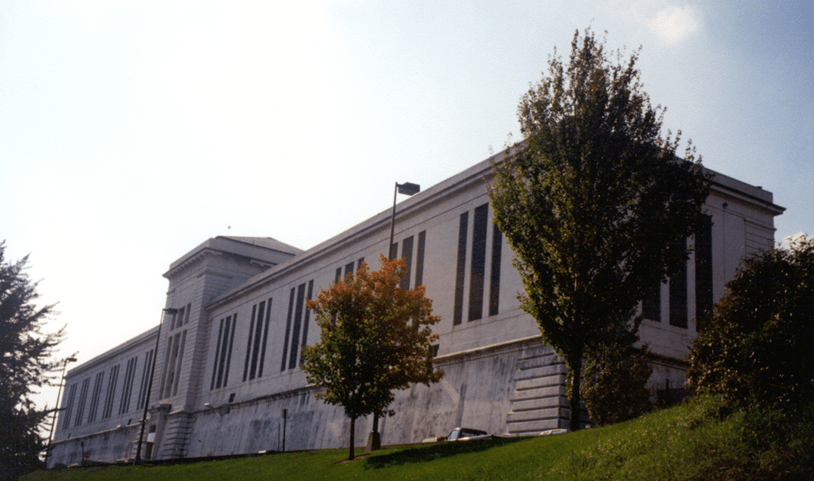
Father Cavaletti showed up early in the morning, and Delfino was said to have “made peace with God.” He was then strip-searched, ensuring he had no weapons to aid an escape on his way to “the deathhouse” at Rockview in Centre County. As he was led out of the ward, the blinds on all of the jail cells were closed so the other men could not see him leaving. As he was about to exit, he shouted “Goodbye” to anyone who could hear his final words to his fellow inmates.
At the Warden’s office was Sheriff Jim Reap. He escorted Delfino to Rockview. He asked if he had any final statements. “Only that I must die in the electric chair for four men who tried to kill me,” replied the doomed man. He then added, “I want you to tell my brother to go back home to my father and mother in Italy. Tell him to stay with them all the time. Tell him to take care of them.” At this point, Delfino seemed truly saddened.
There was still some confusion swirling around some of the events during his escape. Detective Rose asked Dominick if he had come back to Scranton to kill Judge Maxey. “I never came back here. That’s the truth,” he said. Adding that if given the time, he would prove it.
The Trip To Rockview
Sheriff Reap and Captain Rose, along with two state troopers, J.C. Mauk and Charles Cook, were the guards assigned for the trip. They were joined by two newsmen and a handful of others. They hopped in cars outside the jail in front of a group of onlookers. They quickly made their way toward the city. No plans were disclosed on how they would transport the prisoner. Officials worried that there would be an attempt to rescue him. They boarded a train in Luzerne County and headed west. Next stop? Bellefonte Station.
Onboard, Delfino was said to be jovial for most of the trip. Joking that if he were given a two-minute head start, they would never find him. Along the way, he sang “Paddle Your Own Canoe.” He ended the song by saying, “If I had only paddled my own canoe.” Presumably, this was a knock against those who betrayed him. Men, including Joe Calderini, Chief McHale, and the men who testified against him.
Paddle your own canoe
I've travelled about a bit in my time
And of troubles I've seen a few
I found it better in every clime
To paddle my own canoe
My wants are small, I care not at all
If my debts are paid when due
I drive away life in the ocean of life
While I paddle my own canoe.

Then love your neighbour as yourself
As the world you go travelling through
And never sit down with a tear or a frown
But paddle your own canoe.

I have no wife to bother my life
No lover to prove untrue
But the whole day long with a laugh and a song
I paddle my own canoe
I rise with the lark and from daylight till dark
I do what I have to do
I'm careless of wealth if I've only my health
To paddle my own canoe.

It's all very well to depend on a friend
That is if you've proved him true
But you'll find it better by far in the end
To paddle your own canoe
To borrow is dearer by far than to buy
A maxim tho' old still true
You never will sigh if you only will try
To paddle your own canoe.

If a hurricane rise in the midday skies
And the Sun is lost to view
Move steadily by, with a steadfast eye
And paddle your own canoe
The daisies that grow in the bright green fields
Are blooming so sweet for you
So never sit down with a tear or a frown
But paddle your own canoe.
The only time his mood changed was when he talked about his parents in Italy. He lamented that for six years, he did not write to them for fear it would lead to his capture. “I used to send them $10 every month,” he said as tears streamed down his face. It was the first time he showed emotion since his capture. Detective Rose passed him a handkerchief to wipe his tears. The two men had become friends despite being on opposite sides of the law.
At lunch, a “colored” man approached to take their order. Delfino, being the personable man he is, cheered up and said, “What do you say if you take my place?” to which the waiter replied, “I prefer to stay as I is.” When Delfino asked his name, the porter replied, “My name is Wisdom.” Ironically, the waiter’s real name is J. Wisdom. Delfino replied, “Why they say if you go to heaven, you’ll be made the whitest man there.” Wisdom, having none of it, said, “But I don’t want to go just yet.”
Delfino replied, “See. Why is it everybody is told that heaven is the greatest place you could go, yet nobody wants to go?”
Why is it everybody is told that heaven is the greatest place you could go, yet nobody wants to go? – Dominick Delfino on his way to the electric chair
They reached Bellefonte by 4:00pm, then transferred to cars that took them the rest of the way. Before being turned over to the warden, Delfino thanked Detective Rose and Sheriff Reap for the way they treated him on the trip. He also thanked the newsmen and joked with them by saying, “You boys will miss me, I bet. I’ve been your best customer for a long time.”
The Final Chapter
At 7:05 am, Delfino was led to the Electric Chair by Father Cavaletti. They are reciting prayers, “Oh blessed Virgin Mary, ask your divine Son to have mercy on me.”
Sitting in the chair, he recites in Italian, “Jesus and Mary, I give you my heart and my soul.”

March 10, 1924
After receiving two shocks of 2,000 volts of electricity, his body was examined by two physicians. With no sign of heartbeat, they turned to the witnesses and, at 7:11 am, said, “We pronounce this man dead.”
Dominick was just the second man from Lackawanna County to die in the electric chair since hanging was abolished in 1915. The first man was Frank Palma, a murderer from the Bull’s Head section of Scranton who was tied to the Black Hand. Rockview was no stranger to electrocutions. Delfino was the 138th person to die in the chair in the facility that, no coincidence, opened in 1915.
Final respects
Father Cavaletti recalled the time when Delfino and Morabito walked to the priest’s home. It was during a snowstorm to summon the man to visit Morabito’s daughter who was very ill. He claimed the two men were “bosom friends” and could not believe that Dominick would do this to Morabito.
Dominick’s services were led by Father Cavaletti. They were held on March 13th at the Italian Church of Assumption in Jessup. He was buried in the Eynon Cemetery in Archbald. His procession included twenty-five automobiles full of Italians from around the valley. Included in the procession was his brother Tony, who three days later would be officially divorced from his wife. It was reported that Tony carried out his brother’s final wish. He allegedly returned to Italy in June, but I can’t confirm that.
Hundreds of men were said to pay their respects. Many of them never met the man. Still, either out of love for a fellow countryman or morbid curiosity, they attended his services. There were flower arrangements from throughout the valley. They were displayed by his “silver finished cypress” casket at the Margotta funeral home at 402 Church St in Jessup. One, in particular, was rather morbid. It showed the dial of a clock with the time set to 7:11 – the time of Dominick’s death.
The pallbearers for Dominick, who laid him to rest, were all Italians from Archabld. Pasquale Pascorino, Dominick Spinella, Dominick Barbieri, James Cadichia, Fortunato Patli, and Michael Paselli.
Whatever Happened To…
Carmella Monarchio Morabito
Demetrio’s widow suffered more loss less than a year after her husband’s death. That’s when her youngest daughter, Annie, just over a year old, died of bronchitis in Dunmore in March 1917. Shortly after, she moved to Binghamton, maybe to be closer to her two sisters. Her hard luck followed her when her firstborn, Angelina, died at seven in 1918. Two months later, she remarried a shoemaker. Carmella passed away at a relatively young 45 years old after a brief illness.
Patsy Stallone & John Myma
Less than two months later, Dominick’s fellow inmate on Murderer’s Row, John Myma, is also executed at Rockview.
Another guest on Murderer’s Row was Pasquale Stallone. He was spared and sentenced to 10 to 20 years in the Eastern State Penitentiary in Philadelphia. Maybe it was due to the letter the DA received. It was threatened that if Stallone received the same fate, his house would be bombed. Stallone lived to be 82 years old.

Scranton Republican
July 27, 1923

Scranton Times
May 3, 1924
Archbald Police Captain James McHale
McHale had a career that included single-handedly capturing two escaped inmates from Farview State Hospital for the Criminally Insane in 1916.

December 18, 1916
He left his post as Chief and became a private detective in September 1926. Just three months later, he and another Detective, Oscar Chertok, are ordered by none other than Judge Maxey to relinquish their licenses. They are accused of conspiring to extort money from those skirting the liquor laws. The scheme had the two men present search warrants at different businesses. If alcohol was found, they would issue an arrest. Before posting bail, they would offer up a cash settlement, and in return, they would drop the charges.
McHale was convicted and sentenced by Judge Maxey. Upon his parole, he left the city and moved to Erie, likely to avoid confrontations with those he had extorted.
District Attorney George Maxey
The DA who prosecuted Dominick and many others later became a Judge in Lackawanna County. He joined the State Supreme Court in 1930 and rose all the way to the Chief Justice from 1943 until his sudden death in 1950. He remained in Scranton, although he passed away at his office in Pittsburgh.

December 30, 1950
Detective Chris Rose
Christian Rose joined the police department in 1901. In 1906, he became the first paid lifeguard in the city’s history. He was assigned to “The Boom.” This was a popular swimming hole at the time. It was along Roaring Brook just south of the then Spruce Street Bridge.

April 21, 1958
Rose was promoted to Captain in 1923 and Superintendent in January 1926. After a 25-year career with the Scranton Police Department, he went on to become a special officer at the First National Bank of Scranton. There, he served another 25 years before his retirement in 1952. While at the bank, Rose was said to have handled “billions of dollars.” And, “not one cent was ever reported lost or stolen.”
Vancouver Police Chief James Anderson
Chief Anderson received the $1,000 reward. He was asked to share it with the team that was involved in the capture. He resigned from his role as Chief in January 1924. He cited injuries from an auto accident. Others believed it was also from the unjust criticism he and his department were receiving, compounded by a lack of funds.
He went on to say, “The public can say whatever they want about the police, but the police were in no position to air their voices.” Sound familiar?
Vancouver Detective Joe Ricci
The man largely responsible for the capture of Delfino was the Italian detective Joe Ricci.
Ricci went on to help clean up the Black Hand Society’s operations in Vancouver. He earned the moniker “Camera Eye” based on his “photogenic memory” and all of his arrests.
He was dismissed from the force in 1929, likely due to political turnover.
In 1949, after twenty years away from police work, he returned to Police Headquarters.
He became the official Interpreter for the city.
On top of that, Lady Luck treated him and his wife well.

May 28, 1952
Attorney Edward Philbin
Part of Defino’s defense team, Attorney Philbin suffered his own tragedy. He lost his young wife shortly after the murder of Morabito. She was the widow of one of the partners of Brown & McMullen, a prominent liquor wholesaler in North Scranton.
Philbin continued his career in law before moving to New York City and joining a detective agency. He passed away there in 1935.

May 30, 1910
Attorney Clarence Balentine
The other part of Delfino’s team was Attorney Balentine. He also served as defense counsel for Pasquale Stallone. He had a bit more success with the Old Forge triple-murderer, getting him a sentence of 10 to 20 years.
The attorney had a private practice for 30 years before joining with other partners in 1930.
He passed away at 68 in 1937, days before he and a friend were set to sail to Europe.

July 17, 1937
Giuseppe Calderini
The man who allegedly turned in his “friend” suffered a backlash from his Italian countrymen in Vancouver. So much so that he had to leave Vancouver and head east.

January 10, 1924
Giuseppe maintains that he never opened the envelope containing the letter from Delfino. He claims the letter was intercepted by someone named “Antonio.”
Anthony and Catherine Pitea (Pitha)
The couple that owned the store where Dominick met with Chief McHale stayed in the area until 1945. Tony also operated the Tony Pitha Coal Company in Carbondale.

January 16, 1957
They moved to Philadelphia, where Catherine died in 1957. Anthony died in 1965 aboard a ship that was sailing in the Ionian Sea between Calabria and Greece.
Epilogue
I spent countless hours researching old newspaper articles from around North America and scouring Google. I believe that Delfino’s final story was the true story – that he acted in self-defense.
The Black Hand was notorious for extorting fellow countrymen. I want to believe that Dominick was trying to remain independent of the organization. I’ve read dozens of stories of intimidation of other Black Hand victims, and the modus operandi aligns. Dominick tried to avoid the confrontations. But finally had had enough – after being the target on so many other occasions.
I also believe that Chief McHale failed him, but I don’t think that it was his intent. The two men were working together, with Delfino acting as an informant. It was likely that McHale was using Delfino. He wanted to find the seedy characters in the town so he himself could extort them.
I believe that McHale knew that Morabito was a Black Hander. And he felt he could get Delfino off without claiming self-defense. If he could, there would be no penalty. By not allowing him to talk, he gave up self-defense as justification.
During the trip from Vancouver back to Scranton, Delfino insisted on his innocence. He hoped for a new trial and believed that his story would make for a great movie or book. “Next year, by this time, we all be rich if somebody writes that story for me,” he told the officers.
He shared his discontent with his friend Joe Calderini. He said he “passed the word out” and that “he get his, maybe soon, he be killed.”

November 12, 1923
What do you think? Did Delfino deserve to die?
© 2025 William Sallurday. All rights reserved.
 Exploring historic crimes in NEPA
Leave a comment