
My hometown of Scranton, Pennsylvania, has gone through some periods of revitalization and redevelopment over th the years. The town that once fueled the nation’s manufacturing with its abundance of coal mines and steel production has seen more than its fair share of ups and downs.
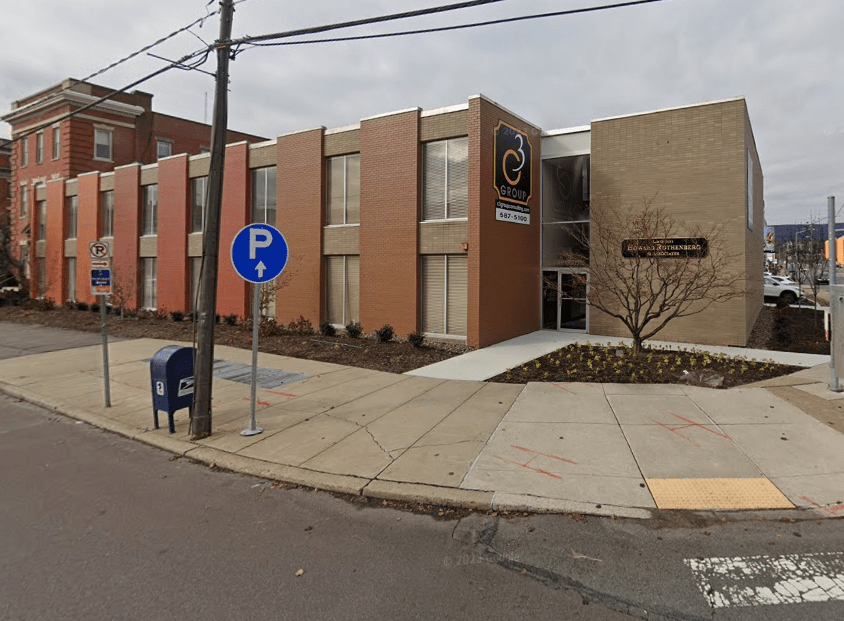
In November 1963, the city celebrated its revitalization with the opening of a brand-new building that was the hallmark of the Scranton Redevelopment Authority. The IBM building at the corner of Wyoming and Linden was touted as the largest single building completed under the urban renewal program – taking over the location where Scranton Preparatory School once stood.
The well-known computer company would move from its location at 717 Linden and take over the ground floor of the new building – using it at a new sales and service hub that would serve the eight counties around Northeastern PA.
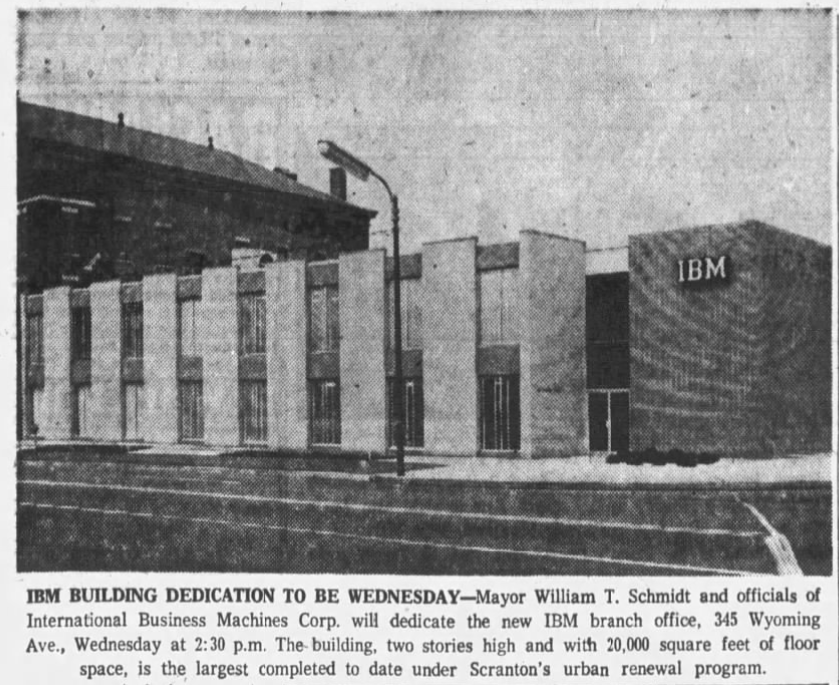
November 19, 1963
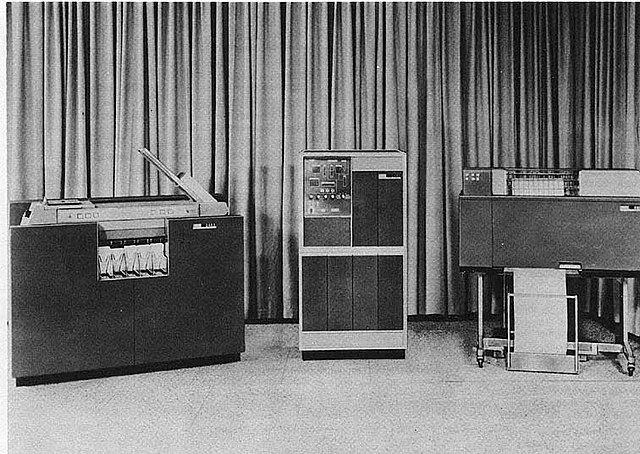
During the grand opening celebrations, the company invited the community in for a tour as they demonstrated the brand new IBM 1404 Series Data Processor.
The top floor was available for lease, and it was quickly snapped up by Integrated Machine Bureau (IMB), a private school that focused on providing education on computer operations, such as key-punch operation and programming. Before the move, IMB was located in the same building as IBM, a few short blocks away near the University of Scranton campus.
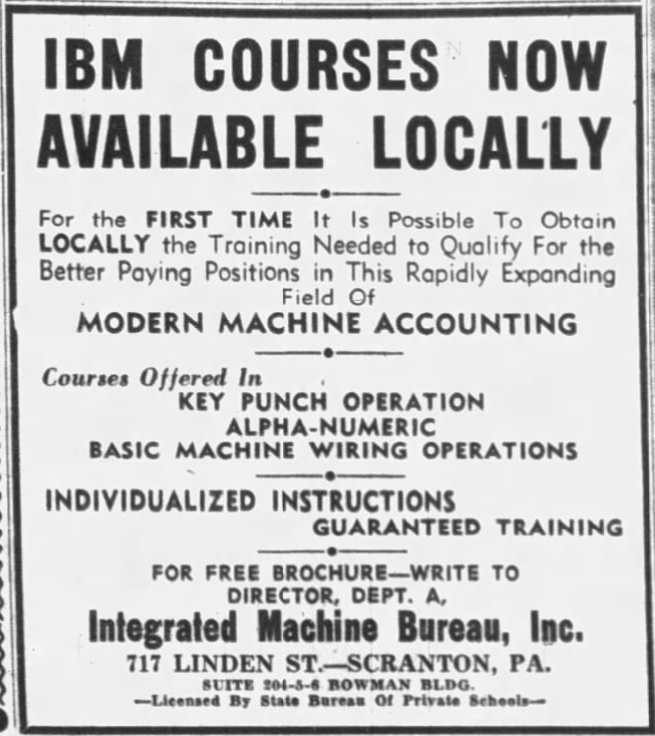
November 15, 1958
IBM had been in their office on Linden Street since at least 1936 – selling typewriters throughout the region. With the introduction of more mainstream and affordable advanced computers, Scranton became an early adopter of the coming high-tech wave. The new building was evidence of the impending growth and was the pride of the business community.
The Murder
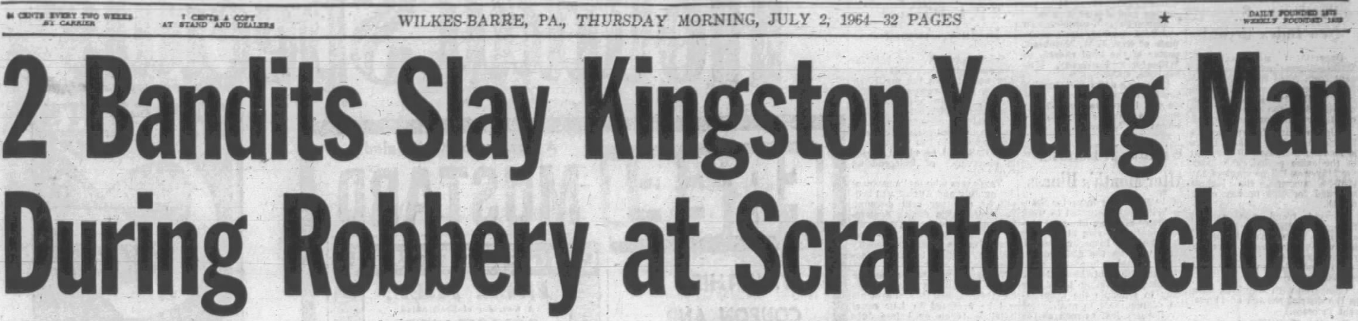
Just seven months after opening the new building, tragedy struck. On the evening of July 1, 1964, US Navy veteran Walter Popkowski, 24, was getting ready to attend his final 6:30 p.m. class at IMB on the second floor of the building in downtown Scranton. This was the last class of his 11-week program, after which he and his classmates were set to graduate.
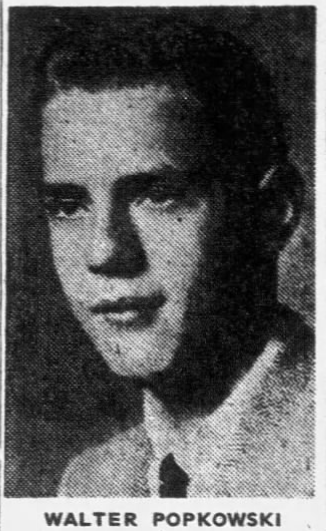
July 2, 1964
Just before 6:20 p.m., two men entered the reception area of the IMB office and encountered an instructor, Harold McGee. McGee was ordered to “get on the floor.” Immediately after, the men started searching a file cabinet in the School Director’s office nearby.
Almost simultaneously, another student, Carl Nardell of Kingston, entered the reception area, and he, too, was ordered to get on the floor. At first, Nardell thought it was a joke but quickly realized these men weren’t laughing.
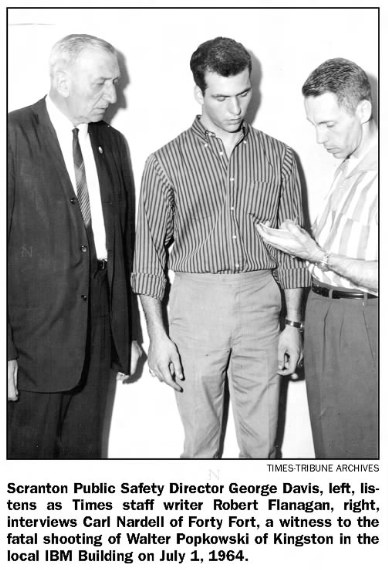
September 17, 2017
Seconds later, Walter entered the reception area and was also ordered down – and, like Nardell, hesitated because he thought it was a prank. This time, the gunman said, “Do you think I’m kidding?” – then immediately a shot rang out. Walter was struck in the face at point-blank range – instantly killing the unsuspecting student.

July 2, 1964
The School Director, Paul McDermott, whose office was being ransacked, and Paul Liptay were just arriving from the stairway and were just steps away from the office when they heard the shot.
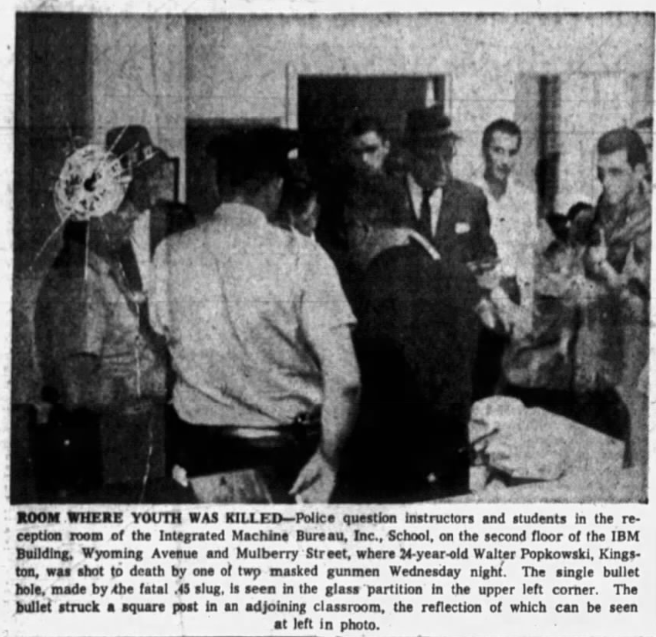
July 2, 1964
They immediately came upon a man armed with a gun in the hallway. The man ordered McDermott into his office while he aimed the gun at Liptay’s head and told him to stand still in the hallway. He kept the revolver aimed at Liptay as he backed his way down the hallway and out of the rear service stairway towards the parking lot at the rear of the building. Liptay would later tell police that it was a “big gun” and that he just “froze” against the wall.
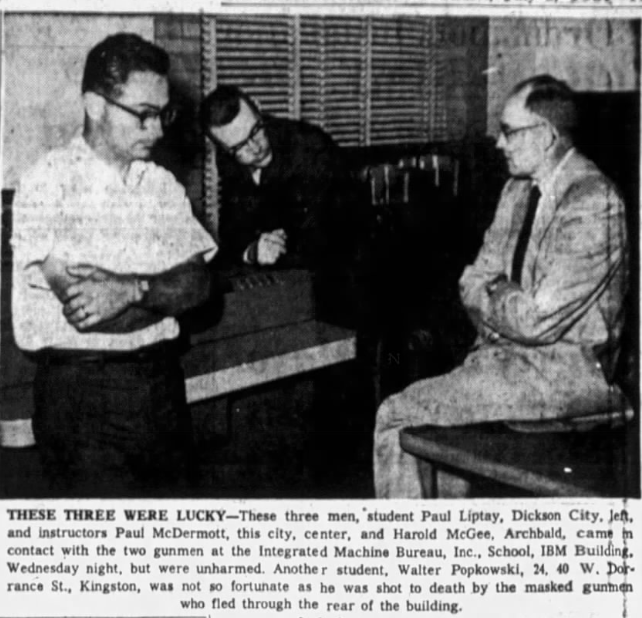
July 2, 1964
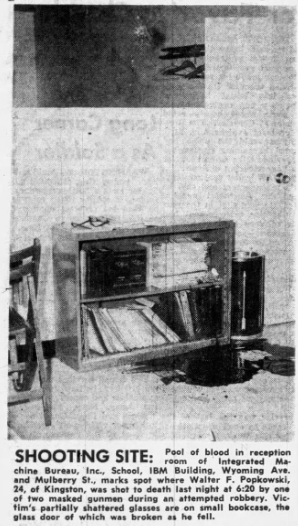
As the gunman exited the building, McDermott and Nardell locked the office door and tried to aid Walter while calling for help. At the same time, Liptay ran into a nearby restroom, searching for safety. Finding none, he immediately returned to the corridor. When he emerged, he saw a shocked Nardell, McGee with Walter on the floor, and McDermott on the phone.
July 2, 1964
The Investigation Begins
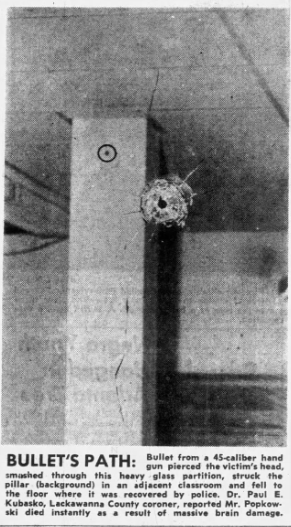
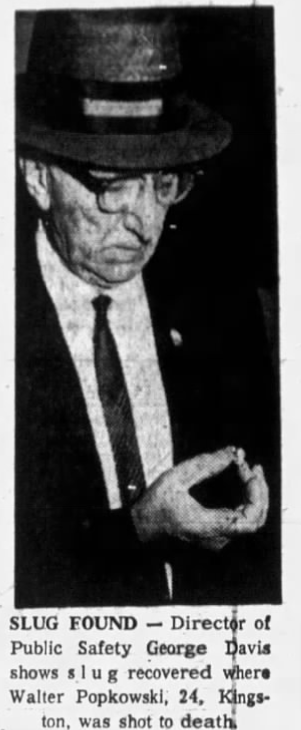
Police and Fire crews, along with the ambulance, arrived quickly on the scene, but the suspects had already escaped. The ambulance crew announced that Walter had already died before they arrived on the scene. Police recovered a .45 caliber bullet that was embedded in the floor behind where the victim fell.
July 2, 1964
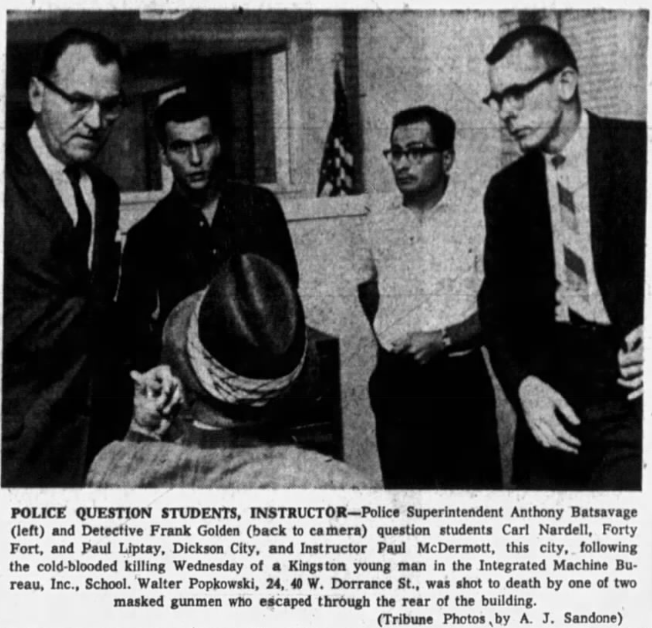
Investigators talked with all of the witnesses, along with two eye doctors with offices across the hall from IMB. Drs. Joseph Guzek and Henry Jones both told detectives that they saw two men making their way down the hallway. The forensics team was able to grab a “good” set of fingerprints from the site.
Jul 2, 1964
Police noticed a ladder and some missing tiles in the ceiling and began to reconstruct the crime scene. They believed that while the gunman escaped down the hall, the other exited through one of the classrooms – without passing through the reception area. The witnesses provided only a basic description of the men – both with white handkerchiefs over their faces. The two were said to be in their 20s. The shooter was described as six feet tall with a husky build, the other smaller at 5′-10″.
July 2, 1964
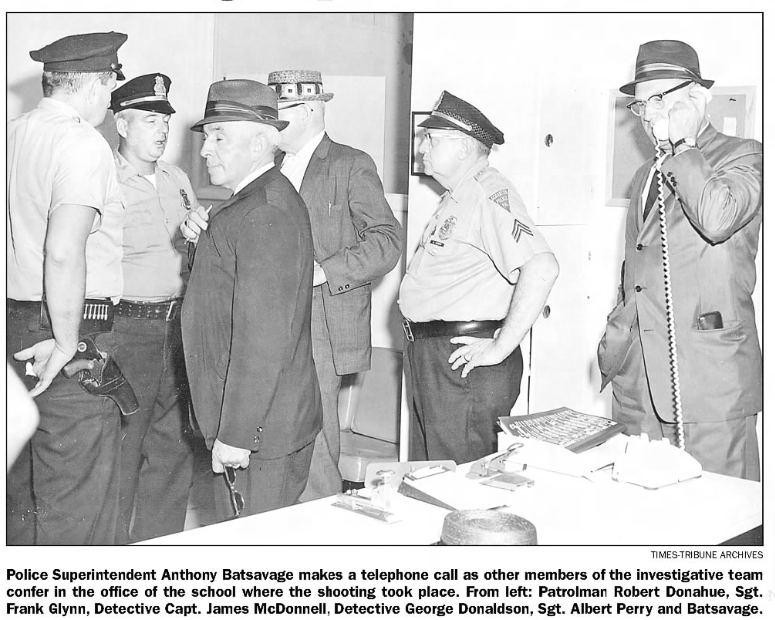
The owner of IMB, Joseph Crynes, told investigators that they usually keep money in the filing cabinet that the men searched. Today, there was $80 found in an office drawer, but no cash was found inside the cabinet. Based on this information, investigators believe the men were familiar with the school, and they speculate that robbery was the motive.
September 17, 2017
While combing the building, investigators find a briefcase with some papers inside. They don’t release any information to the public about its contents.
Within minutes, police received a tip that two men matching the description were just blocks away at Franklin and Linden – and they were asking for directions to Stroudsburg.
Police quickly established roadblocks through the city to try to contain the two men – and got assistance from the Pennsylvania State Police to help establish a perimeter outside the city limits. Initial reports were that the suspects were driving a 1957 Chevy – that was later deemed to be incorrect.
Investigators dredged a nearby sewer basin in hopes of recovering the murder weapon but were unsuccessful. They expand their search to include other likely hiding places but, again, come up empty.
July 3, 1964
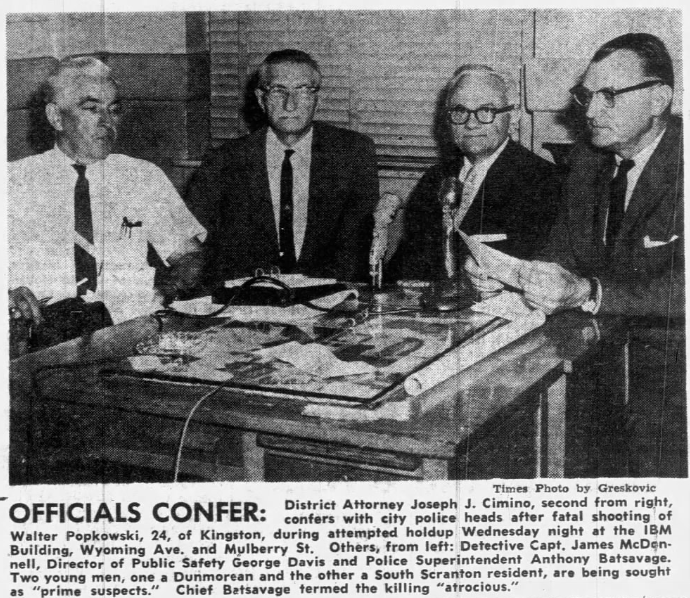
The next day, police were still stymied. They believed that the men could not have escaped the city. They believed that they had ditched their car and were hiding in or around Scranton.
Tips led police down a couple of different paths. First, two men matching the description were seen in the area of S. Washington and Hickory St. Police tracked down the two men and immediately ruled them out as suspects.
Another report came in that someone picked up two men who were hitchhiking along Interstate 81 and were dropped off near Tompkinsville north of the city. Eight police cars convened in the area but also came up empty.
State Police brought two men into custody who matched the description, but they, too, were later ruled out.
The detectives were growing frustrated.
The Big Break
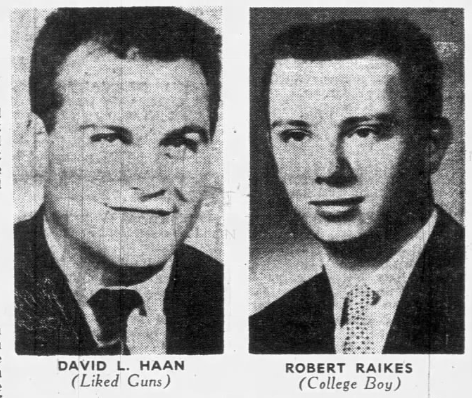
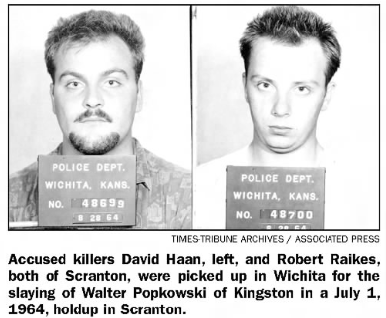
Later in the day on Friday, news breaks that police are searching for two men considered to be prime suspects in the shooting. David Lee Haan, 23, and Robert “Bob” Kerien Raikes, 19. Both men had been seen at the building on the day of the shooting – once at 2 p.m. and again at 5:30 p.m. Police believe they were casing the business to plan their heist. But that’s not all.
July 3, 1964
It was learned that Haan had just started working for Muzak the week before the murder, and he was installing the music service at the IBM building. On Friday morning, his boss called the police to alert them that he was working at the building and that he had not shown up for work the next day.
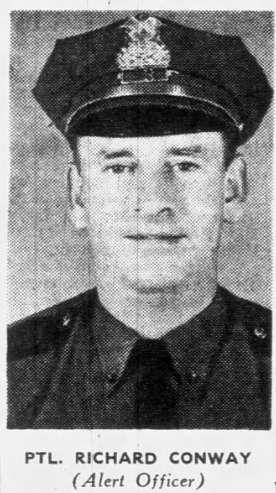
Patrolman Richard Conway took the call from Haan’s boss and quickly connected the description provided to that of the suspect. He then placed a call to Haan’s home. Haan’s wife, Annette, told Officer Conway that he had not come home all night – and that was out of character for him. She also told Conway that her husband was friends with Robert Raikes and that he, too, was missing from his home.
July 3, 1964
Police also learned that Mrs. Haan had called the Dunmore Police the morning after the murder to report her husband missing. Presumably, she called Robert Riakes’ house to see if her husband was there, and that’s when she learned he also didn’t come home the night before.
Annette shared the Raikes’ unlisted phone number with Conway. The patrolman called the home, but Robert’s mother was not cooperative. She told Conway she had reported her son missing, but the Scranton police said there was never a report of a missing person for Raikes.
Annette must have been floored. She told police that she and David did not have any arguments and that he wasn’t a heavy drinker. She had no idea what drove him to this. What she may or may not have known is that David was reported to be in deep financial debt. The innocent and unassuming wife, obviously unaware of her husband’s actions, unknowingly helped to identify the suspects.
Dunmore police went to the Haan home on Jefferson Ave, where they removed several other weapons after interviewing Annette.
David Haan
Haan’s parents divorced when he was just six years old. In his youth, he and his sister lived with their mother at his step-grandparent’s home in Grand Rapids, Michigan. Haan had moved to Scranton around 1960.
At some point after his arrival, he actually applied to the Scranton Police Department – twice. He was rejected because he had not lived in the city for the mandated five years. Scranton police had information on file from his application and thought he might make his way back to Michigan – so they alerted Grand Rapids authorities. Haan’s father was a county sheriff in Grand Rapids.
Others described Haan as a gun “fancier” and “dealer” who owned a .45 caliber revolver and was known to carry a .38 in his car. But still, no one could see him killing someone.
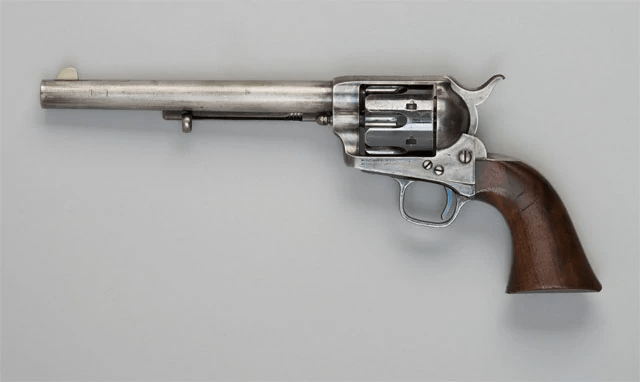
(not the actual murder weapon)
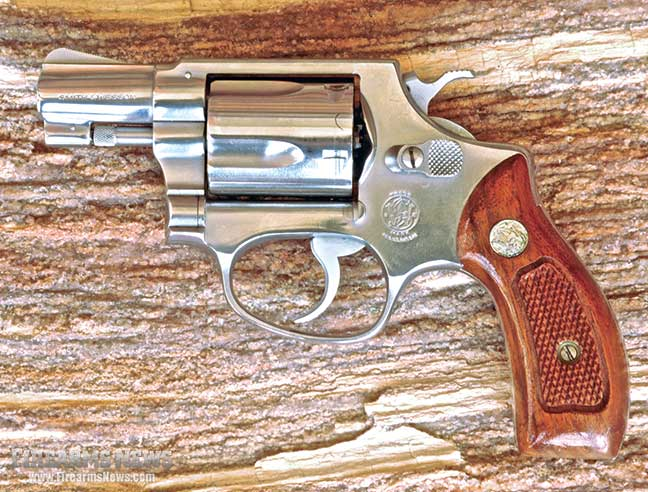
(Similar, but not the actual weapon)
It was believed that the former construction worker took the job with Muzak to increase his income and earn a steady paycheck to support his wife and two young children.
David and his family lived with his mother-in-law and sister-in-law.
Robert Raikes
Robert was living with his mother and younger sister on River St. in Scranton. For a short period, the family lived in West Virginia – until Robert’s father was tragically killed in a train accident in 1951 when Robert was just six years old. His mother then moved the family back to Scranton.
Raikes briefly attended St. Patrick’s School in West Side before transferring and graduating in 1962 from St. Mary’s Assumption High School in South Side. He was enrolled at the University of Scranton and was a member of the school’s ROTC unit. He had just completed his sophomore year of business classes.
He’s described as being flat-footed and was without the special shoes that he normally wears. This is important because investigators believe it would impact his ability to walk long distances.
It’s reported that the two men met just three weeks prior to their fateful day while working together as vacuum cleaner salesmen, and neither had any criminal record up to this point.
The Hunt
After the news radio reported the description of the wanted men, the Haan family was said to have contacted the police again. They asked the newspapers and radio stations to broadcast a message to the men – asking them to turn themselves in and to call home.
The two men are believed to be traveling in a white 2-door 1960 Pontiac Bonneville, and they are listed as armed and dangerous. The initial report of a 57′ Chevy was inaccurate because Haan had sold that car in April to acquire the Bonneville. At the time of the sale, Haan kept the license plate from the Chevy. It’s believed that they may have switched the license plates to avoid detection.
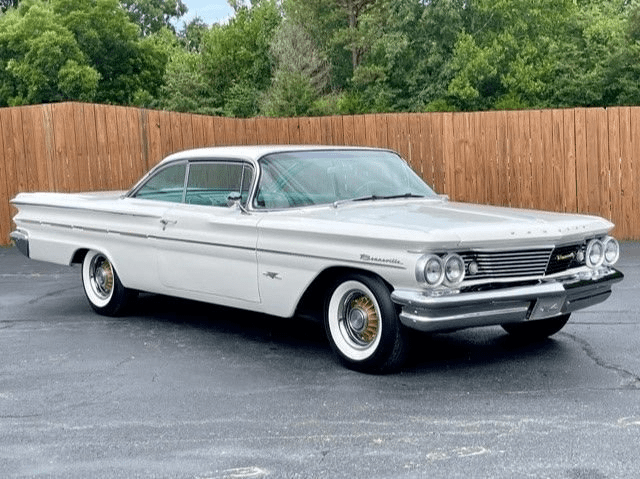
(similar to the one the suspects were driving)
Haan was said to be carrying two loaded revolvers. A .38 caliber and a .45 caliber, the murder weapon. He was also known to carry a fake Lackawanna County deputy sheriff badge and use it as needed.
Haan reportedly traded a .357 magnum for the .45 caliber a few weeks prior to the murder. And it was reported that he had purchased a revolver from Bill’s Sporting Goods several weeks prior to the murder – perhaps the .38 caliber.
Separate reports come in from Syracuse and Detroit that authorities have two men in custody matching the descriptions. It’s quickly determined that the men aren’t the suspects, but it goes to show the reach of the search.
Days pass with no new information. Police continue to follow up on leads, but all are fruitless. A group of officers were sent to Moscow (PA) to search a vacant home along Elmhurst Blvd. It was reported that the two men were seen in the area several weeks ago. The building was planned to be used as a teenage center – but authorities squashed those plans because of the secluded location. Again, however, no results. Instead, they continued to search wooded areas and lakes around the region.
Days turn into weeks, and police are still without their suspects. They urge the public for assistance and warn that helping the two men will result in a 10-year jail term.
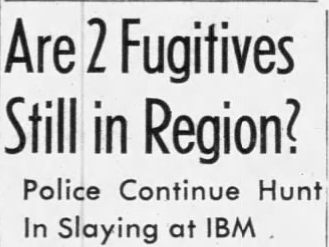
July 23, 1964
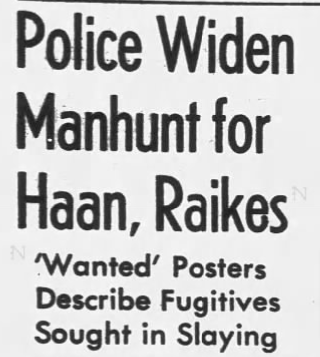
Weeks turn into months. There’s been no mention in the newspapers about the July 1 murder until almost two months later. Scranton Police are distributing fliers reminding the community and surrounding law enforcement agencies of their search.
The men were estimated to have only $100 when they disappeared, so it’s likely they are getting desperate for cash.
August 27, 1964
The Capture
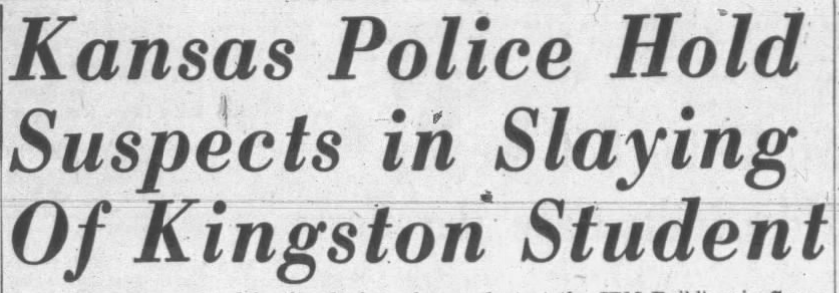
Just two days after another appeal and push for leads, Haan and Raikes are captured in Wichita, Kansas!

August 29, 1964
Two men identifying themselves as David Haan and “Robert Curran Musgraves,” tried to sell their car to a salvage yard but could not produce the title. The dealer grew even more suspicious, considering the out-of-state license plate. Details are fuzzy, but it appears the dealer called the police while the two men were still at the salvage yard. Detectives arrived and questioned the men.
Haan told the detective that he wanted to sell the car because he needed money. The officer, still unaware of who he was dealing with, reiterated the rules about having a title and instructed Haan to report to police headquarters the next day for more information.
The men left, and the officer pulled a check to see if the car was stolen. The title came back as clean, but still, the detective was still suspicious.
Following up on his instincts, the detective sent a “teletype” to the Scranton Police asking if the two men were wanted, and within minutes, Police Captain James McDonnell was on the phone with Wichita authorities.
An all-points-bulletin (APB) was put out to keep an eye out for the vehicle. Within an hour of the initial phone call, a Wichita officer spotted the vehicle in downtown Wichita and called for backup. Police blocked off the area and then zeroed in on their target. When the Bonneville was stopped at a red light, an unmarked police car cut in front of the men, and three armed officers jumped out and surrounded the car.
August 29, 1964
It was reported that Haan had intended to engage in a shootout if given the opportunity – but the element of surprise caught him off guard, and the two were taken without incident.
September 17, 2017
The men confessed to the crime, with Haan admitting to firing the shot that killed Walter – albeit an accident. He claims he was waving the gun, and the just went off.
Investigators also revealed that Haan dismantled the murder weapon right after the shooting and discarded it, piece by piece, along the way. They were said to have made their way out of the city through South Scranton and West Scranton and confessed to discarding the components across the city.
Investigators in Witchita impounded the car and began processing it for evidence. While taking photographs, they found shell casings from a .45 caliber weapon.
The two had been living in Wichita and picked up some odd jobs to make some money. They worked at construction jobs, a car wash, and a carnival for the past three weeks – with Haan using the alias Dave Holmes. They even sold Haan’s .38 while in Witchita.
Family Reaction
The families of the two men were relieved to hear their loved ones were still alive and would be returning home soon.
Bernadine Raikes was quoted as saying, “Our whole family is behind him,” and that she is “happy that he’s all right and I can’t wait to see him.” She added, “I have a feeling that he’s innocent.” “This is absolutely beyond my comprehension. He’s a wonderful boy…an obedient boy… I have to hear what he has to say.”
Annette Haan reserved comment, saying only, ” I really don’t know much.”
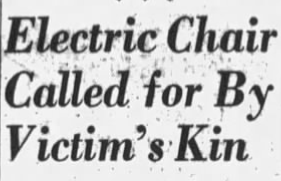
Walter Popkowski Sr. did not hold back. He wants the killers to “pay the full penalty” for their crimes and face the electric chair. He told reporters that the shooting was “brutal” and “uncalled for,” adding that his son had no chance to obey the orders given by Haan.
August 30, 1964
Haan and Raikes waived extradition, and Scranton Police were sent to Wichita to return the two men to the city. Detective Captain James McDonnell, along with Detectives Earl Kugler, Frank Karam, and Robert Murphy, were scheduled to drive to Wichita to pick up the prisoners and return them to face trial.
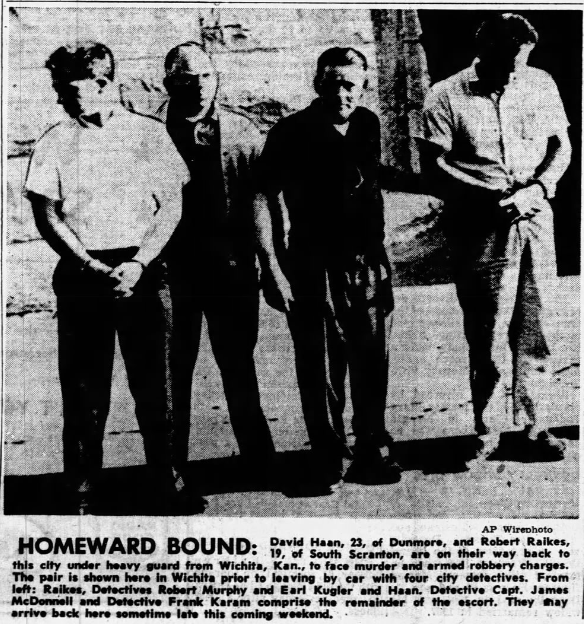
September 3, 1964
When the officers arrived in Wichita, one of the first questions that Haan asked about was his family. He wanted to know if they were OK and holding up, given the stress of the situation.
Return to Scranton
The four detectives and the two prisoners make it back to Scranton on Saturday afternoon, September 5th. Captain McDonnell is relieved, but he says the two men are just as relieved to finally have the chase come to an end. Evading capture had not been easy. The two were “scared to death” and, for several days, survived by drinking milk and eating candy bars while on the run.
One of the first people the two men meet is Police Superintendent Anthony Batsavage. Haan tells him, “Chief, I am very sorry for the trouble that I have caused you.”
It was around that time when he signed his confession. He seems remorseful for his actions and requests that he meet his family and Father Robert Gibson from St. Paul’s Church. Batsavage agrees to the request.
After getting the runaround for a while, Haan was finally able to meet up with his wife and Leona Lenczycka, the attorney that Annette had secured for her husband.
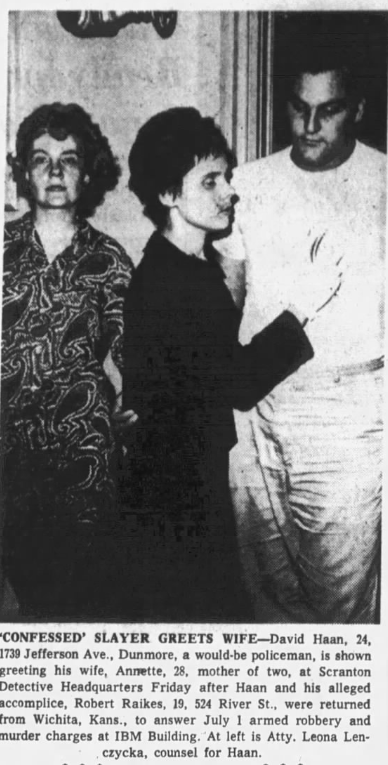
September 5, 1964
Lenczycka was critical of Scranton Police. She said Annette had not been given any information about her husband’s return and was being denied any information on his whereabouts. Lenczycka demanded that she wanted to “advise my client of his constitutional rights.” She added, “If he makes any statements, I will contest them – signed or not.”
Raikes was greeted by his crying mother. He was said to have signed a statement in Wichita, but it’s not clear exactly what he signed. Scranton Police did not question him because it was reported that he would not sign anything that would incriminate him – even though Haan had already outlined his involvement as an accomplice.
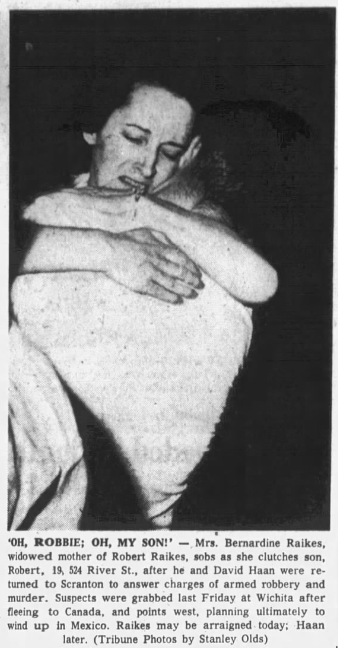
September 5, 1964
Preliminary Hearing
The pair appear together at the preliminary hearing. Both are cleaned up and well-presented. Haan, represented by Lenczycka, and Raikes by Peter O’Malley. Attorney O’Malley was standing in for his father, Carlon, former long-time Lackawanna County District Attorney who was out of the country at the time of the hearing.
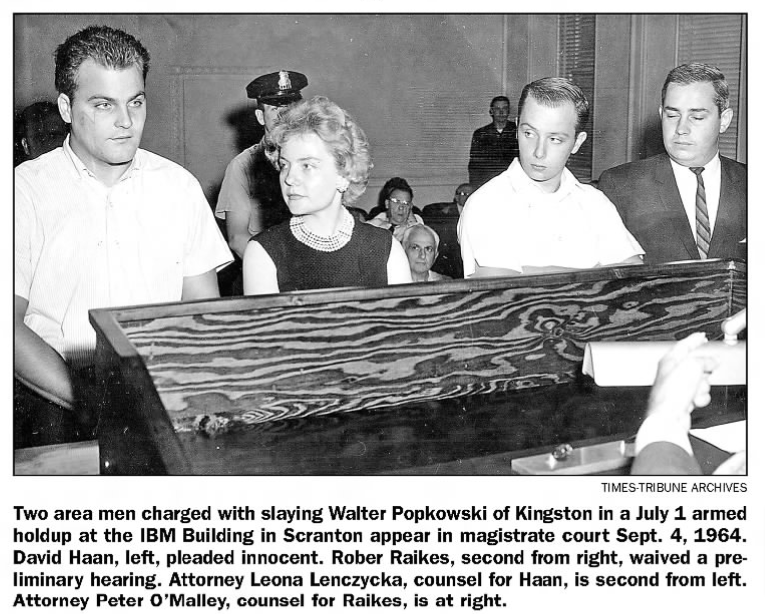
Scranton Times
Sept 24, 2017
Haan pleads innocent and demands a full preliminary hearing, which is agreed to by DA Joseph Cimino. Raikes waives his right to a preliminary hearing, which, in essence, is equivalent to a “not guilty” plea.
Both men are held without bail. Haan is held at the very basic Scranton Police headquarters lockup, where meals will be brought in from local restaurants, and Raikes is removed to Lackawanna County Prison, where he’ll have a larger cell and more amenities – if you can call them that. Both are under constant police guard.
Piecing Together the Crime
More details surrounding their escape come to light. The men had originally fled to Niagara Falls and into Canada before making their way through Michigan, Minnesota, Nebraska, and finally, into Kansas. It was believed that they were going to try to make it to Mexico – and the money from the sale of the car would help them get there.
The two men claimed they were more frightened than the men they encountered when their robbery went sideways. Captain McDonnell said the men panicked when their plan was interrupted and that Haan stood frozen, staring at the gun in silence after he fired the shot. Haan said he didn’t even recall hearing the shot he fired that killed Popkowski.
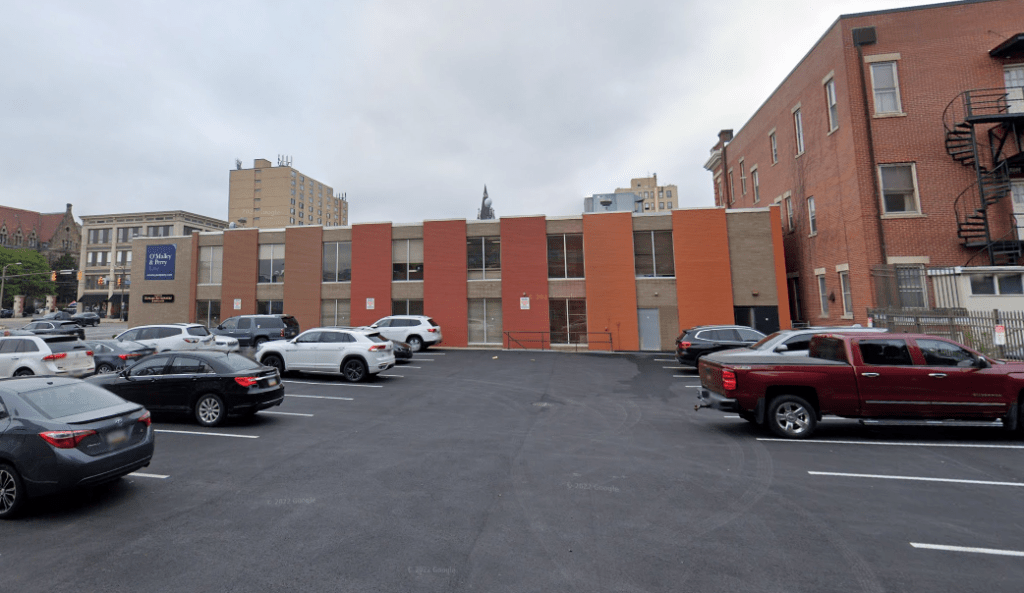
As they escaped the building, they made their way south on Oakford Court toward Linden St. On Linden, they encountered a Policeman. Raikes allegedly told Haan, “If you kill that policeman, I’ll kill you.” Thankfully, Haan complied.
Exit Route
They made their way to Haan’s car, which was parked in the 300 block of Penn Ave. Once in the car, they just sat there. Stunned. They considered turning themselves over to authorities but opted to consider their options.
They drove to an isolated area in South Scranton to contemplate other options. At this point, Haan was so distraught that he considered suicide. As he stared down the barrel of the snub-nosed .38 revolver, Raikes talked him out of it – telling his new friend, “Things may not be as bad as they seem.” Haan responded, “I know he’s dead. I know he’s dead.” From there, Haan disassembled the murder weapon and threw some parts away. They continued on to West Scranton, where he discarded additional parts – making it difficult for investigators to find the critical evidence.
On the radio, they learned that Walter had died from the gunshot. They took off down Keyser Avenue and up the Morgan Highway towards Tunkhannock. They wouldn’t stop until they got to Canada.
They drove continuously for twenty-six hours as if the troubles would be left behind. Captain McDonnell was asked by reporters if he believed they would commit more burglaries along the way. His response? “They were so scared they wouldn’t steal a loaf of bread.”
Legal Maneuvers
Haan’s attorney files an appeal to the court that he is destitute and unable to pay legal fees. Attorney Lenczycka asks the court to pay for her and an associate’s legal fees. Haan testifies that his father is coming to Scranton to support him but that he can’t afford legal fees since his mother was left disabled from a car accident some years ago. The request was taken under advisement.
Shortly after this surprise move, Haan appears for his full preliminary hearing. Atty Lenczycka was repeatedly denied access to the signed statement her client made while being detained. She was not happy that this critical piece of evidence was apparently being withheld from her. She was also not happy about not being granted a delay – as she wanted time to get witnesses from Wichita to testify on her client’s behalf.
The prosecution also added burglary to the charges – on top of armed robbery and murder.
During the hearing, the magistrate heard from Harold McGee, who had witnessed the robbery, and Joseph Crynes, President of IMB, who testified that he was missing $100. Both provided testimony supporting the State’s case against Haan
Detective Kugler also testified that while in Wichita, he informed Haan of his rights but that David was “glad to see us.” He added, “He sat down and told us what happened. There were no promises or threats made. He wanted to tell us the whole story.”
When it was over, Atty Lenczycka was unsuccessful, and Haan was ordered held without bail and transferred to the Lackawanna County Jail.
Just days after his petition, Haan won his request for court-ordered attorneys. Atty Lenczycka and Hugh McMenamin, a Fellow of The American College of Trial Lawyers, are set to represent him.
The Investigation Continues
Still looking for the murder weapon, police finally uncover a piece they believe belongs to the .45 caliber revolver that was used in the crime. Using an Army mine-detecting device, Det. Kugler and Dunmore Detective Lee Mecca found a cartridge belonging to a .45 caliber weapon in West Side. It was buried under six to eight inches of dirt – apparently recently covered by a bulldozer.
Police won’t share the exact location out of fear that the public will convene at the area and potentially destroy evidence. Instead, they say they are searching an area between S. Main Ave and Keyser Ave.
It wasn’t luck. Haan told investigators in Wichita that he threw a piece of the gun in a salvage yard along Washburn St. while driving – so they knew it wouldn’t be far from the road.

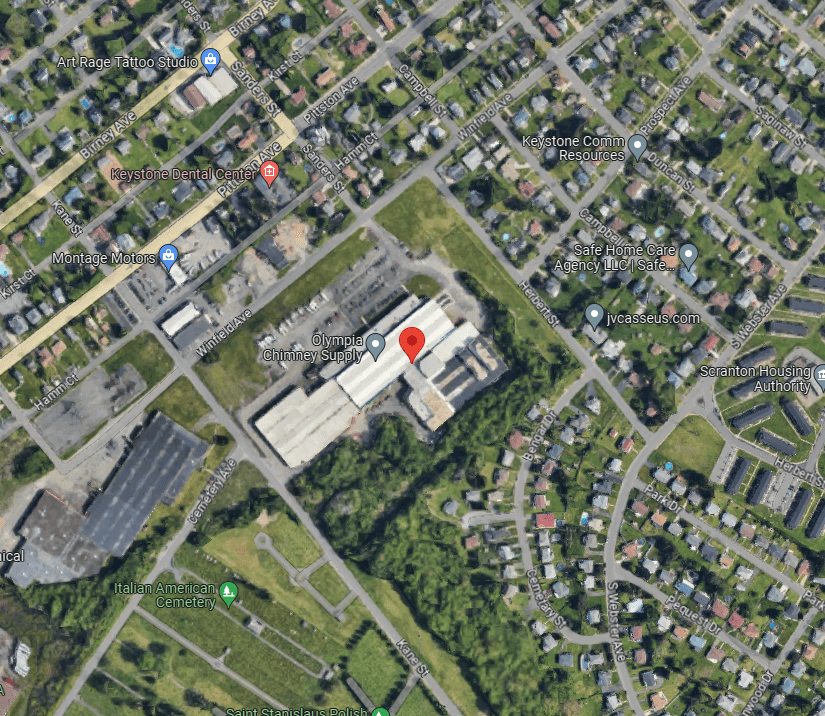
He also told them that other smaller pieces were thrown out at the GE plant on Sanders St. in South Side.
Grand Jury
Interest in the case is sky-high! The Grand Jury convenes, and it’s reported that all 24 members of the jury appear. It’s deemed to be an “extraordinary” event to have all jurors present. Judge Linus Hoban had to excuse one member to reduce the body to its legal limit. It’s reported that six or more jurors often seek to be excused from the duty – but this case is different.
It should come as no surprise that the Grand Jury handed down indictment charges against both men. The pair are charged with murder, robbery, and burglary.
The trial is expected to take place in November, less than a month away.
Waiting for Trial
A week after the Grand Jury indictment, Raikes’ attorney sites an 1860 Pennsylvania law that allows murder suspects the right to separate trials. He requests and is granted a separate trial.
Haan’s trial is set to move forward in late November. The first charge he’ll face is murder. The two other charges will be pushed to a separate trial. It’s expected that Raikes’ will not face a jury until February.
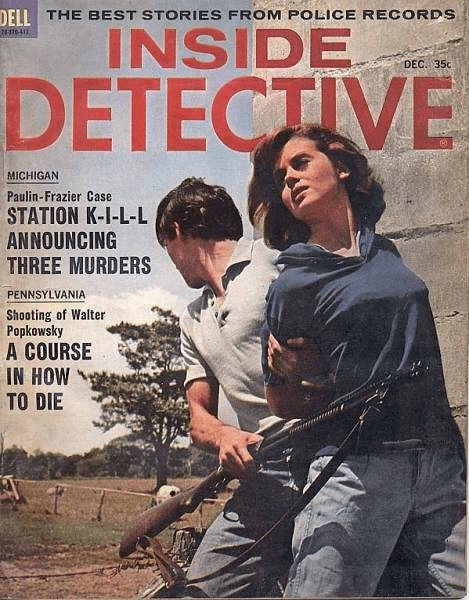
Meanwhile, the case is getting national attention. An article appears in the December 1964 edition of “Inside Detective,” a national magazine highlighting police work. The article “A Course in How to Die” features quotes from Scranton detectives.
It’s announced that the prosecution will seek the death penalty in the Haan case.
Jury Selection
On Monday, November 23, 1964, jury selection began, and only six jurors out of the initial eighty called had been selected on the first day. Most of those were excused because they were opposed to capital punishment.
The next day, more potential jurors are called, and David Haan falls ill. Appendicitis is the likely cause. Jurors are sent home, and the selection is postponed another day.
By Wednesday, they are up to ten jurors, and Haan is deemed healthy enough to attend the proceedings.
The court takes the day off for Thanksgiving. The eleven jurors that had been selected to date are sequestered at the Hotel Casey and forced to spend Thanksgiving dinner together – and away from their families.
Judge Robinson makes a special request that the jurors be as comfortable as possible and that they have an “especially fine Thanksgiving Day dinner.” He tells the jurors that he realizes the inconvenience and burden this has placed on them and their families. He adds that they should “reflect on the blessing of this country where persons, regardless of the crime committed, can receive a fair trial and every man is presumed innocent until proven guilty.” As a special treat, the jurors were taken on a bus ride to Lake Wallenpaupack to help pass the time.
Back in court on Friday, Judge Robinson noticed that Haan appeared ill again. He’s still suffering from appendicitis, and once again, proceedings were cut short to determine the extent of the illness. The Judge orders a doctor to examine Haan and report back.
The next day, Haan is back in court, looking healthy and dealing with what doctors called an “intestinal disorder.” After interviewing 135 potential candidates, a twelfth juror was chosen. They quickly added two more alternates, and the trial was set to begin.
The eight-man, four-woman jury consisted of Claude Meredith, Ethel Morris, Dominick De Passale, Elizabeth Jones, Jule Nacious, Frank Johnson, Charles Moffat, Winfield Rodney, Earl Brister, Olin Van Fleet, Roy Webb, and Rebecca Ehrgood. The alternates were listed as Herbert Bankes and Eleanor Bittenbender.
The trial is expected to be a long and expensive one. Each side is expected to call at least 45 witnesses – with several coming from Wichita.
Testimony is Heard in Haan Trial
Day 1
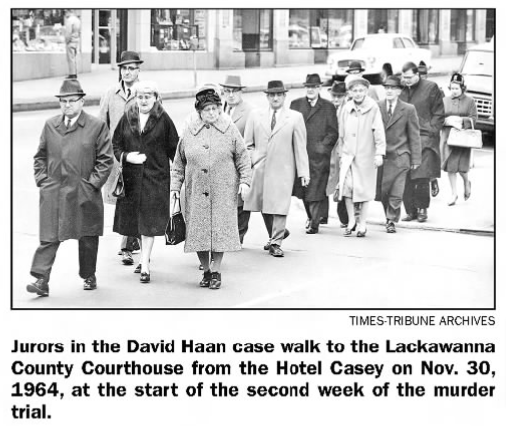
The prosecution team was led by DA Joseph Cimino and assisted by Assistant DAs James O’Brien and Ralph Needle. The jury was led to the courthouse from their rooms at the Hotel Casey by the tipstaves, Michael Dorosh and Richard Mahon.
September 24, 2017
The first order of business was to have the jury and the court tour the scene of the crime. After their short four-minute walk to the site, they returned, and the prosecution called their witnesses.
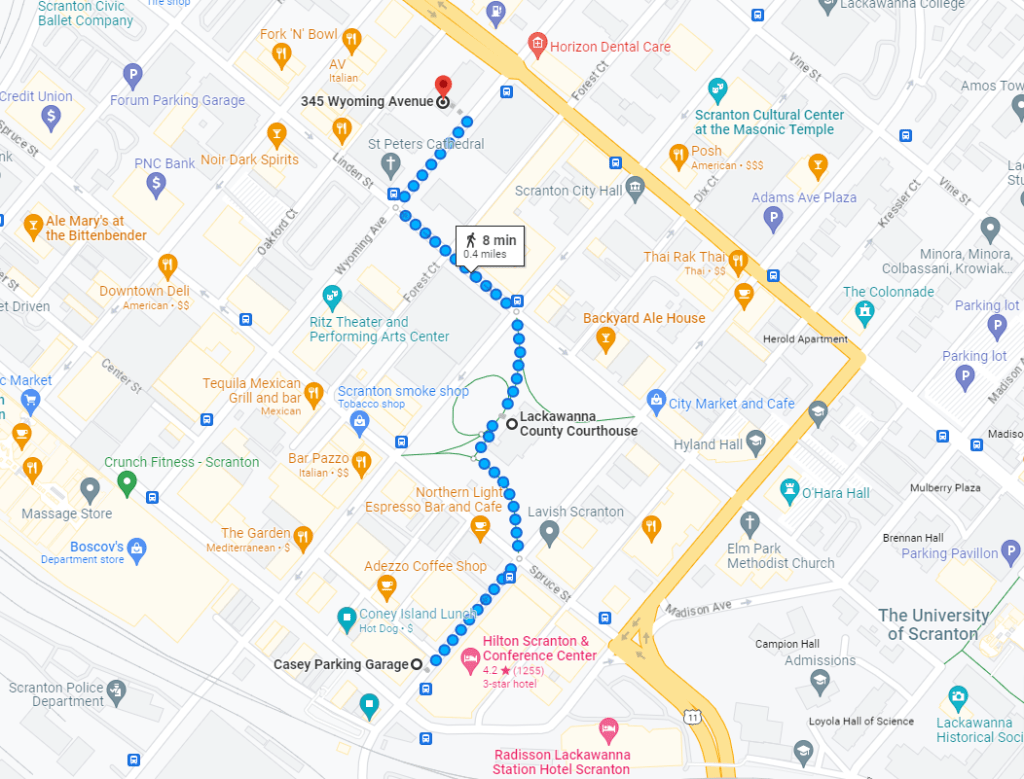
One of the first called was the instructor, Harold McGee, the man who first encountered the robbery. McGee stunned the court when he left the witness stand and laid on the floor, face down, in front of the jury box – showing the jurors what he was instructed to do on the day of the murder.
McGee said he initially thought they were pulling a prank, but that quickly changed when he heard one of the men pull back the hammer on the gun. He immediately hit the floor.
He later left the witness stand again, walked within two feet of Haan, and pointed at him when asked to identify the shooter.
Day 2
The next day, prosecutors brought in two witnesses that linked Haan to the murder weapon. First was John Metallo, founder of Metallo’s Formal Fair in Dunmore, who testified that he traded Haan a .45 caliber chrome-plated revolver for a .357 magnum revolver earlier in the year.
Metallo, who was later known as a competitive marksman, also testified that he endorsed Haan by signing Haan’s application to the NRA after he traded him for the gun. The application was found at the scene of the crime in the abandoned briefcase that investigators found. Clearly, the police knew more the night of the murder than they had let on. Haan had told investigators that he used the briefcase to sneak the weapons into the building.
Next to tie Haan to the weapons was a coworker from Muzak. John Krokos, the twentieth witness called by the prosecution, testified that he saw both a .45 and a .38 in the glove box of Haan’s car at the end of June. At the time, Haan told him that he was a deputy sheriff for Lackawanna County, earning $1,600 per month to assist with raids and other activities.
Another witness, Joan Sirotnak, testified that she placed a $100 cash tuition payment and a $25 check in an envelope and then put them in the filing cabinet in the director’s office. She also testified that she saw Haan at the office that day.
By the end of the day, Atty McMenamin was able to inject some doubt as to the identity of the suspects. None of the six present on that day, McDermott, McGee, Nardell, Liptay, and Drs. Guzek and Jones were able to positively identify them – only their basic characteristics.
Day 3
The strongest testimony of the day was when a state police ballistics expert testified. Technical Sergeant James Deffley testified that the two shell casings that were found in the Haan vehicle in Wichita matched the shell casing that was found at the scene of the crime.
Atty McMenamin objected and tried to get the evidence thrown out, claiming illegal search and seizure – but he was unsuccessful. Then, when he asked the ballistic expert, ” This isn’t as sure as fingerprints, is it?” the sergeant replied, “Yes, sir, it is.” Ouch!
In addition to the ballistics expert, the prosecution planned to enter a voice recording into evidence. Wichita Police made the recording when they interrogated Haan after he was detained. In it, Haan made voluntary statements incriminating himself in the murder. Before it was entered, Judge Robinson excused the jury and heard arguments from both sides. He would rule later on the damning evidence.
Day 4
Judge Robinson allowed the tape recording into evidence, saying that the statements were made “freely” and “voluntary” – and it was all the prosecution needed to wrap up their case. On top of all of the circumstantial evidence that had been presented so far, they now have Haan, in his own voice, confessing to the crime.
The entire recording was played in court, then transcribed and posted in the Scranton Times. In it, David was made aware of his rights but was willing to tell the police what happened. He answered all questions and usually ended with a “Yes, sir” or “No, sir.”
He says after the first man entered (Harold McGee), he told him to lie down on the ground. Then, a couple more entered, and he “got scared and started waving the gun around.” He continued, “Before I realized what happened, the gun went off. I don’t remember what happened. But we ran out of the building and ran down to the car, and we took off.”
When asked if he had anything else to add, he said, “The only thing I can think of (is) thank God somebody stopped us.”
Day 5
The defense started the day but offered little resistance. They interrogated one witness about the blueprints Haan was seen with and showcased three character witnesses. Frank Payne, who once sold a used car to Haan; Joseph Svadeda, a neighbor of Haan’s; and Andrew Marcinek, a county tax assessor who was friends with Annette and David. David Haan was not called to testify on his own behalf.
After 41 witnesses testified, 37 of which were on behalf of the prosecution, it was time for closing arguments.
Lenczycka started by saying that the evidence presented did not prove “beyond a reasonable doubt” that Haan committed the murder. She argued that his incriminating statements were just “a man trying to assume responsibility for a crime when I’m not sure he was even there.” She finished with plausible, yet unlikely, explanations for a couple of the points made by the State.
DA Cimino opened with a statement saying that in his 30 years of practice, he has “never seen or heard of a stronger case either in quantity or quality (of evidence).” He argued that while the defense painted Haan as remorseful, he asked this rhetorical question to the jury, “How remorseful was the defendant when he took the gun from the satchel, forced a man to lie on the floor, and took his wallet, and some money from the file cabinet?”
Cimino added a little flair for the dramatic saying, “When that fatal shot left that gun…that bullet entered the heart of a woman in Kingston and will remain there until death seals her lips,” referring to Walter’s mother.
He also quoted an article that had been recently reprinted in the newspapers about the assassination of John F. Kennedy. In an editorial called “What We Shall Remember…” printed the day after his death, Mary McGrory wrote, and Cimino quoted, “When the ugliness of yesterday has been forgotten, we shall remember him (President Kennedy) smiling.” The DA added that “the bullet of David Haan blotted out the smile of Walter Popkowski.”
With that, the case was handed over to the jury. If they come back with a guilty verdict, more testimony will be heard to determine life in prison or if he will be sentenced to death.
The Haan Verdict
After just over three hours of deliberations, the verdict was in. At 6:34p.m. on December 4, 1964, five months after the murder – and only three months after their capture, David Lee Haan is guilty of murder in the first degree.
December 5, 1964
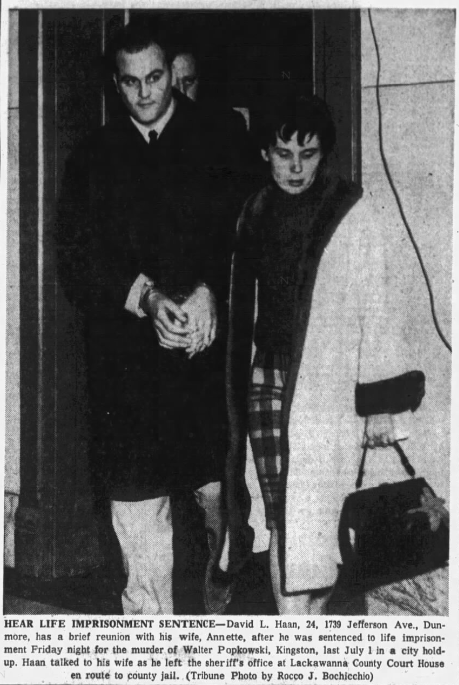
Once that verdict was determined, the jury was told that neither side wished to present further information prior to sentencing. It only took them 21 minutes after that to issue a life sentence.

December 5, 1964
Judge Robinson thanked the jury for their time and told them their decision was “just and correct.” He added that while some people would put Haan in an electric chair, “it’s not their decision to make.” Later, DA Cimino added, “The jury has spoken. We abide by their judgment.”
It was later learned that the jurors sounded as if the life sentence was too harsh. They asked if a first-degree charge was “mandatory” in a federal case, and another juror was holding out as long as possible on a life sentence – thinking it was too severe.
Even after receiving a sentence of life in prison, David Haan is “relieved.” He’s painfully aware of what he did, but his life on the run is over, and he is now back home to serve his sentence.
DA Cimino openly applauded the efforts and cooperation of the Wichita Police Department in solving this case. Their professionalism, “splendid efforts,” and “thorough investigation” were lauded by Cimino – so much so that he must have taken some heat for thanking them but not the Scranton Police. Two days later, Cimino publically thanked the Scranton team for their role in solving the crime and called out several men who were involved. And then, a couple more days later, thanked the Dunmore Police.
With his mother and father in the courtroom, David Haan was formally sentenced to life in prison on January 6, 1964.
Meanwhile, Bob Raikes still awaits his fate as he sits in the Lackawanna County Prison. His attorney, Carlon O’Malley, was asked if the Haan verdict would change his strategy, and O’Malley’s only response was, “No comment.”
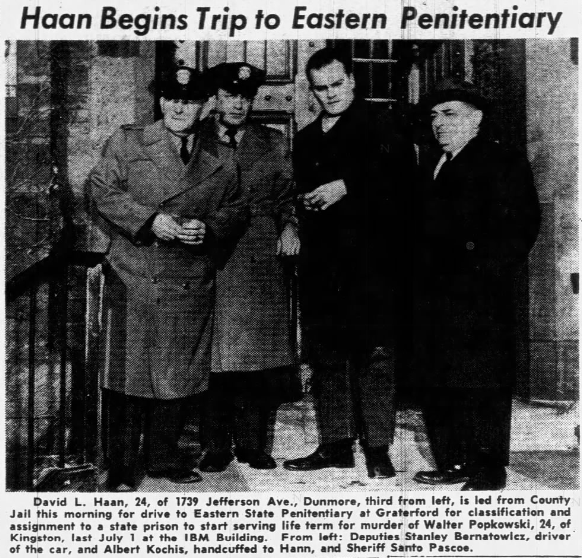
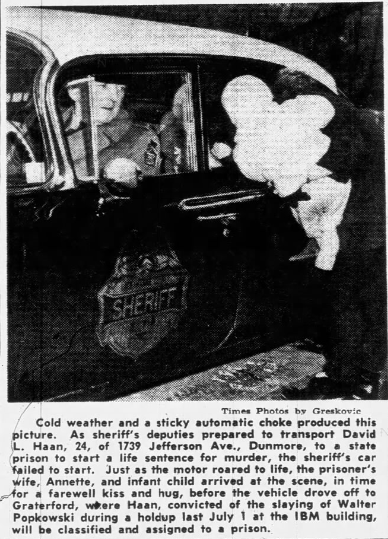
On January 19, he would be sent to the Eastern State Diagnostic and Classification Center in Philadelphia for an evaluation to determine where he should serve his sentence.
January 19, 1964
January 19, 1965
Raikes Trial
Days after the Haan verdict, on January 15, 1965, Robert Raikes pleaded not guilty to the murder charge. He was returned to prison while they prepared for his February trial. Even with Haan receiving a life sentence as the trigger man, Raikes is still eligible for the death penalty.
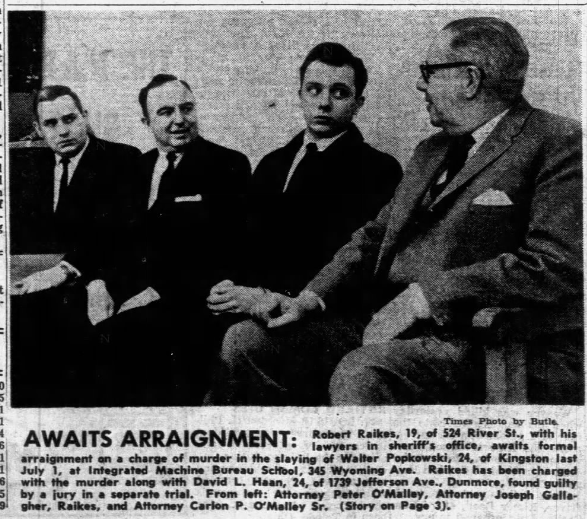
January 15, 1965
In a surprise move, on the morning the trial was set to begin, Robert changes his plea to guilty against a general charge of murder. He claims he was there “to rob but not to kill.” Witnesses will now be heard to determine the degree of murder.
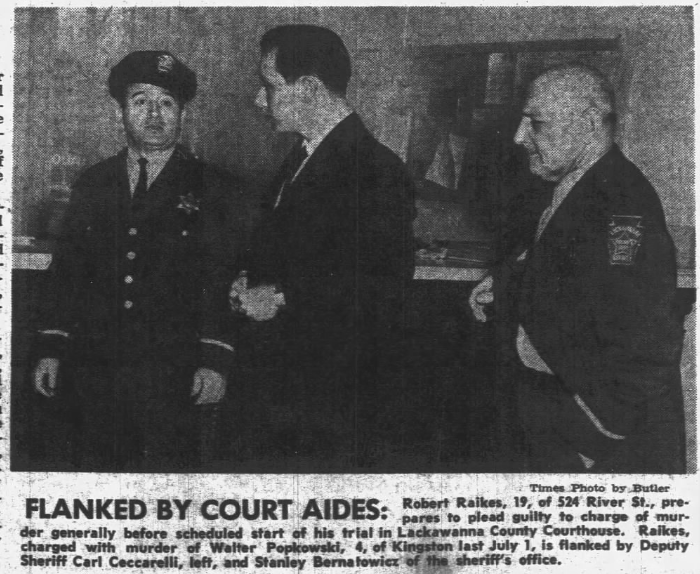
February 1, 1965
Many of the same witnesses were called by the state, and most of the testimony was a repeat of that which was heard just over a month ago. The few additions are a witness to testify that the fingerprints found at the scene of the crime were that of Raikes and his own 28-minute recorded confession of his involvement.
During testimony, Det. Earl Kugler was pressed on cross-examination by O’Malley to admit that it was Haan, who was already convicted of first-degree murder, was the one who planned the burglary and that “Raikes went along.”
Raikes took to the stand in his own defense. He claimed “loyalty” to David was the reason he participated in the robbery. He also testified that the two men visited five or six other locations in the city to determine if they could be potential targets.
On the day of the murder, Raikes said he was picked up at his home by Haan but that he didn’t know where they were going. He told David he needed to be back home shortly to complete his chores. In his recorded statement, he told police he was going to be married soon and that he was supposed to be going to make arrangements later that evening.
When the men arrived at the IBM building, they went inside, and Haan told Raikes that the businesses would be closing down soon and it would be easy to rob – and they shouldn’t run into anyone.
Robert testified that Haan gave him the gun – and he thought it wasn’t loaded because David rarely had his weapons loaded. When asked what he planned to do with it, he commented, “A gun is a very efficient means of frightening people.”
After his testimony, a dozen character witnesses testified in his defense. After three days of testimony, Judge Robinson said he would have to wait until the entire court proceedings were transcribed before he would make a decision. He wanted to make sure he could review the case in its entirety.
It’s now up to the court to decide between first-degree or second-degree murder. With the lesser charge, he can receive between 10-20 years in prison. With the higher charge of first-degree, he can face life in prison or death by the electric chair.
The Raikes Verdict
In his 8-page opinion, Judge Robinson finds Robert Raikes guilty of first-degree murder and sentences him to life in prison. Robinson claims, ” Malicious outlawry at best is risky business.”
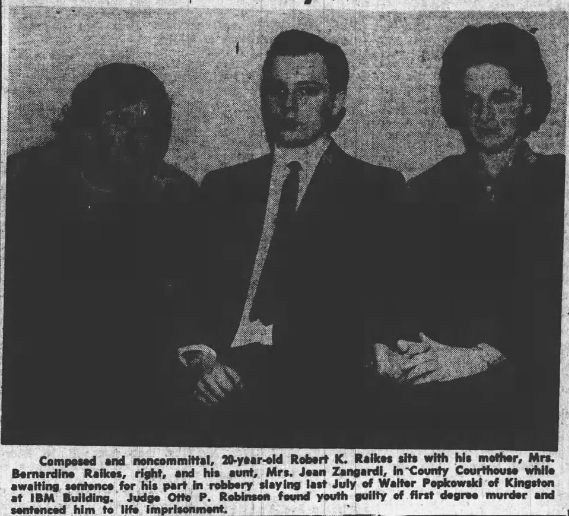
March 5, 1965
Within two weeks, Robert is on his way to the Eastern Diagnostic Institute in Philadelphia to determine where he will serve his time.
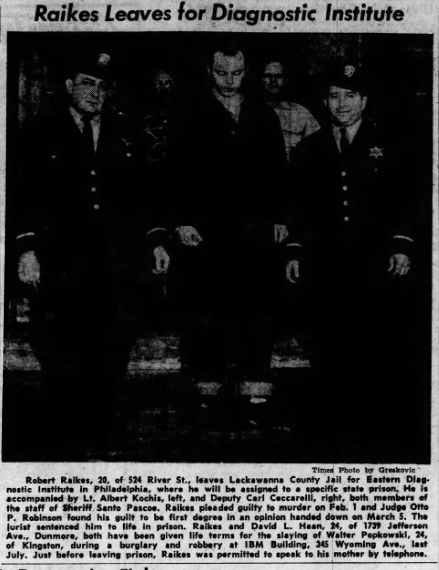
Petitions
While both men are serving their terms in Graterford Prison outside of Philadelphia, they each file multiple petitions to appeal their cases.
In November 1970, Raikes and his attorneys argued for a petition to review his guilty plea.

November 25, 1970
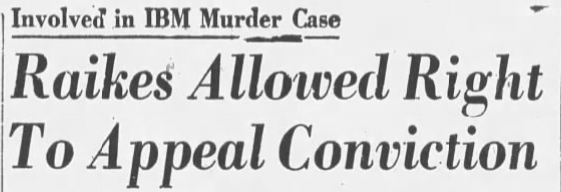
In May 1971, Raikes’ attorneys were granted a petition to appeal. It was determined that Raikes was not advised that he could appeal his conviction, so Judge Robinson had to grant the appeal.
May 27, 1971
In June 1973, while both men were still incarcerated, the State Board of Pardons commuted their sentences to 10 years and 4 months – making them eligible for parole in January 1975.
Good behavior while in prison is said to be the reason for parole. Raikes took a two-year landscaping course while in prison and was reported to be a “good prisoner.” He enrolled in a 4-year degree program from Penn State while still in prison.
Walter’s mother was very vocal about the thought of parole being granted for the two men convicted of killing her son. Judge Robinson had previously told the Board of Pardons that he did not impose life sentences only to have them overturned later. He added that someone should look into the sentencing process to find out how many sentences are cut short by commutations or paroles – in conflict with the sentencing judges who presided over the cases and heard all of the testimony.

May 3, 1974
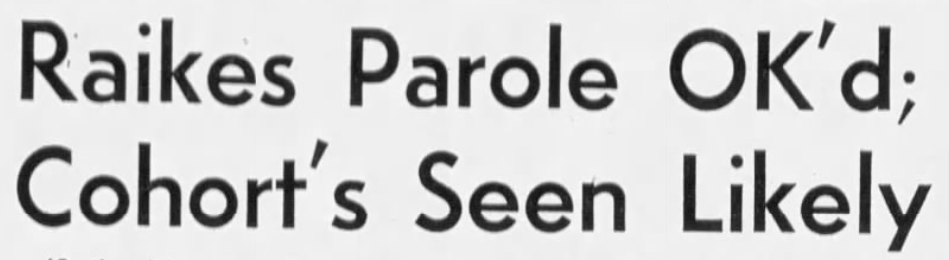
And DA Paul Mazzoni also petitions the Parole Board to uphold the life sentences for the two men. To no avail, Raikes was granted parole in January 1975 after just over ten years in prison.
January 9, 1975
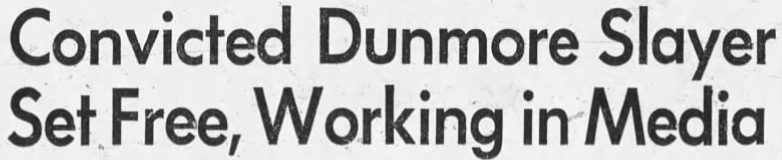
A couple of months later, in March 1975, David Haan, now just 33 years old, was released on parole. His conduct in prison was also cited as being the primary reason for his release. Haan learned photography while in prison and was assigned to several projects throughout the prison system. It was reported that he was working in Media, PA.
March 10, 1975
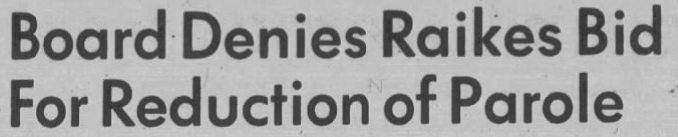
After his two-year landscaping course while in prison, Raikes enrolled in a four-year program at Penn State while on parole and living in State College. He wasn’t content with just being on parole, so he petitioned to have his parole commuted altogether. His request was denied in May 1983. He would have to wait another year before applying again.
May 19, 1983
Even after filing for bankruptcy in 1973, Integrated Machine Bureau’s President, Brian Crynes, went on to have a successful business career – with senior leadership stints at Price Waterhouse, The Daily News, Apple, Coca-Cola, Starbucks, and others.
Scranton, PA
This case is an interesting one. It was a clear case of murder, but I truly believe that neither Haan nor Raikes had any intention of harming anyone that evening. That said, one can argue that bringing a gun to commit a crime is an invitation to disaster, and you should be prepared to pay the ultimate price for your actions.
In this instance, a young, innocent life was snuffed out, and the Popkowski family suffered unimaginable loss. At the same time, the families of Haan and Raikes were also torn apart. A tragedy all around.
Haan and Raikes went on to live their own separate lives and, the best I can tell avoided any additional trouble in their lives. Still, the Popkowski family was left to wonder “what if.”
 Exploring historic crimes in NEPA
Leave a comment