
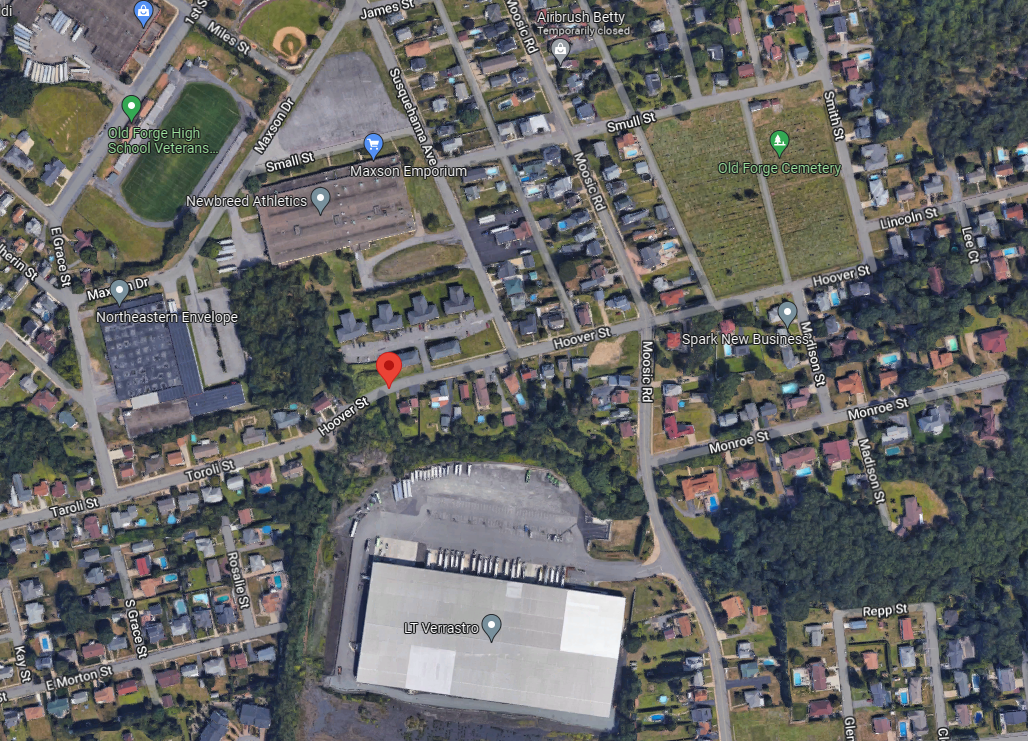
On March 25, 1934, two decomposed bodies were found by Joseph Hosker, a “fire boss” for The Pittston Coal Company. The bodies were located at the base of the 250′ deep abandoned Carbon Hill mine shaft near Hoover Street in Old Forge.

March 26, 1934
The remains were frozen and estimated to be there for about three months. Initial reports said their “heads were badly crushed.” Based on their fashionable attire, it was theorized that the men were small-time racketeers and had been “taken for a ride” – a term used to refer to the modus operandi of the gangs.
Investigators had to use dynamite to free the men from their icy tombs. One man was covered with an astonishing four feet of ice. At the coroner’s office, officials determined that one of them had been attacked by rats. His face was completely eaten away to one ear. Neither man had identification. However, the quality of the suits was noted. A pack of cigarettes was also found. Fingerprinting would have to wait until the bodies thawed sufficiently to see if the men were known to the police.
As the bodies were thawing, it was reported that an ankle fell off one of the men. It was presumed it was severely damaged during the fall down the shaft.
March 26, 1934
The Investigation
Investigators believed that there was a local tie to the killings based on the location of the bodies. The shaft had been abandoned for over thirty years. It was tucked away from the main street – about 1500 feet off Moosic Rd along a cinder path. It was reported that a man, Frank Pagnotti, committed suicide in the area a year earlier. Because of that, many avoided the area as it’s believed to be haunted.
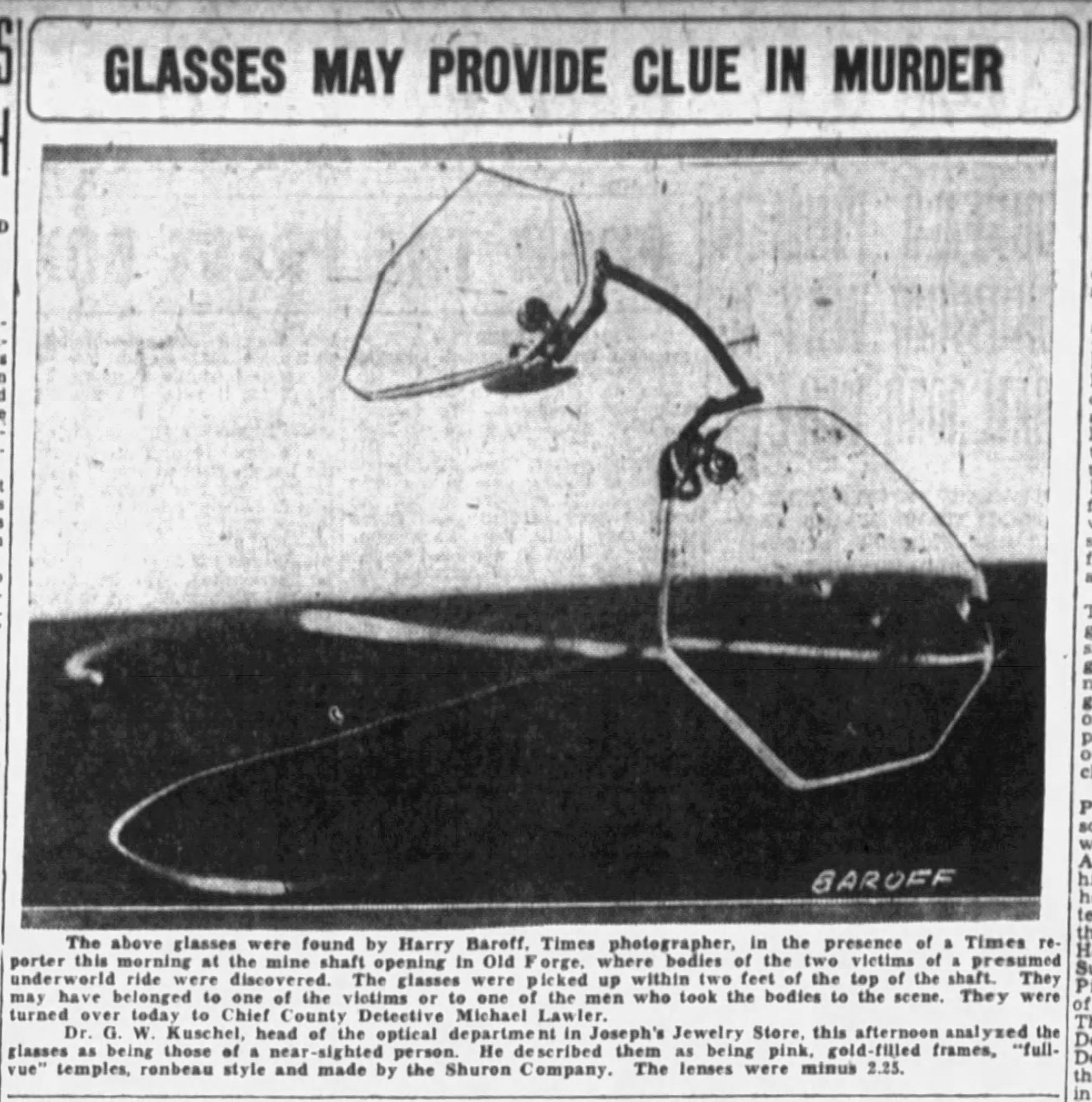
A reporter found a pair of gold-framed eyeglasses outside the mine and handed them over to the police.
March 26, 1934
One of the men had a gold ring on his finger, and that, too, was taken by investigators. And a crowbar that was believed to be part of the murder was found about thirty feet down the shaft.
Detectives immediately thought the murders were connected to the sting that State Police executed in January in Old Forge. That’s when there was a raid on two locations. At the Brown Derby and The Babylon, thirty-five men and women were arrested on various charges. Most were charged with counterfeiting, liquor laws, larceny, and other charges.
A few other clues were uncovered as the bodies thawed. A laundry tag on one of the shirts gave a clue to one of their hometowns. And a cigarette lighter was found. Then the coroner determined that one body was littered with at least five bullet wounds from a .38 caliber revolver- the other, only one.
Identities Determined

March 28, 1934
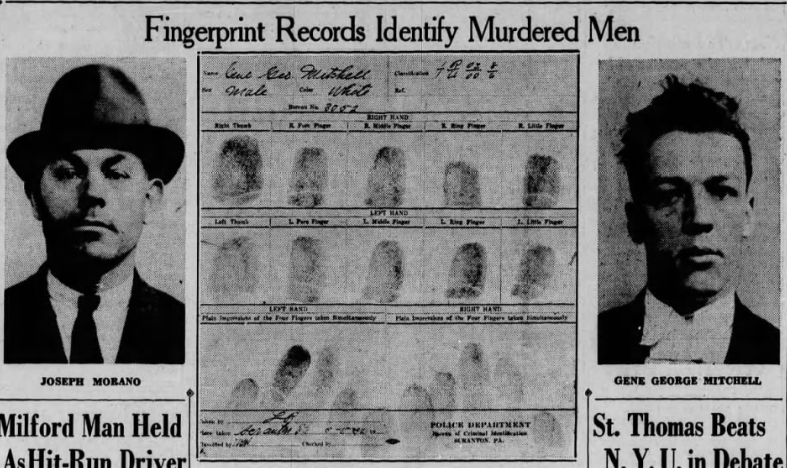
Investigators had plenty of clues taken from the bodies. It didn’t take long to identify the two men. Gene George Mitchell, 28, and Joseph Mariano, aka Joseph Moran, aka Joseph Morano, 35. Both Scranton residents were identified through fingerprints, meaning they already had a police record. Morano was a fugitive after not showing up for a hearing on robbery charges filed against him a year ago.
March 29, 1934
Mitchell was originally from Wilkes-Barre. He was also a fugitive for a short time. He was captured and spent three months in jail for burglarizing a store on Franklin Avenue.
The two men were known to travel between Scranton, Wilkes-Barre, and New York City. It was reported that after they stole from local businesses, they would head to NYC and lay low for a while. Several other crimes were attributed to the two men, but they were never tried for their involvement.
After identifying the bodies, police now believe that the key to solving the murder is the pair of glasses that were found outside the mine shaft. Since neither man was known to wear glasses, it was initially believed they belonged to the killer.
A Possible Third Victim
That theory quickly changed. The glasses were traced back to Scranton, and the optometrist identified the owner, Lester Levenson of Prescott Avenue in East Scranton. When police went to question Levenson, he was nowhere to be found. His last reported sighting was two months ago. He was known to be acquainted with Mitchell. Police are now concerned for Levenson’s safety.
March 29, 1934
Officials plan to revisit the mine for a thorough search. Given the amount of ice at the bottom of the shaft, they might have missed the third body.
A Revolved Discovered
Meanwhile, a young boy found a .38 caliber revolver near the mine shaft – about 100 yards away near the cemetery. The weapon was turned over to the police. Investigators sent the serial number back to the manufacturer to see if they could identify the owner.
Search for Levenson
Another attempt to locate Levenson’s body fails. The ice is too thick, and the conditions too difficult. Officials request $150 in funding. They want to completely remove all of the debris at the base of the mine shaft. The County is hesitant because of the liability linked to the dangerous job.
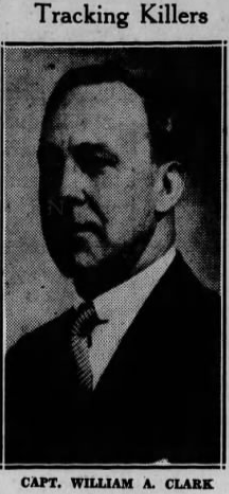
Captain William A Clark of the Pennsylvania State Police is tasked with tracking the killers. He claims they are working through a half-dozen leads and asks for patience as they work every possible aspect of the case.
March 31, 1934
While negotiations over clearing the mine shaft continue, authorities turn to New York in the search for Levenson. The missing man was known to wander. He lived in different parts of Scranton and New York.
A tip came in saying he was alive and well and living in NYC. Accordingly, the mine search was postponed until they could rule out the NYC lead.
Levenson Found
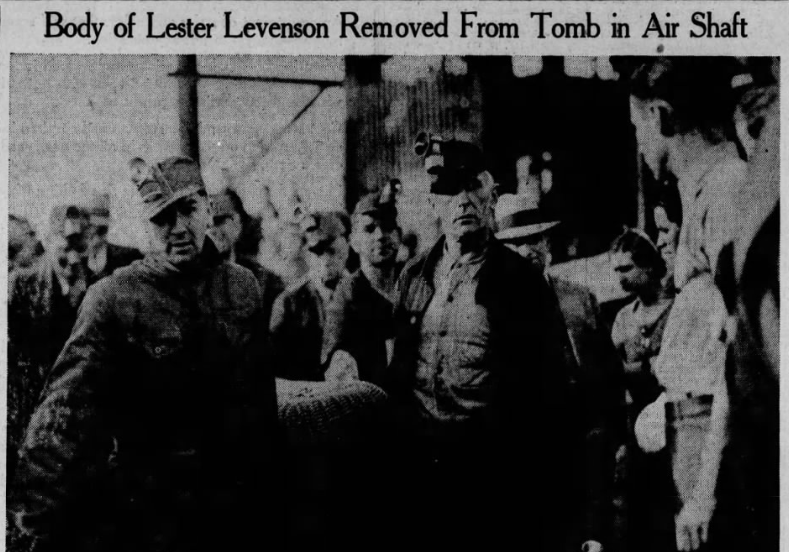
Finally, on April 5, the search resumed. Eleven days after recovering the bodies of his associates, Lester Levenson, 25, is found in the mine shaft. He was twenty feet above where his associates were found. He had been shot in the head from behind with a .38 caliber weapon. Five more shots were fired into his body from the front. Several broken bones were reported, and his face and head were eaten away by rats.
Like Mitchell and Morano, Levenson didn’t have any cash on him. Police believed all of the men had been robbed before being thrown down the shaft. But they didn’t name robbery as the motive.
One of Levenson’s brothers, Leo, identified the body. The clues were his ring with his initials, and his monogrammed shirt, initialed “L-Lev.”
One oddly reported fact was that Levenson had recently had a manicure. His nails were painted a deep red color that “glistened brightly” once his gloves were removed. His hairline also revealed that he had just received a haircut. Investigators will be looking into this lead for clues as to the day the men were killed.
April 6, 1934
Recovery workers delayed removing Levenson’s body from the mine until after the 3:30 pm shift of mine workers arrived. It’s said that workers will not enter the mines if they see a body being taken out. Out of respect for the workers, the recovery was delayed until 4:30 pm.

June 4, 2017
Motive Starts to be Revealed
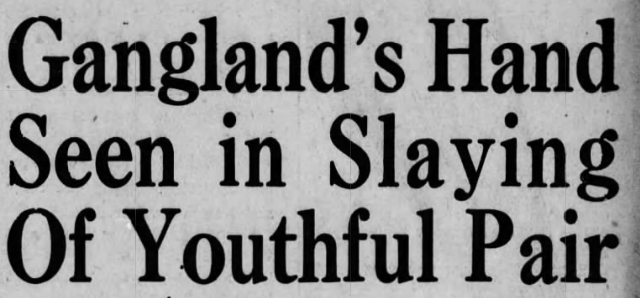
Detectives believed all three men were killed gangland-style. They pointed to a New York or Brooklyn gang with connections to the area. It was the first triple-slaying since Patsy Stallone gunned down three men in Old Forge in 1922. The men were arguing over an election dispute.
Investigators were also convinced that the three men were mobsters. Several other robberies had since been attributed to the trio. It was assumed that the underworld bosses were orchestrating the robberies, and these three men would execute on their behalf.
They believe the men were killed by professional killers. And the killers were brought to the area by the local arm of the mob. They were likely killed over a dispute over the proceeds of their haul.
Each man was shot at least once in the back of the head. More shots were fired into the front of their bodies. This indicates there were at least two killers.
Levenson didn’t have a criminal record, but he was known to be an associate of the two other men. He was also known to hang around the Tenderloin district, where he was friendly with two women.
Two other leads were being pursued by investigators. They were made aware of another missing man. At the same time, it was learned that Morano’s automobile was missing. They were working to determine if these incidents are related.
The Suspects
Several suspects were detained and interviewed for the murders. The men were captured across the area as far away as New York City.
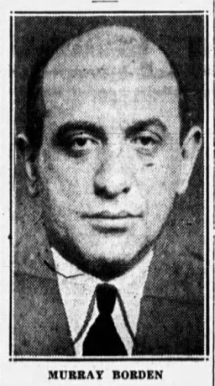
Thomas Burke and Murray Borden
On April 16, three weeks after the first bodies were recovered, police in New York City picked up two men.
Two plainclothes detectives were watching over a vehicle reported to be owned by Joseph Morano. The men were seen dragging an unwilling man into the car at 2:00 am in Greenwich Village.

April 16, 1934
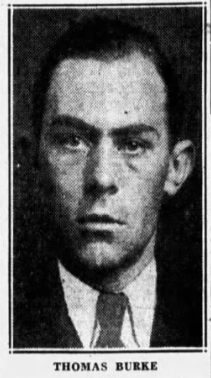
The two were arrested at gunpoint and taken in for questioning. Murray Borden, 32, and Thomas Burke, 25, both from New York City, had long criminal records. When police inquired about the vehicle’s registration, it was confirmed that Joseph Mano of Syracuse was the owner. After talking to the Syracuse Police Department, it was believed that Mano was another alias for Joseph Morano.
May 9, 1934
Both men stated that a man named Mano had loaned them the car approximately ten days prior. They said it was so they could go on a double date.
When police searched the car, they found no evidence tying it to the murders. They did, however, find that the Studebaker’s rear seat was modified. It had a compartment below the seat. The police theorized that this was likely a place to hide guns.
May 9, 1934
The men were detained for a Dyer Act violation for having a stolen automobile. Authorities tried to have them extradited to Scranton for questioning. These attempts were thwarted because of a lack of evidence. Investigators in Old Forge were forced to gather more support for their case.
Borden was later convicted on an unrelated robbery charge. Burke was questioned almost 10 years later in a separate murder case.
Witnesses Challenge and Support Theory
In January 1935, in an attempt to build their case, several acquaintances of the murdered men were questioned.
Morano’s wife, Nettie, said that her husband did, in fact, own the car. She said he registered it under a false name because he was wanted by authorities.
The coroner testified to the grand jury. He said Morano could not have loaned the car to Burke and Boden in the timeframe the men had said. The coroner testified that Morano’s death occurred over a month before they said Morano gave them the car.
Still, there’s not even evidence to bring murder charges against the two men.
Aurelio Gonzales
On April 20, 1934, just days after nabbing Burke and Border, police arrested Aurelio Gonzales, 31, of Plymouth. Gonzales confessed to committing several robberies with Mitchell and Morano. He emphatically denied any involvement in the killings. But he welcomes his time in the Lackawanna County jail. Presumably because it would be a safe haven from the mob.
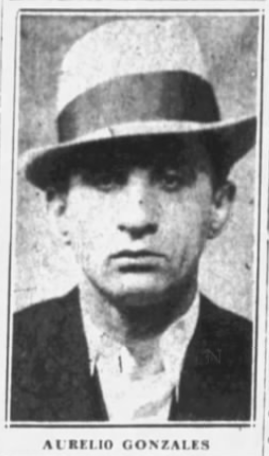
In May 1934, Gonzalez pleaded guilty to robbery and was sentenced to 10 to 20 years in prison.
While under investigation, Gonzales implicated Rocco Carey in the robberies, but he fell short of testifying against him in court.
Rocco Carey
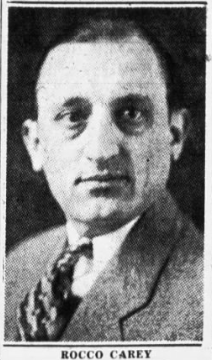
Carey was 33 years old. He was a labor leader from Old Forge. Police wanted him for questioning in connection with the robberies and the murders.
July 12, 1935
After four months on the run, New York police detained Robert C Carey in August 1934. Presumed to be Rocco Carey. Detectives from Old Forge travelled to New York to question the man. It was determined that it was, in fact, Rocco Carey from Old Forge.
Carey initially fought extradition but eventually agreed to return to Lackawanna County to face burglary charges. He denied any knowledge or involvement in the triple murder.
Carey was later sentenced to jail for a prior DUI conviction. Prosecutors used this tactic to keep him in jail while he awaited trial for the robbery.
At the same time, they tried to build a case against him for the murders. He was ultimately sentenced to 6-12 years in jail, but again, no murder charges were ever filed.
Joseph Hornstein
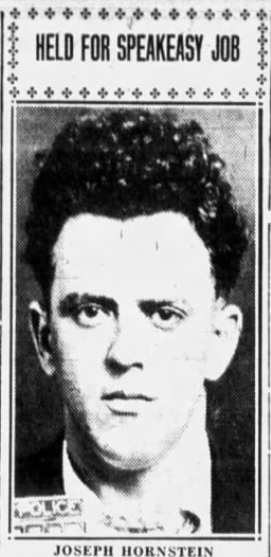
In July 1934, in New York City, Joseph Hornstein, formerly of Scranton, was detained by police. He was wanted in connection with several crimes in Scranton. In one robbery at Nick Ross’ Spruce Street speakeasy, he used a wire to tie up nine patrons while an accomplice stole their money.
He was also listed as a potential link to the murders.
Hornstein was ultimately brought to Scranton and held for trial.
July 18, 1934
After several delays and continuances, Hornstein was found guilty in connection with the speakeasy robbery. However, there were no charges filed in the murder. Hornstein was transferred to Eastern State Penitentiary in June 1935 to serve 7 1/2 to 15 years for the robbery.
Leads Dry Up
Investigators are convinced the triple murder was a gangland killing as leads dried up. To this day, justice has yet to be served to those responsible for their deaths.
Other “gangland-style” murders occurred during this time. Those were also linked to the slayings. Yet, there was no movement in identifying the killers or the leaders of the criminal gangs.
An Unexpected Development
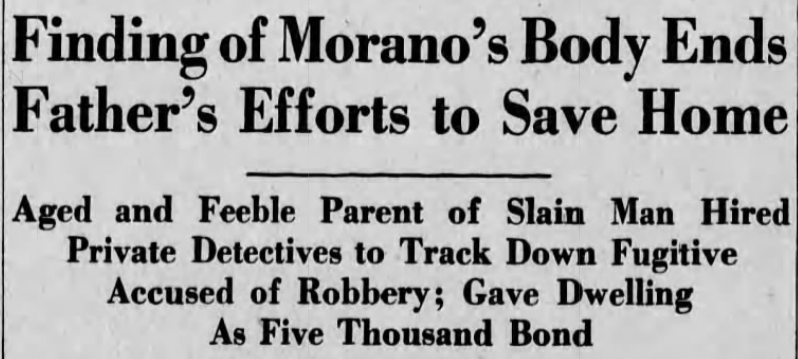
A bit of good news came out of the death of Morano. His father had put up his home on Scranton Street as collateral for his son’s release on bail. Since Joseph didn’t appear for his trial date, his father’s home was scheduled for foreclosure in February 1934.
The father petitioned for an extension and implored local detectives to find his son so he wouldn’t be forced to give up his home. The extension was granted until October 14, 1934.
With the discovery, the father loses his son but won’t have to forfeit his home.
March 30, 1934
The Deceased
Joseph Morano left behind a wife and five children, along with his parents and several siblings. He was given full military honors for his service in the First World War.
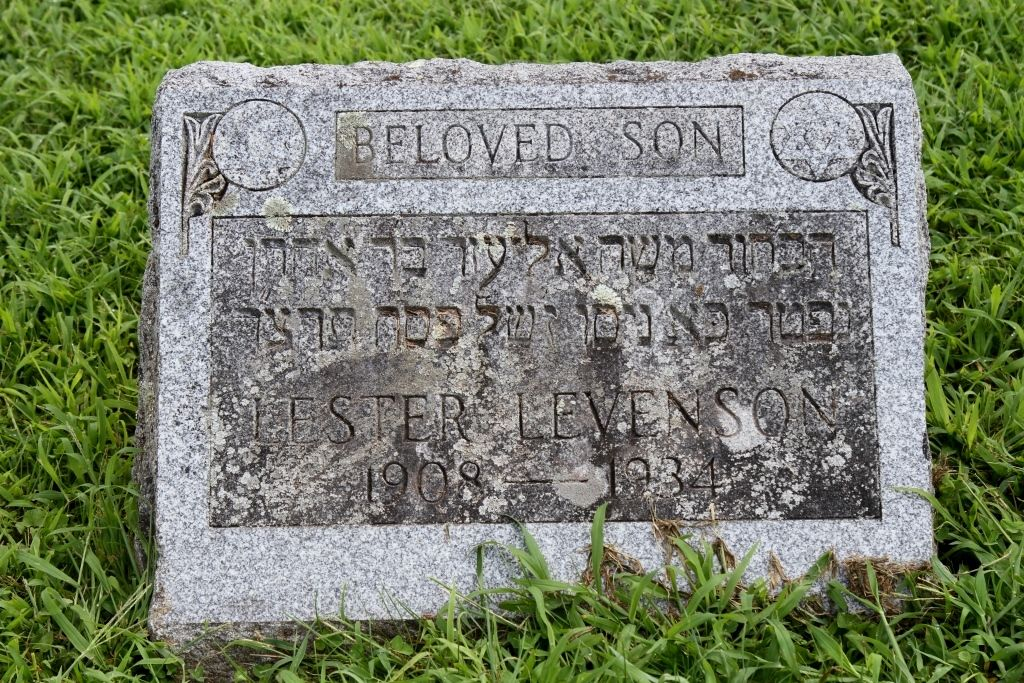
Lester Levenson was single and left behind his parents and two brothers. He was laid to rest in the Dalton Jewish Cemetery.
And finally, Gene Mitchell’s body, to my knowledge, went unclaimed and was allegedly buried in the Old Forge Cemetery.
Summary
The term “gangland violence” continued for some time before organized crime became known as La Cosa Nostra, aka “The Mafia.” From the early days of the Black Hand to later iterations of the Mafia, violence was commonplace in the underground. And it wasn’t just Italians who were responsible.
So, who do you think did this? Was it a professional job? Did the killers ever kill again? We may never know.
Like, comment, subscribe, and share to keep this case alive, and perhaps someone may provide the answers.


Leave a comment