
The Black Hand in Scranton was notorious for extorting money from other Italians. But they also had their tentacles in different businesses. One of the most lucrative crimes came to light when police busted a Counterfeit Operation in Chinchilla on April 29, 1915.
For months, investigators built their case against the operation. The man behind the investigation was well-known and well-respected Scranton Police Detective John Cartusciello. Cartusciello had been instrumental in dozens of cases against the Black Hand during his illustrious career. In October of 1914, he was led to believe an operation was in business, cranking out half-dollar coins. While it may not sound like a lot today, in 1914, each $0.50 coin would be worth about $15 today. Still, not a lot individually, but when you’re cranking them out in masses, it adds up quickly.
Six law enforcement officials were involved in the raid. One was dressed as a “tramp,” another as a hunter, and the others in rundown clothes that made them look like “hoboes.”
The men stormed the building, guns drawn, shouting in English and Italian, “Hands up! The man who moves is dead!”
April 30, 1915
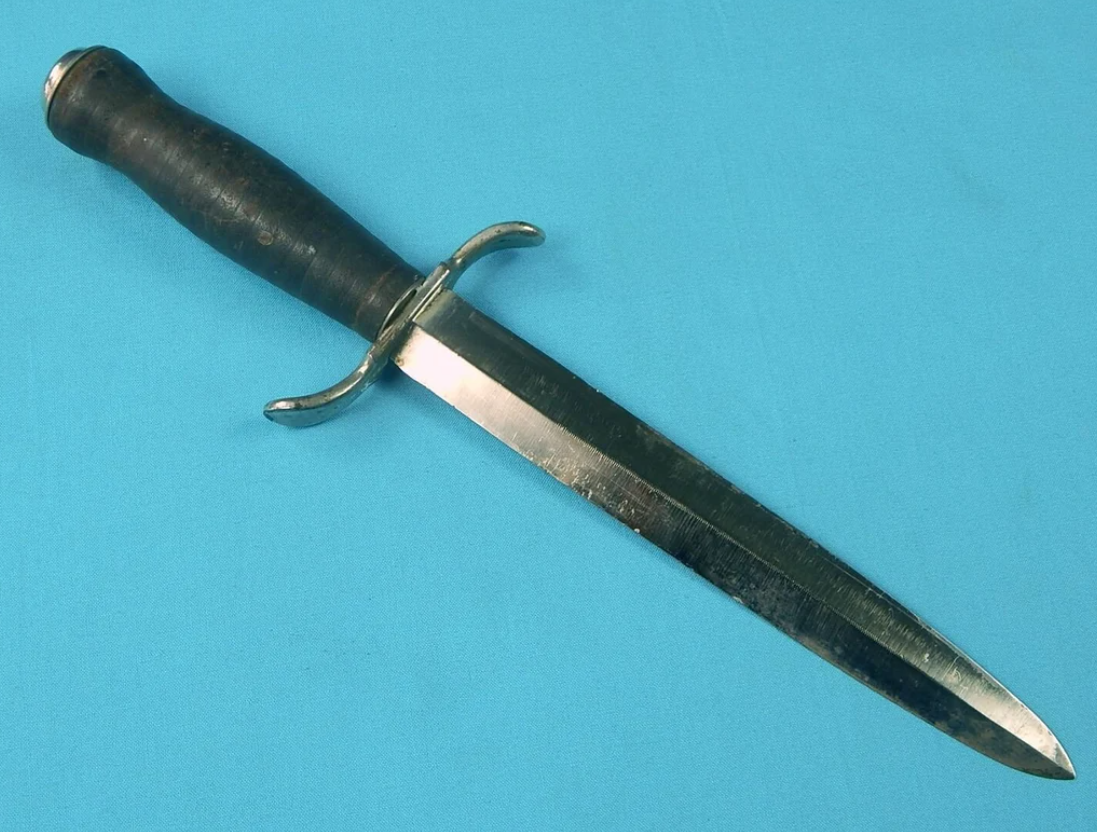
Without any further drama, five men, including two youths, were taken into custody. Thankfully, officers surprised the operation. Thanks to two of the lookouts who were allegedly deep into a game of cards in the barn. If the faintest hint of a raid was coming, the men had a cache of weapons at their disposal. They were armed with “a repeating rifle of the heaviest caliber ever seen hereabouts,” two loaded double-barrel shotguns, two loaded revolvers, and six sticks of dynamite. Two of the men were also carrying stiletto knives with 8″ blades. This was the tool of choice for the Black Hand.
In addition to their armory, the men were caught red-handed with all of the necessities for making thousands of counterfeit coins. The items seized during the raid included two tools to make the coins. There were ten “spurious” (fake) coins and six good coins. The authorities also found a pile of “babbitt” metal, tin, acid, and plaster of Paris. They discovered bicarbonate soda, a clay mold, and other tools of the trade.
The Suspects
The players involved were either already known to law enforcement. Some were tangled up with the Black Hand in Bull’s Head. It was the hotbed of nefarious activities in the city during this time.
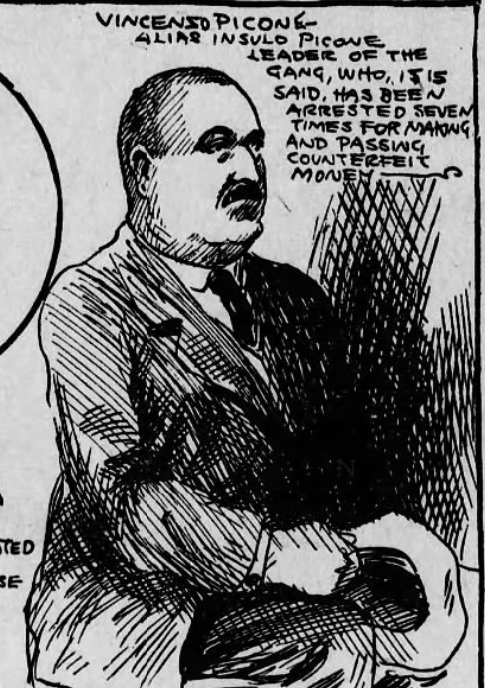
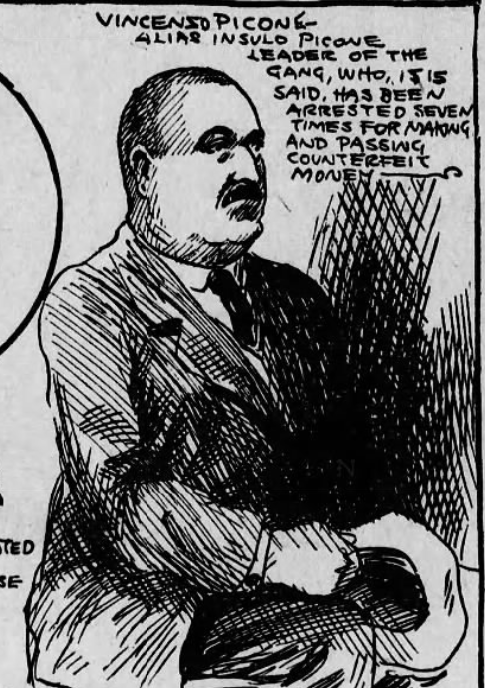
The leader of the gang was believed to be a 30-year-old, Vincenzo Picone. Picone had been arrested seven times on counterfeit charges in New York. Each time, he evaded conviction. He’s said to live in both New York City and South Scranton. Just a few months prior, he was also implicated in a holdup at Baryta Chemical Manufacturing. The plant was along the Laurel Line in what was known as “Little Virginia” near Davis Street.

February 6, 1915
He was married, without any children, and was an immigrant from Agrigento, Sicily.
April 30, 1915
George Mangano, aka “Big George,” 29, was originally from Nicastro, Calabria, Italy. For the record, “Big George” was listed as 5′ 8-1/4″ and 208 pounds. He was involved in the Rosario Cuda murder in Bulls Head just six months earlier. He was initially arrested but released after Frank Greco confessed to the murder. I covered that case in my Black Hand of Bull’s Head post. And I also cover Mangano’s death in Double Murder in Bull’s Head.
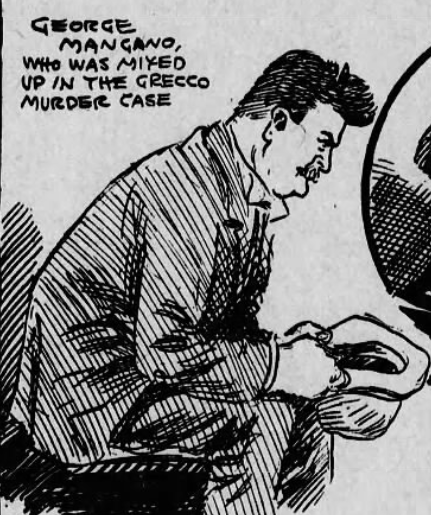
April 30, 1915
Gasper Marcianti, 31, of West Side, was listed as an “oil agent” on his naturalization papers. He immigrated to the US from Caltabellotta, Sicily, in 1903. He was a grocer who sold imported olive oil.
Gasper was no stranger to crime. He was tied to an explosion at Giovanni Fazio’s macaroni factory on Franklin Avenue on New Year’s Day 1906. The Fazio factory had been hit twice by the Black Hand.
He was also jailed for possession of weapons in 1908 and believed to be part of the Black Hand.


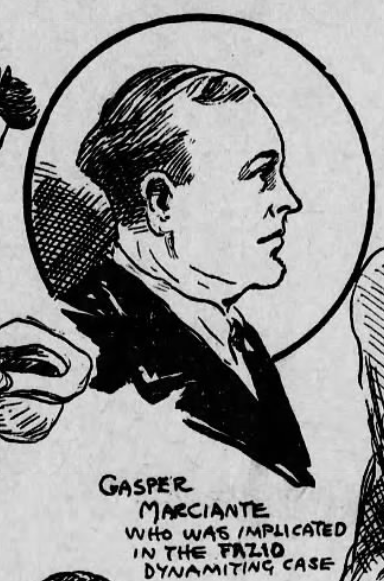
April 30, 1915
The two younger men included Tony Ducati and Michael Esposito, also known as Michael Sposito. Ducati, 19, was listed as a barber. He was arrested in 1914 for hopping a rail produce car and was found with a gun in his possession. He was also implicated in a Black Hand extortion scheme, but charges were dropped when the victim refused to testify.
Esposito, 22, was also a barber. He was the lessee of the property. He was involved in some of the early Black Hand feuds. I covered those in my post, The Black Hand Society of Bulls Head.
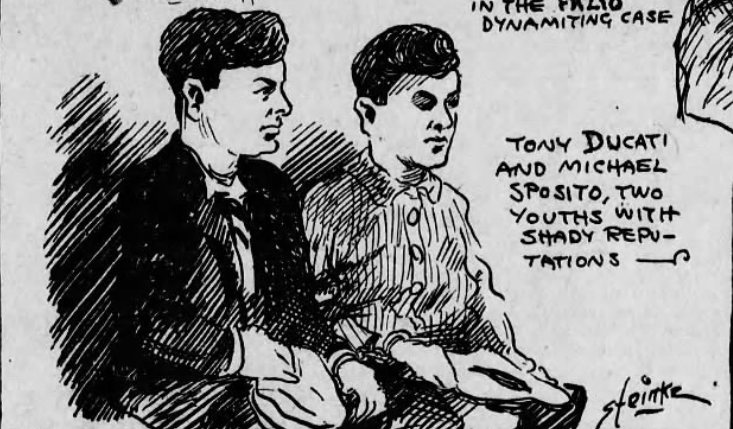
April 30, 1915
The Investigation
The investigation began in October 1914. That’s when Angelo Menoni, 24, was arrested for passing a bad coin at the Delaware and Hudson line. At the time of his arrest, he had 195 counterfeit coins in his pockets. That would be almost $3,000 today! Police were not impressed with the workmanship of the coins. A lead-based alloy was said to be used, and coins didn’t look or feel like the real deal.
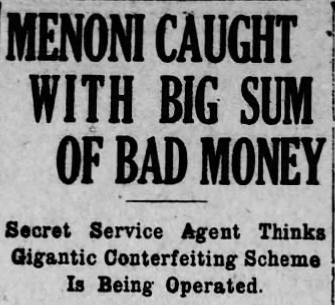
October 29, 1914
Menoni was questioned by the police. He said he bought the coins from a man he had met at the Laurel Line earlier in the day. He explained that the man said he had too much silver. He wanted to exchange it for paper money. Menoni said he had paper. He didn’t mind having the coins. He liked to jingle them in his pockets. Police didn’t believe this story and pressed on. They believed that Menoni was simply a “runner” for the larger outfit and would eventually break under pressure.
Two days later, police arrested Diego Sardegna in connection with the coins. He was the owner of an olive oil store on Locust Street in South Scranton. Both men were placed in the Lackawanna County Jail while they awaited trial.
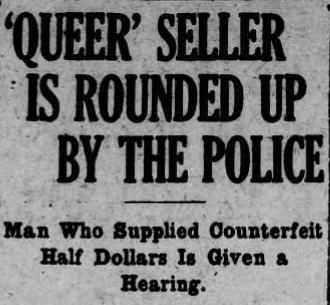
October 31, 1914
Menoni wasn’t the only one caught with the fake coins. Days later, police arrested two other Philadelphia men in connection with the phony money. Additionally, there were reports that the fake coins were turning up all over the state.
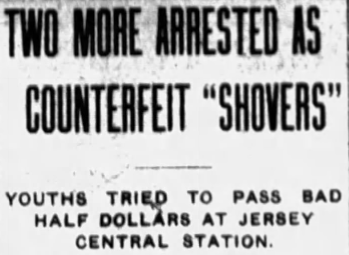
November 3, 1914
The situation escalated. The coins started to show up at banks and merchants. Police had to put out bulletins to be on the lookout for the fake coins.
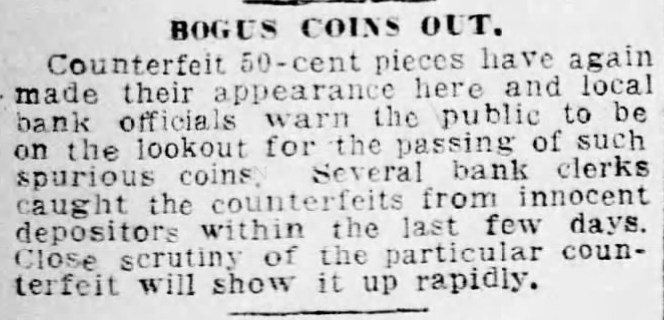
December 17, 1914
As the trial neared, “a swarthy, heavy-set, scowling individual” visited Menoni and Sardegna in jail. It was believed that the man was there to intimidate the accused, as well as the prosecutors. That man, Detective Cartuschiello determined, was Vincenzo Picone, brother-in-law of the imprisoned Diego Sardegna.
While in jail, Sardegna was also visited by his young daughter, likely Grace. He allegedly told her, “You must not believe that Papa is guilty.”
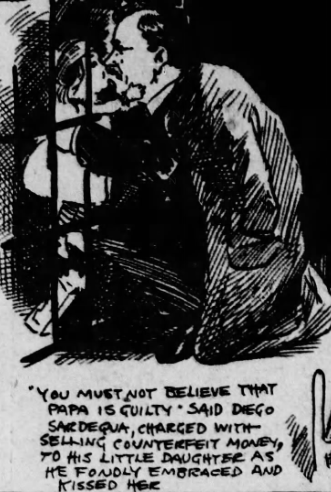
March 9, 1915
Despite his words to his daughter, both men would plead guilty. They would be sentenced to time served (four months) plus two months for Menoni and five months for Sardegna. The light sentences were due, in part, because this was both their first offense.
Picone was already known to Cartuschiello. Months earlier, the Detective learned that Picone had offered to train a man on how to counterfeit money. In letters between Picone and Marcianti, the West Scranton man offered to pay Picone $10 in exchange for the supplies to make “fifty-cent cigars.” Police believed that this was code for the fake coins. Detectives had intercepted the letters and steamed them open. They photocopied the contents, sealed them up, and sent them on their way.
With that combination of evidence, Cartusciello started watching Picone’s every move. The Detective even coordinated with the United States Secret Service to have Picone trailed in New York City. In case you didn’t know, the Secret Service was initially founded in 1865. Their purpose was to investigate all counterfeit operations involving US currency. Today, they still hold that responsibility, among other duties.
It was determined that just two weeks before the raid, Esposito leased land in Chinchilla from Dr. D.H. Jenkins of North Scranton. The small bungalow was along Northern Boulevard, across from the current post office. The building was set back about 200 yards from the main road. It was perched up on a hill, providing a view of the valley below. My guess is that it was where I-81 is today.
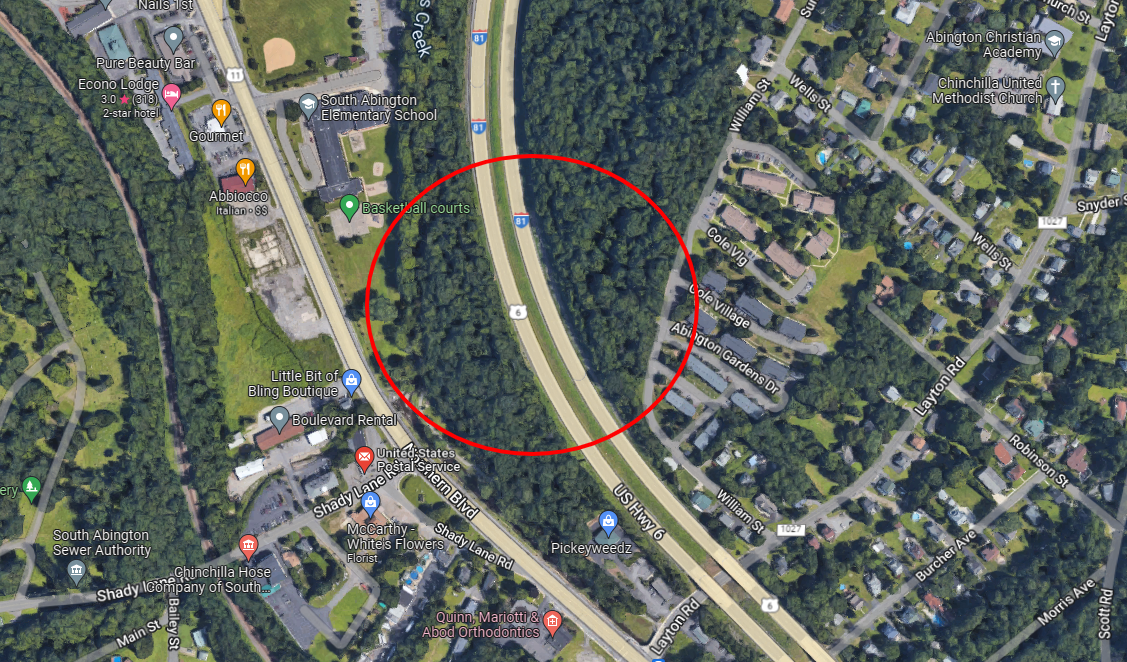
Esposito and his wife, the former Anna Trunzo, were married in 1913. He was 20, and Anna was just 15. Together, they operated a farm on the property as a front for the operation. It was said that Mrs. Esposito, now 17, would take an old mule and deliver eggs to customers in the city. The legitimacy of the business quickly became questionable. It became known that they would have to buy their eggs elsewhere to fulfill orders. They didn’t have enough chickens of their own.
On the morning of the raid, as the men were set to meet at the farm for production, Picone grew suspicious. He felt that Cartusciello was onto him. Intending to throw off the Detective, Picone visited a friend’s house in West Scranton near the Detective’s home at 122 St. Francis Cabrini Avenue (then called Chestnut Avenue). He waited for the Detective to pass by on his way to work so he could strike up a conversation with him. Seemingly to let the Detective know his location.
His plan worked. Cartusciello saw Picone standing in a doorway, and they had a quick conversation. Picone told him that he had other plans for the day to try to throw the Detective off his tail. Or so he thought. Cartusciello continued on his commute to his office downtown.
At Police Headquarters, a man approached Detective Cartusciello and asked some strange questions. The Detective saw through the farce and realized that the man was tailing him and reporting back to Picone. The detective played along until the man eventually left the station. Once he did, the six officers took off for Chinchilla in a large touring car.
Once there, three men went around the back of the cabin, and three approached from the front. They quickly entered the building and detained all of the men without any issues.
The Trial
All five men were summoned to appear in court in Sunbury the following Tuesday, May 4th, 1915. The two young men, Ducati and Esposito, had already confessed to the crime. But prosecutors didn’t want a plea bargain in exchange for lighter sentences.
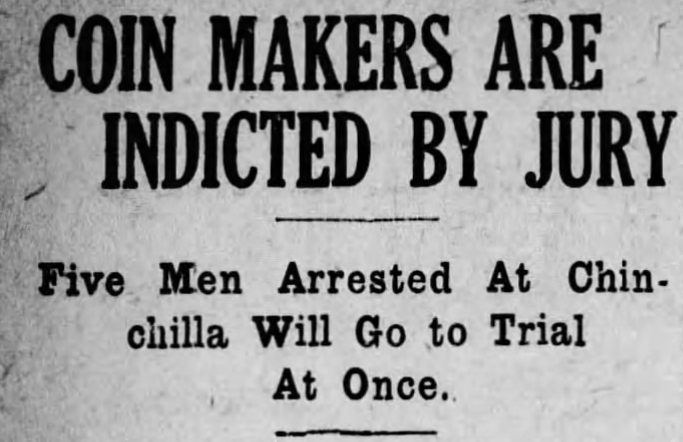
May 6, 1915
All five men were quickly convicted. Picone was sentenced to six years and six months. Marcianti received four years and six months. Ducati and Esposito each got two years, and Mangano initially received four years.
Leaving the courtroom, Mangano, who had stared at Cartusciello the entire trial, said to the Detective in his native Italian language, “Four years won’t be long passing, and by God’s mother, I’ll stab you to death when I come out.” The Judge heard the threat and ordered Mangano back into the courtroom for questioning.
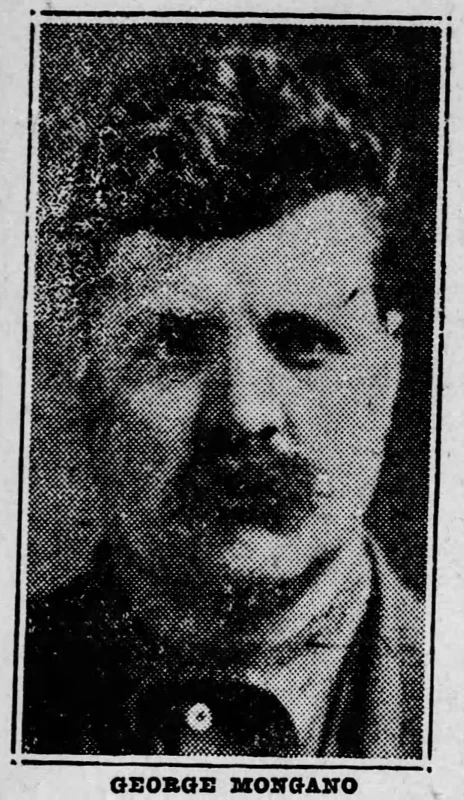
Mangano, talking through an interpreter, admitted to making the threat. He said, “Well, he sent me to die in jail, and I don’t see why he should not die, too.” With that, the Judge modified the sentence by adding six more years in jail. Mangano received a total of ten years in prison.
Prison Time
All of the men initially reported to Eastern State Penitentiary in Philadelphia, PA. They would later be transferred to the United States Federal Penitentiary in Atlanta, Georgia. The facility in Atlanta housed other New York City mobsters. They included Giuseppe “Clutch” Morello, founder of the Morello Crime Family, and his under-boss brother-in-law, Ignazio Lupo. Both men were also convicted of counterfeiting in 1910. In 1915 alone, over 65 new inmates were sent to this facility for Counterfeiting. It was the highest number of new inmates for counterfeiting during that time.
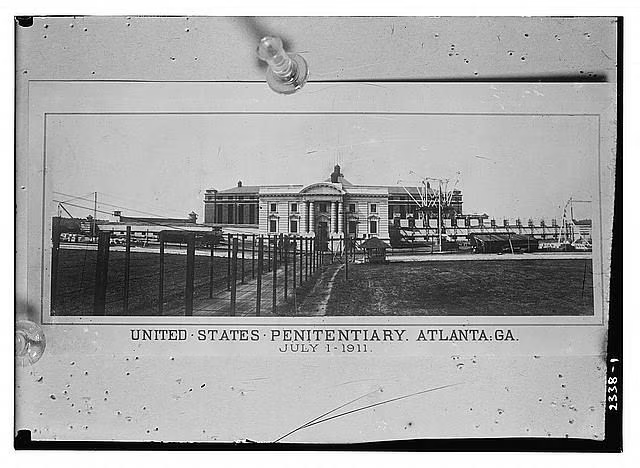
Atlanta, GA
The Outcome
George Mangano would be released on January 25, 1922, after serving almost 6 1/2 years. Within 2 1/2 years of his release, Mangano was shot to death in a gun battle in Bull’s Head.
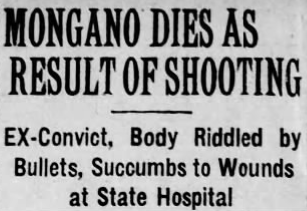
June 27, 1924
Tony Ducati was released on December 16, 1916, after serving just seventeen months of his 24-month term. His freedom didn’t last long, and his incarceration did not reform him. He was convicted in 1918 of the Bull’s Head slashing of John Sharo. He was sent back to Eastern State Penitentiary for a seven-year sentence.
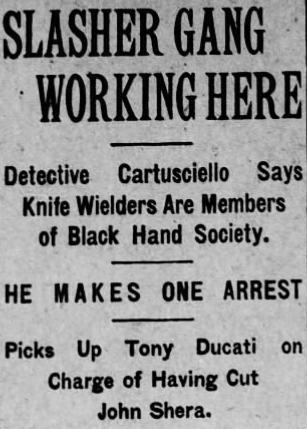
January 10, 1918
Once again, he was promptly released after just eighteen months. He was married in Scranton in 1928. He eventually moved to NYC and spent the rest of his days, allegedly, as a barber.
Michael Esposito was released the same day as Ducati on December 16, 1916. Within 28 months of his release, he was stabbed to death in Bull’s Head.
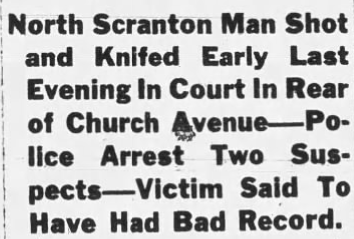
April 25, 1919
Gasper Marcianti was released on October 27, 1918. He would die of illness in the Hillside Home in 1929 at the age of 46. His obituary lists only a cousin, Samuel LaBella, and a brother in Italy.
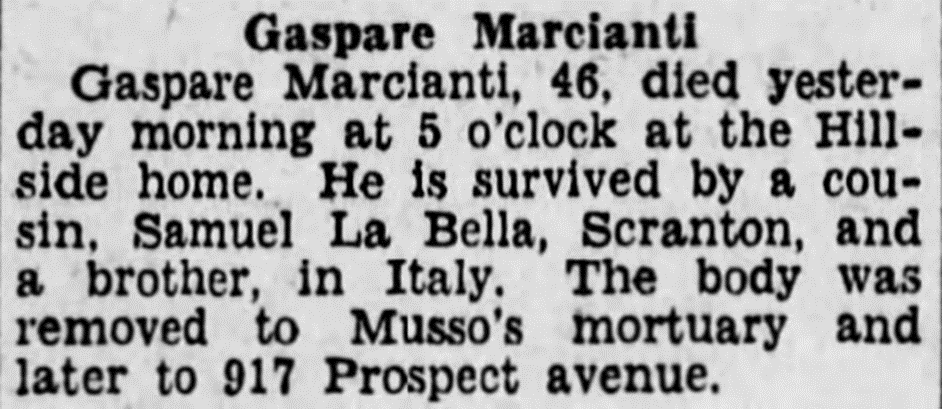
November 12, 1929
Vincent Picone
The ringleader, Vincent Picone, was released on February 24, 1920. He served just under 5 years of his 6 1/2-year term. Upon his release, he returned to New York City. The best I can tell is that he divorced his first wife, likely during his prison time. He remarried shortly after returning to the City. It looks like Picone died of a heart condition in 1923 at the age of just 38. He left behind a wife and a newborn son.
John Cartusciello
Detective John Cartusciello gained tremendous accolades for his efforts in taking down this ring. While there were others involved, all pointed to the Detective as the mastermind behind the bust. Cartusciello went on to have a long and prosperous career in police work and later as a private investigator. The Detective was originally a restaurateur in Scranton before becoming a Patrolman about 1912. He left his job with the City after about a decade and opened Cartusciello’s Detective Agency in 1922.
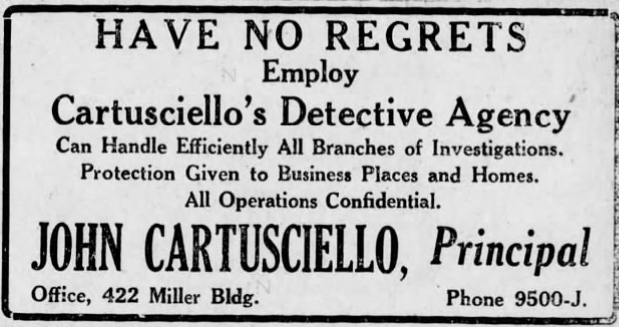
September 13, 1922
However, he wasn’t without his faults. He and his brother, the city Alderman, were arrested in 1929 for kidnapping a man. The man was wanted for spousal support in New Jersey, and he was in Scranton. The Cartuscilleo brothers detained the man and, against his will, transported him back to the New Jersey state line. There, they handed him over to the authorities. The two brothers would eventually be exonerated of the “crime.”
Detective Cartusciello passed away in Scranton in 1973 at the age of 89. His legacy in protecting the city lives on. Thank you, Detective Cartusciello!
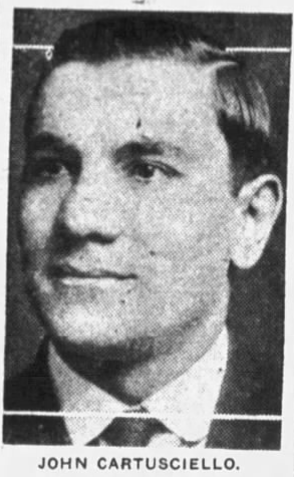
The Chinchilla counterfeit bust of 1915 dealt a major blow to the Black Hand’s operations in the Scranton area. It was due in large part to the relentless work of Detective John Cartusciello. Though many of the men involved would meet violent or tragic ends in the years following their imprisonment, their downfall highlighted the growing resolve of law enforcement to root out organized crime. Cartusciello’s success in dismantling the ring earned him widespread respect and a long career in public and private investigation. His efforts stand as a testament to a time when courage, persistence, and sharp instincts were the best weapons against the criminal underworld.
 Exploring historic crimes in NEPA
Leave a comment