A jealous husband, a morning struggle in the yard, and a revolver hanging on a nail upstairs.
Just after sunrise on May 22, 1893, in the Italian settlement on Spencer’s Hill in Dunmore, a woman screamed in a shared back garden on Center Street. A few minutes later, her husband came down from his room with a revolver, and a man who lived in the same house fell with a bullet wound above his right ear. He was dead within the hour, and by then the shooter was walking east through the woods toward the Elmhurst depot with a ticket to New York still to buy.
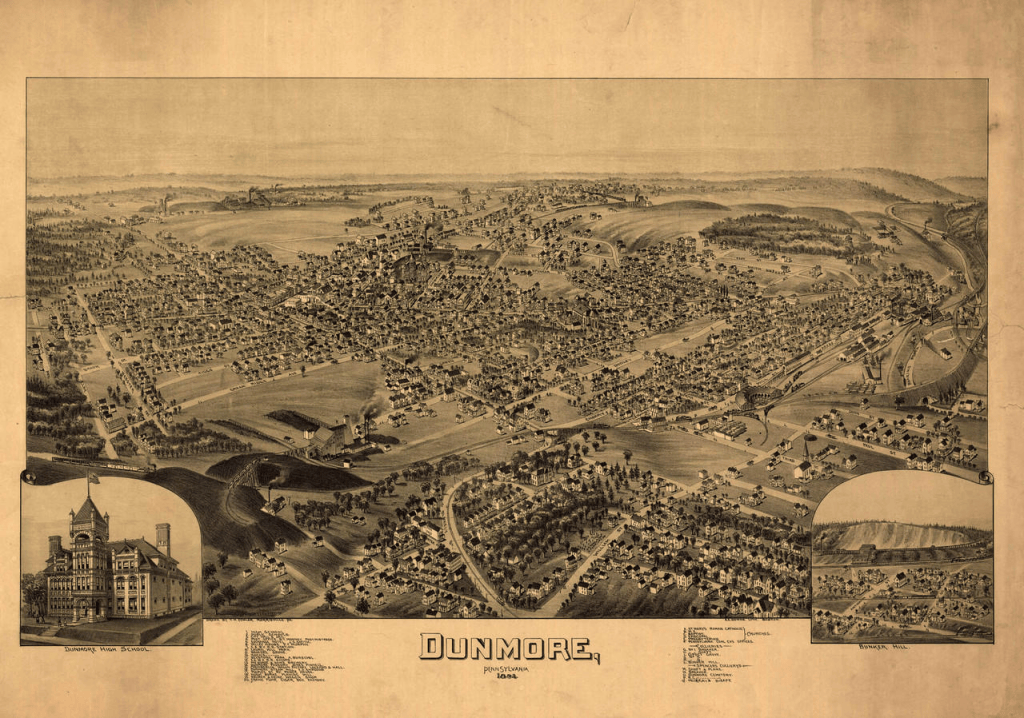
1892 Map of Dunmore, PA
This is the case of Commonwealth v. Agostino Nolè, aka Augustino Nolli. It’s a story about jealousy, a disputed self-defense claim, and a woman the papers could never settle on a name for, which, as you’ll see, is exactly where the genealogy research starts to get challenging.
One housekeeping note before we start. Almost nothing about this family was written down the same way twice. Names, ages, arrival dates, even the victim’s first name change from document to document, and in a few places they flatly contradict each other. I’ve made a judgment call every time and used the version the evidence best supports. Where I had to choose, I’ve said so. If you think I chose wrong, I’d like to hear it.
A Face Striped Like a Zebra
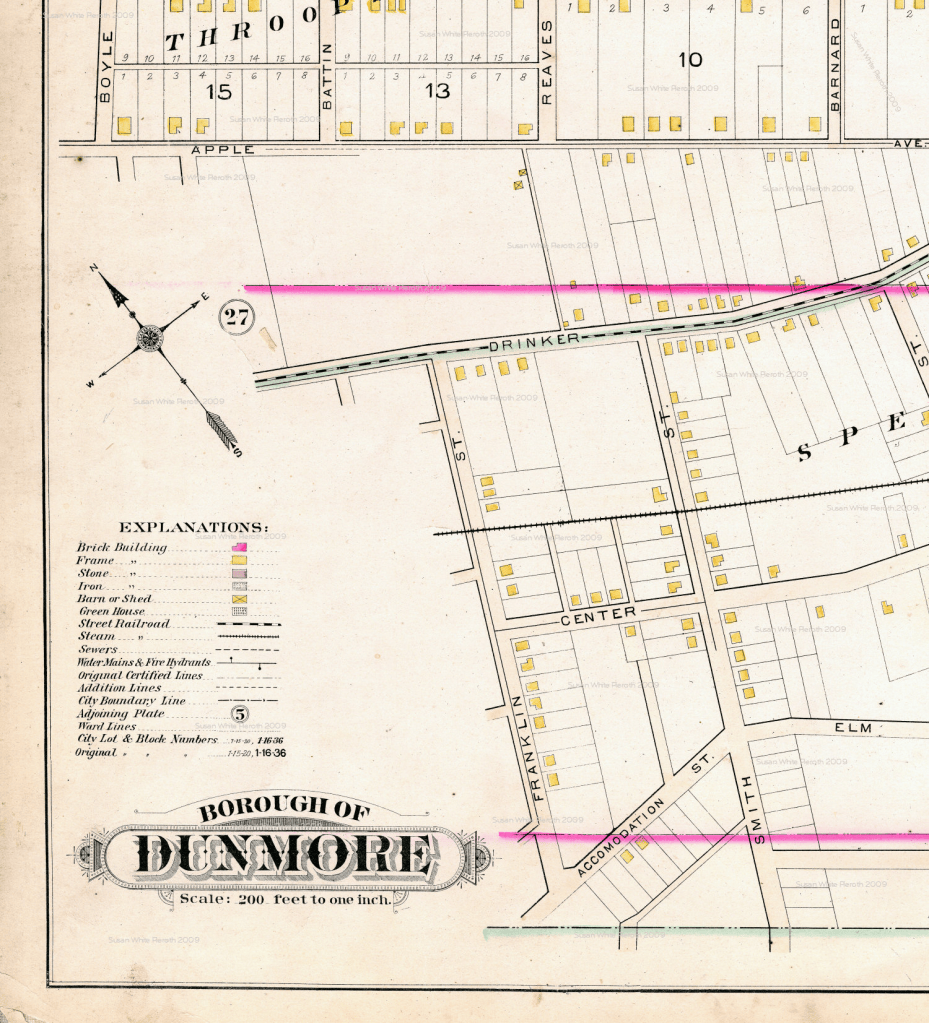
The facts, as the Scranton papers first told them, were simple enough. Augustino Nolli, 26, and Concordio Prignano, 37, were neighbors who lived in the same multi-family house in the 500 block of Center Street, between Smith and Franklin Streets. It’s about half a mile east of Dunmore Corners.
Center Street between Franklin and Smith. Nolli and Prignano lived in that block. Atlas of the Borough of Dunmore, 1898 Courtesy: Susan Carter White Pieroth
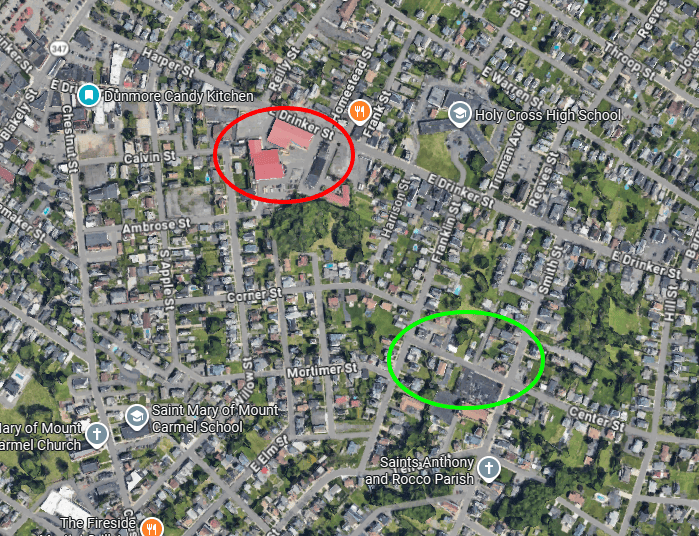
The neighborhood was there because of coal. Spencer’s Hill took its name from the Spencer family and the Spencer shaft, which sat a few blocks from the house. Many immigrants came to Dunmore to work in that shaft.
But not everyone who lived there worked in the mines. Both Nolli and Prignano worked for the Scranton Gas and Water Company. Between 1887 and 1893, the company built three new reservoirs to supply water to the valley, one in Elmhurst, one at Oak Run, and one at Williams Bridge on the Stafford Meadow Brook. It was back-breaking work, as hard as the mines, but above ground.
Spencer’s Hill, Dunmore. The Spencer shaft is in the red circle. Nolli and Prignano lived in the green circle. Google Maps
On May 22nd, Nolli’s wife went out to the outhouse in the early morning light. From there, testimony varied, with some saying Prignano was already in the outhouse when the woman was either pulled in or tried to enter on her own. Others said he followed her and, according to one account, “bumped against her, knocking her off the path.”
Regardless of how they collided, the two ended up fighting in the garden. She scratched his face so badly that the Tribune wrote that “his face was striped like a zebra’s body.” Some would claim that she knocked him down and beat him with a stick while he kicked to keep her off of him.
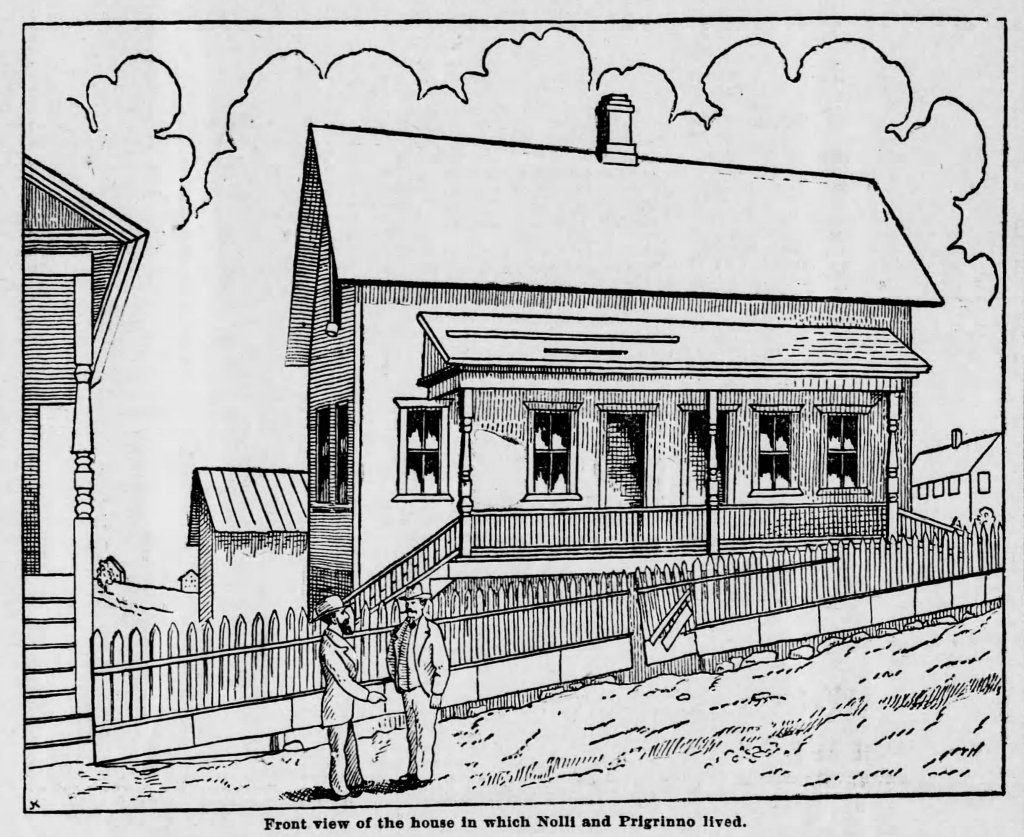
Front view of the house in which Nolli and Prignano lived. Scranton Republican, Oct 18, 1893
The trial never settled exactly where Nolli was standing when it began. The prosecution’s witnesses said he was on the porch. His wife would testify he came up from the basement, where she had left him after breakfast. Others testified that he was in the garden with an axe, presumably chopping wood for the stove, before the fight began.
Both sides did agree on what he did next. He went into the house and up the stairs, to a revolver hanging from a nail beside his bed. The Commonwealth’s evidence said he stopped at the window and lit his pipe. Then he came back down, walked into the garden, and fired one shot from six or seven steps away, striking Prignano above the right ear. The bullet lodged in his brain. A doctor reached him quickly, but he was dead within the hour.
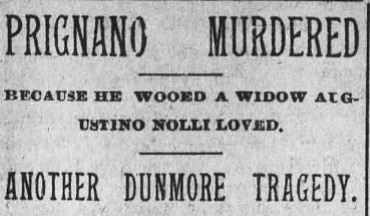
Because he wooed a widow Augustino Nolli loved. The Times-Tribune, May 23, 1893
Nolli calmly went out through the woods on foot, southeast along the railroad through Nay Aug. At the Elmhurst depot he bought a ticket to New York.
Elmhurst was not just some random place. His employer had been building a reservoir there since before he arrived in the country. He likely knew the area well.
“I Get Six Months”
Sheriff John Fahey received a tip that a man matching Nolli’s description had been seen passing through Nay Aug. Fahey notified Deputy Sheriff Bortree of Moscow to be on the lookout for Nolli and said the suspect could be headed his way.
Fahey eventually met up with Bortree in Moscow. They were told that the suspect may have purchased a ticket for a New York-bound train in Elmhurst. When the train pulled into Moscow, the two men boarded and searched for the fugitive. They found Nolli hiding under a seat in the train’s last car, the smoking car.
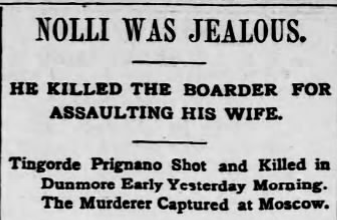
Scranton Republican, May 23, 1893 – Captured
He still had the revolver on him, a cheap, heavy .38 with five chambers, a spent shell in one of them. In his pockets, along with the gun, was ten dollars in cash. He did not resist.
And he talked. Before the day was over, he had made statements about the shooting to at least four men: Fahey, Bortree, Detective Shea, and Charles Daniels. The papers printed them in the broken English they were given. To Bortree: “All right. I go with you. He killa my wife, and I killa him. I get six months.” Elsewhere: “Him hit me wife, then him throw piece of coal at me. Won’t a man take care his wife.” The Republican reported that he laughed when the shooting was mentioned.
Those statements would be argued over for the next five months. Every one of them describes a man whose wife was being beaten.
Son of Canio
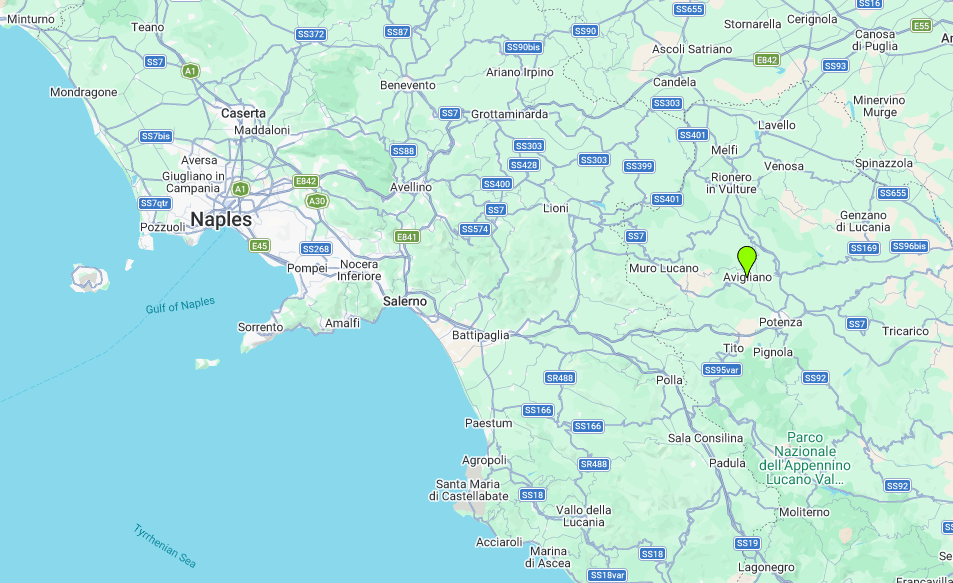
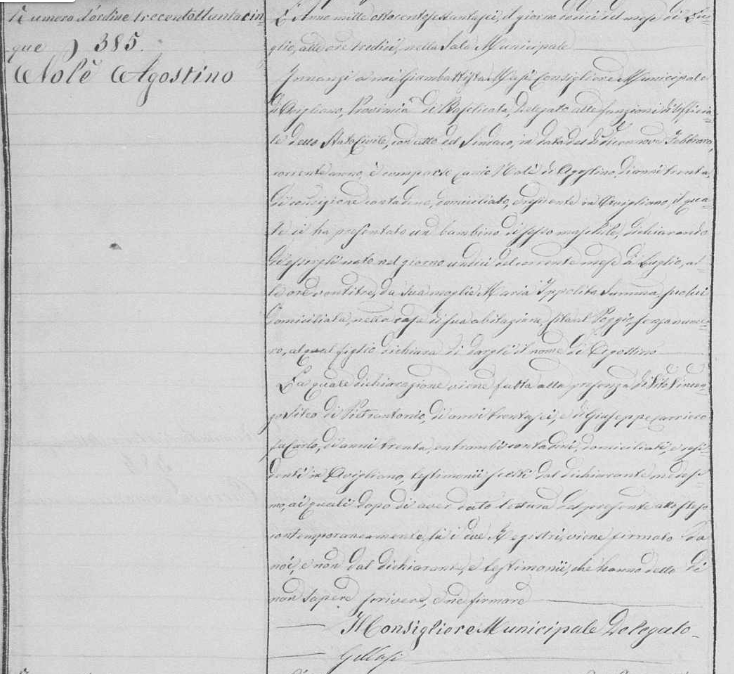
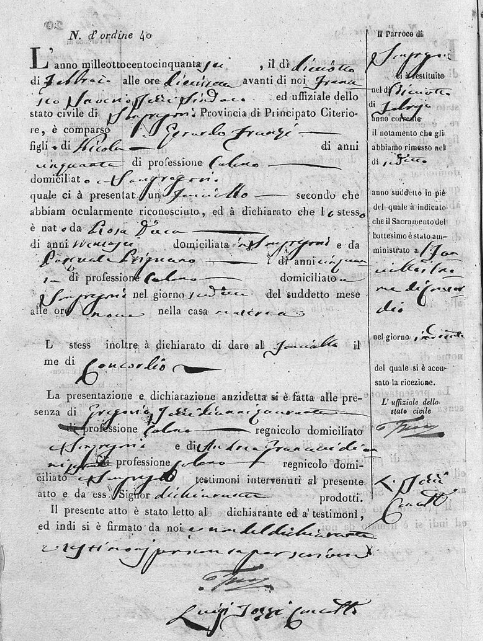
The man Fahey and Bortree pulled out from under a seat was born Agostino Nolè in Avigliano, in the province of Potenza, on July 11, 1866. He was the son of Canio Nolè and Maria Ippolita Summa. He was twenty-six, seven weeks short of his twenty-seventh birthday.
Avigliano, Potenza, Italy
The father’s name matters. Southern Italian families named the first son for the paternal grandfather, almost without exception, and Nolli’s first son, born just over seven months after the shooting, was also named Canio. The custom predicted a grandfather named Canio before I ever found the record. The Avigliano register says Canio Nolè. That is a small thing, but it means the naming convention can be trusted as evidence, and it will have to be, later in this story.
And note the mother: Summa. Remember that name for later.
Agostino Nolè. Born July 11, 1866, Avigliano, Potenza, Italy. Son of Canio Nolè and Maria Ippolita Summa.
He arrived in the United States on June 27, 1890, traveling with two other men bound for Scranton.
A. Nolè Passenger Manifest, June 27, 1890
His reputation in Dunmore, as the papers had it, was bad. He was described as violent and short-tempered, a man the Italians of Dunmore were said to fear, and the Republican passed along a story that he had been banished from Italy for running with the “banditti” in the south.
The Man Whose Name They Never Got Right
The newspapers printed several first names for the man who died in the garden, and eventually settled on “Concordia” Prignano. And it was wrong. Concordia is a woman’s name; the masculine form is Concordio, and it is rare even in Italy. That just goes to show how much the 1893 coverage can be trusted on Italian detail.
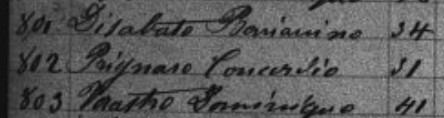
One document I found for him, an 1887 passenger manifest, reads Concordio Prignaro. I’ll use Concordio here.
Passenger Manifest, 1887 Concordio Prignaro
He had been in the United States for about six years when he was shot. The manifest gives his name and New York as his destination, and nothing else. His wife and several of his children were still in Italy, waiting for him to establish himself and send for them. This was normal for men in his position, and the reason the papers could report his death without ever printing his wife’s name.
His brother Gregorio had come over in 1888 and was living in Dunmore. Gregorio’s wife, Donata Maria Gerardi, arrived on July 12, 1899, and she was born in Avigliano. She did not travel alone: on the same manifest are Domenico Pace, Angelo Vito Pace, and Angelo’s wife, Rosa Maria Prignano, all of them from Avigliano. Parties like that came from the town the household came from. It isn’t proof of where Concordio was born, but it’s a clue pointing to Avigliano.
New York Passenger List, July 12, 1899
Remember the name Pace. The Commonwealth’s first witness at the trial, five months after the shooting, was a next-door neighbor named Caterina Pace.
And remember who Concordio was living with. That same witness would testify that he boarded with a man named Donato Mecca, in the same multi-family house as the Nollis. Thirty years later, Mecca’s death certificate would reveal his mother’s name: Angela Maria Nolè.
The Woman Between Them
The hardest part of writing this article was working out who Nolli’s wife actually was.
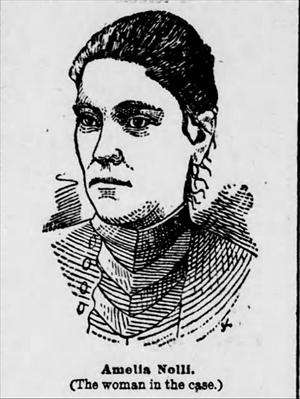
The Scranton papers called her Amelia, Carmina, Carmela, and Millie. Her surname moved around too. By the October trial, they had mostly settled on Amelia Nolli, and that’s the name most readers of the 1893 coverage would have known her by, so it’s the one I’ll use here. When I’m working with a record, I’ll use whatever name the record gives.
Amelia Nolli, as sketched for the Scranton papers during the October 1893 trial. The Tribune
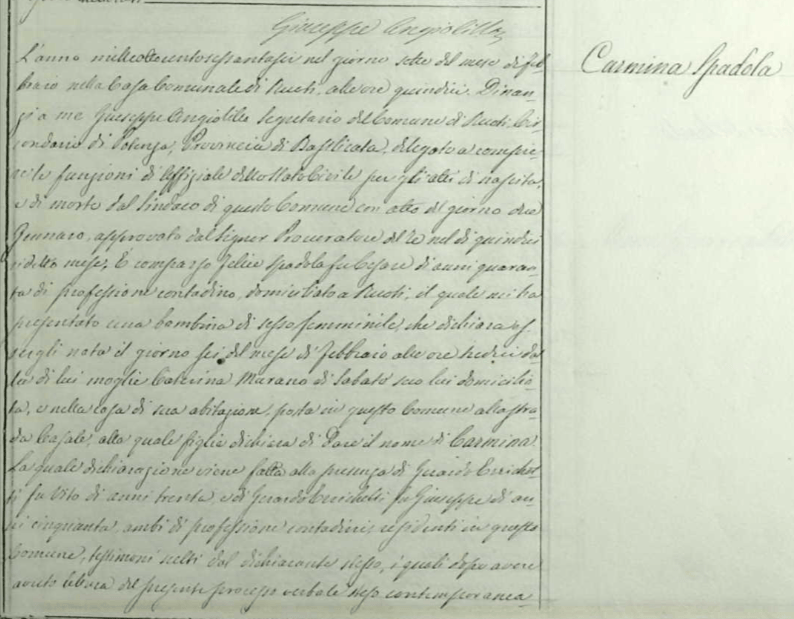
I believe Amelia was born Carmina Spadola on February 6, 1866, in Ruoti, in the province of Potenza. She was the daughter of Felice Spadola and Caterina Marano. Ruoti borders Avigliano, where Nolli was born.
Birth record of Carmina Spadola, February 6, 1866, Ruoti, Italy.
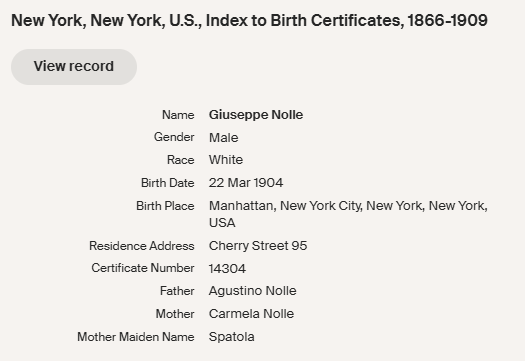
That identification rests mainly on a 1904 birth record. That’s when she and Nolli had a son in New York. That record names the mother as Carmela Spatola. Spatola and Spadola are the same surname, just spelled differently based on dialect, and a clerk taking a name by ear in New York. The discrepancy looks like a dead end, and it’s actually a match.
There is a second test available, and it caused me some concern.
In the “Son of Canio” section above, I said the southern Italian naming custom could be trusted as evidence, because it predicted Nolli’s father’s name before I found the record. The custom also says the second son takes the mother’s father’s name. If Amelia was Felice Spadola’s daughter, the second son should have been Felice.
He wasn’t. Nolli and Amelia’s second son, born in 1904, was Giuseppe.
Birth Record of Giuseppe Nolle, aka Nolli Ancestry.com
A Felice does arrive as Felice Antonio, but not until 1907, as the third son. So the name is in the family, just one slot late. I don’t know why they didn’t adhere to the custom.
Amelia had a complicated history of her own, long before Prignano moved into the house.
The Tribune described her as “a small, vivacious brunette.” The papers reported that she had been married two or three times, and that her second husband and father of her two children, a man named Rossi, had died in Dunmore before she moved in with Nolli. Another account said she had a living husband in New York.
That last one was true. And chasing it down settled who she was.
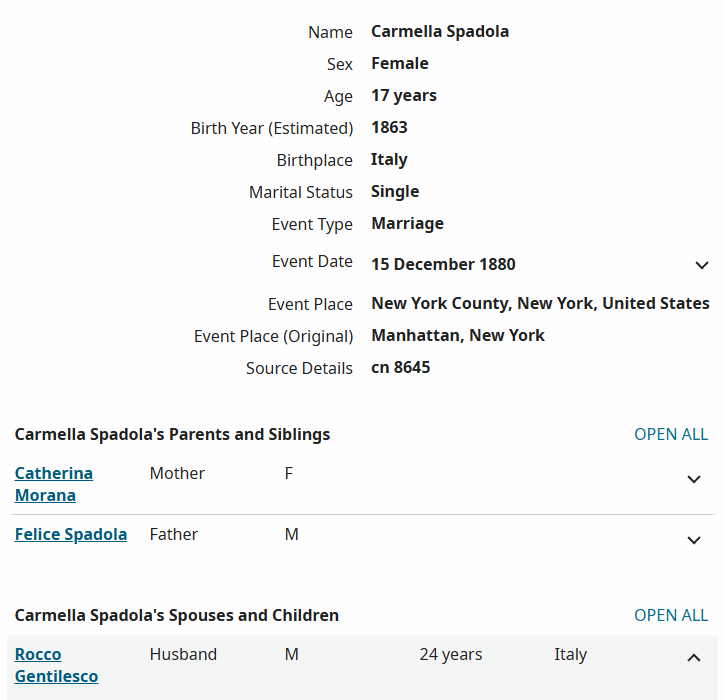
On December 15, 1880, in Manhattan, Carmella Spadola married Rocco Gentilesco. The certificate names her parents: Felice Spadola and Catherina Morana. The Ruoti birth register names the parents of the girl born there in February 1866 as Felice Spadola and Caterina Marano. Same father, same mother, one an Italian clerk’s spelling and one a New York clerk’s. Four thousand miles apart, and the same family.
New York, New York, Extracted Marriage Index Carmella Spadola and Rocco Gentilesco December 15, 1880
It also explains what the newspapers could never manage. If she was Carmela, then at home she was ‘Mela. An Irish deputy, a Scranton reporter, and a New York police clerk writing down what they heard would produce Amelia, Millie, Melina, Moltie. Those aren’t four names. They’re one name, heard four times by men who didn’t speak the language.
She and Rocco had two children. Both died young, before 1885. By 1890, Rocco was boarding in another man’s household, and Carmela had vanished from the New York records altogether.
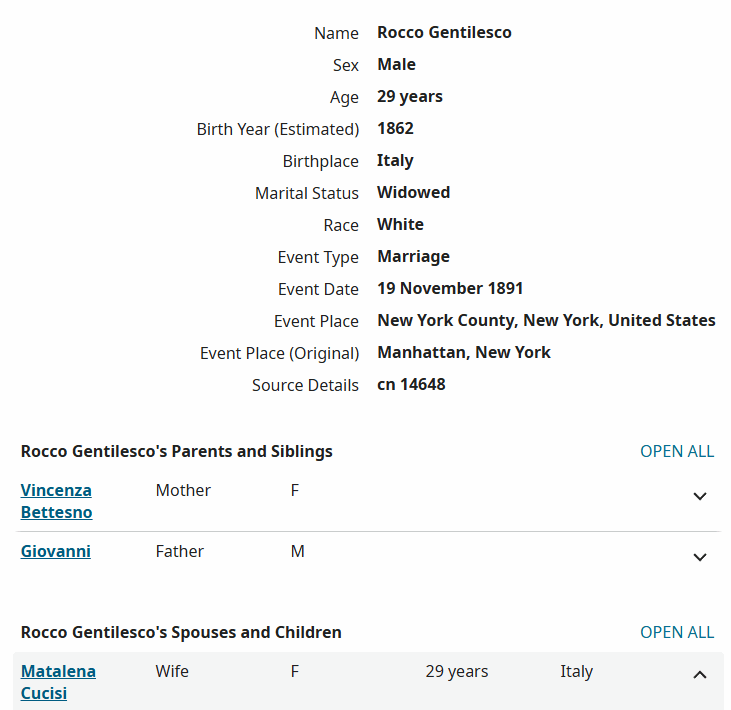
Then, on November 19, 1891, Rocco Gentilesco married again in Manhattan. The record lists him as a widower.
New York, New York, Extracted Marriage Index Rocco Gentilescoand Matalena Cucisi November 19, 1891
He was not. Amelia was living in Dunmore and still very much alive. Seven months after Rocco got married as a widower in Manhattan, Carmela allegedly married Augustino Nolli in Lackawanna County. Neither of them was free to do it.
That is the part I keep questioning. Two people, a hundred and thirty miles apart, in the same eight months, each declaring a dead marriage dead and starting over, because the alternative, divorce, was not available to immigrants without money. Whether Rocco believed she had died or simply found “widowed” the easier word to say, I can’t tell you. What’s certain is that she had disappeared thoroughly enough for him to proclaim it to a New York clerk.
It also explains something that still bothers me. I found no marriage record for Amelia and Rossi, and none for Amelia and Nolli. I had been treating that as a failure of research. It wasn’t. There was nothing to record.
And it means the Scranton papers, who could not spell her name the same way twice, got one thing exactly right. When they reported that Amelia Nolli had a living husband in New York, they were telling the truth.
Ten Days, and Two Children at Five Dollars a Week
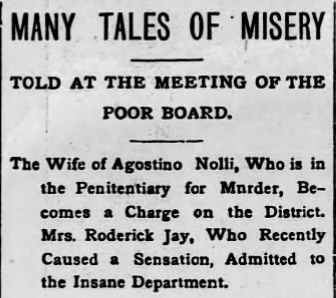
None of that stopped Gregorio Prignano, the victim’s brother, from telling the authorities that Amelia had been part of it. She was arrested as an accessory to the murder and taken to the county jail alongside Nolli.
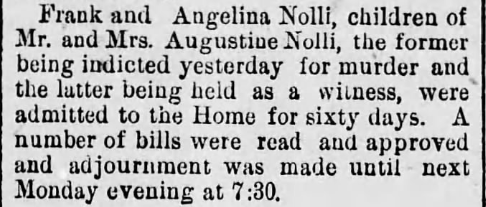
That left Frank, 2, and Angelina, 4, her children by Rossi, and Nolli’s stepchildren, without a guardian. For nearly two weeks, the neighbors kept them. Then, on June 3, the neighbors took them to the Poor Board.
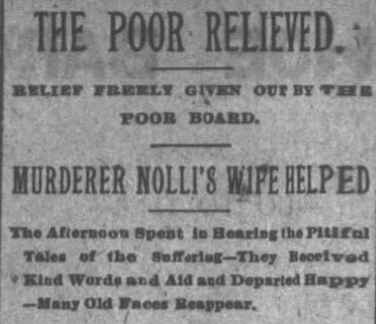
Nolli children admitted to the Poor Home. Scranton Republican, June 3, 1893
Patrick J. Murphy, the Poor Board Director for Dunmore, told the rest of the Board the children were too young for the Poor House to care for them. Another Italian woman, who wasn’t named by the newspapers, stepped up and offered to care for them for five dollars a week. Murphy and the Board agreed to hand the children over.
Hold on to that figure. Amelia will be petitioning the same board in November.
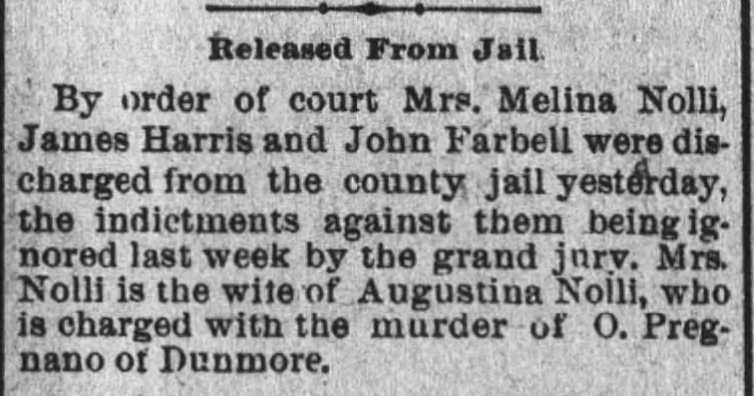
She didn’t lose the children for long. The grand jury refused to indict her, and she walked out of the county jail on June 13, about three weeks after she went in. Twelve men looked at everything the Commonwealth had against her, with the victim’s own brother pressing the case, and declined to charge her.
Released from Jail The Times, June 14, 1893
There’s a detail in the Poor Board notice worth noticing. The Republican called them “the Nolli children.” They were actually Rossi’s children by birth, and Amelia’s marriage to Nolli, as we now know and nobody in Dunmore did, does not appear to be formal. Everybody on Center Street treated that household as a family, but I can’t find a document that supports the marriage. That doesn’t mean they weren’t married, but just that I can’t find records to indicate that they were.
A Taste of That Knife
The coroner’s jury convened the afternoon of the killing, and the testimony taken there would haunt Nolli’s defense for the rest of the case.
Neighbors came in one after another and told the coroner they had seen Nolli in the preceding days showing off a homemade stiletto and that he had said somebody “would get a taste of that knife,” and that Prignano “had to die by his hands.” The jury’s verdict was blunt: premeditated murder.
The names of those witnesses, as they were printed, are worth a look. Vito Galasso, Frank Williams, Donato Zackinee, Joseph Gannio. Galasso is the only properly transcribed surname. The others have been Anglicized or spelled phonetically. I can’t find anything for these men, and that is the single biggest obstacle to reconstructing who actually lived in the house with Nolli and Prignano.
One thing to keep straight, because it matters later. What the coroner’s jury heard that afternoon and what the trial jury heard in October were not the same body of evidence. An inquest ran under looser rules. When two of these same witnesses tried to tell the stiletto story from the witness stand in October, the defense objected, and the judge shut them down both times.
Premeditation was the biggest question of the entire case. Was this a sudden act by a husband who came around a corner and found his wife on the ground? Or was it the end of something he had been promising to do for weeks?
The Prosecution Presents Its Case
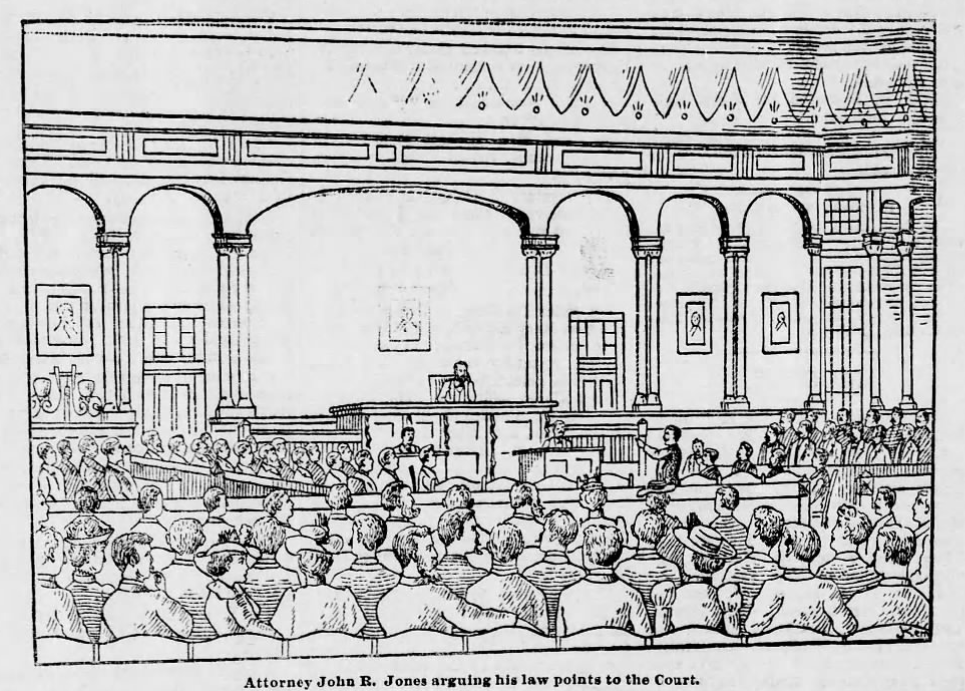
When the case finally reached Judge Gunster’s courtroom, it drew, by the Tribune’s account, one of the largest crowds ever. It was standing room only, aisles and corridors packed. Nolli was defended by attorneys Charles S. Olver and John R. Jones; the Commonwealth was represented by District Attorney John P. Kelly.
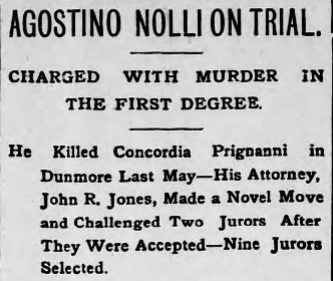
Agostino Nolli Trial Scranton Republican, October 17, 1893
During jury selection, several men were chosen, only to be “challenged” by the opposing side. Daniel Dunn of Jermyn stood out. He was against capital punishment and said he could not render a verdict for first-degree murder. He was released from the pool. After some delay, the jury panel was sworn in and seated.
Attorney John R. Jones arguing his law points to the court. The Tribune, October 20, 1893.
The Commonwealth’s first witness was a next-door neighbor named Caterina Pace.
Remember that name from the manifest: members of the Pace family came over from Avigliano in 1899 with Gregorio’s wife; one of them married to a Prignano. I cannot yet prove Caterina was related to them. But the Commonwealth opened its murder case with a woman who shared a surname with the victim’s extended family, and no one in that courtroom appears to have raised it.
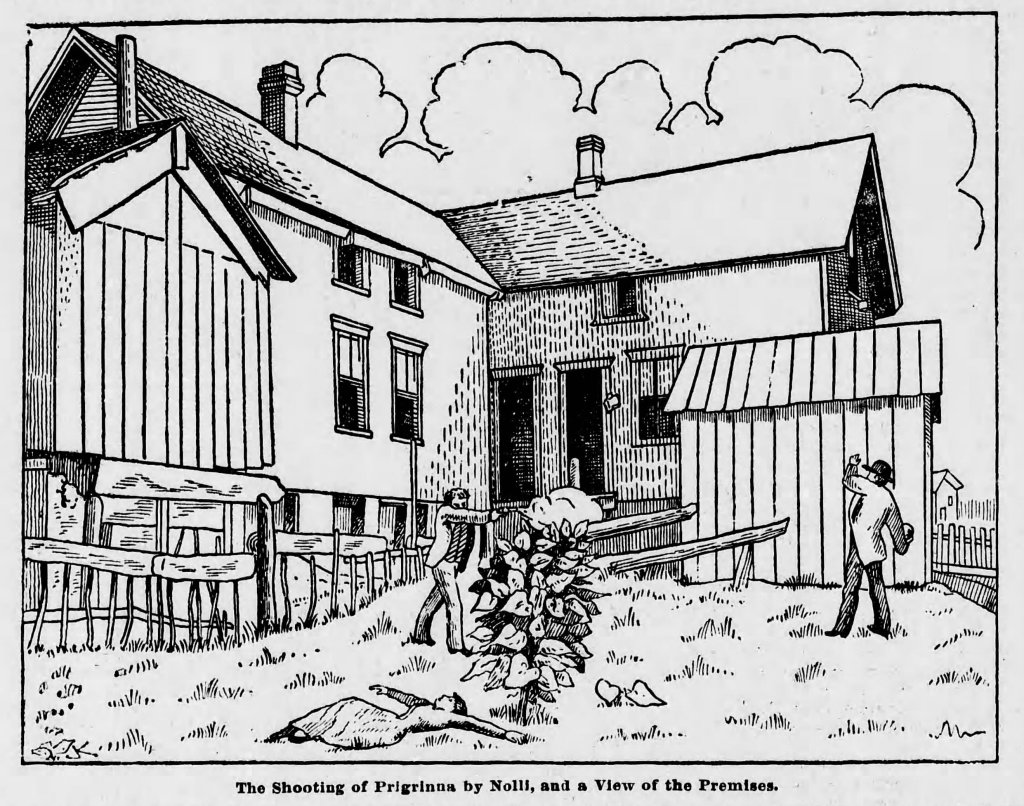
She testified that Prignano boarded with Donato Mecca, in the same multi-family house as the Nollis. She saw Prignano walking away from the outhouse as Amelia walked toward it. They brushed shoulders in the garden. Amelia shoved him to the ground and scratched his face, then took up a stick and beat him with it. Prignano kicked to get her off, got to his feet, threw her down, and kicked her once or twice. Then Nolli appeared and fired from six or seven steps away.
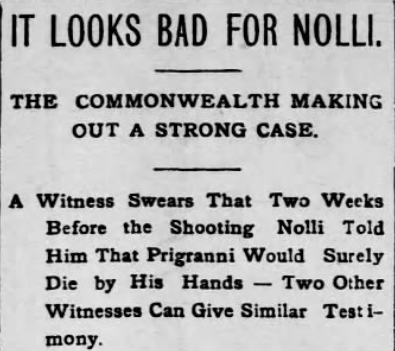
It looks bad for Nolli. Scranton Republican, October 18, 1893
The prosecution’s first witness seemed to have just handed the defense its case. Prignano threw Amelia to the ground and kicked her. Whatever else was in dispute, the state’s lead eyewitness said there was an assault.
Other witnesses corroborated her account and added another detail. Nolli came into the garden with an axe in one hand.
Then the Commonwealth tried to bring the stiletto into the case. A man who boarded with the Nollis testified that Nolli had made the knife with someone in mind. Jones objected, and Gunster sustained. Vito Galasso took the stand and said the same thing. Jones objected again, and Gunster sustained again. The story the coroner’s jury heard in May was not going to be heard by this jury.
The scene of the crime. Scranton Republican, October 17, 1893
Then Leonard Summa testified that he worked with Nolli, and the defendant told him, “As soon as I get $10 I will fix Prignano. If I hit him, I will hit him right,” referring to his stiletto.
Summa. The same surname as Nolli’s own mother, Maria Ippolita Summa of Avigliano. It is one of the most common names in that town, and it proves nothing on its own. But it is one more Avigliano name in a courtroom Nolli would shortly tell the jury was full of strangers from somewhere else.
Sheriff Fahey was sworn next. He described the arrest on the train at Moscow and the gun they took off him, “a cheap, heavy 38-calibre weapon with one empty shell.” He said Nolli talked freely about the shooting, that he had fired because Prignano was beating his wife, and that Prignano had thrown a piece of coal at him first.
And he read out the inventory of what Nolli was carrying. Ten dollars in cash.
Kelly would come back to that ten dollars in his closing, but not for the reason you might expect. He argued it was train fare. As far as I can tell from the coverage, nobody in that courtroom ever stood up and put Summa’s sentence next to Fahey’s inventory. That was the exact sum Nolli was said to be waiting for, in his pocket on the day he was captured on the train.
A Most Pitiable Sight
The Commonwealth finished on Wednesday morning. Deputy Bortree told the jury what Nolli had said when he was taken off the train: “All right. I go with you. He killa my wife, and I killa him. I get six months.”
With that, the prosecution rested.
Olver opened for the defense that afternoon with one goal: to make Prignano the aggressor. His first three witnesses had all been part of the coroner’s inquest back in May, and all three testified that the dead man’s face had been covered in fresh scratches. In doing so, he used the Commonwealth’s process to his advantage.
Other witnesses testified that the two men knew each other, worked together, got along, and there had never been trouble between them. That didn’t align with what the prosecution’s witnesses had sworn to the day before.
Then Olver called Amelia.
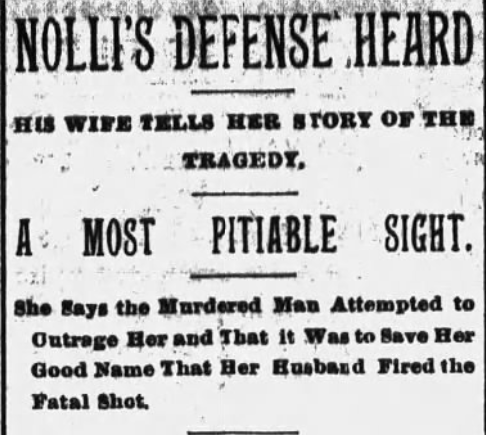
The Tribune called her “a most pitiable sight.” She was neatly dressed in brown, her two small children beside her, six months pregnant with Nolli’s child. It was true, and it was also staged by her husband’s attorneys.
Nolli’s defense heard. The Times, October 19, 1893
Her account began at five in the morning. She had gone down to the basement to make breakfast. Afterward she went out to the outhouse, found the door shut, pushed it open, and saw Prignano inside. He grabbed her and tried to pull her in. She broke free and ran.
Prignano chased after her, caught her, threw her to the ground, and pressed her face into the dirt. She said he choked her, and that he tried to “outrage” her, the word the papers used for rape. She said he tried to drag her back toward the outhouse, and that she kicked and screamed and clawed at his face until he let go.
She began to cry on the stand, and Gunster stopped the proceedings until she could continue. This was the first time rape had been mentioned in the attack.
When she could, she said she picked up a stick and went after him with it, and that he came at her again. And that was when her husband appeared from the basement. Prignano, she said, took up chunks of coal and threw them at him, shouting “I will fix you too!” Nolli went back into the house, came out with the revolver, and shot him.
She claimed the stiletto was a knife he used for cutting dandelions. She had never heard him threaten anyone.
Now compare her account to Caterina Pace’s, because they are similar, but very different.
Both women described a scratched face. Both described a stick. Both put Prignano on the ground, and both put Amelia on the ground. Both ended with Nolli walking into the garden and firing from a few steps away. The two accounts differ in one respect: the order. Pace said Amelia knocked him down first, and throwing her down was what came after. Amelia had it the other way around.
That was the whole case. Not a dispute about what happened, but about the sequence, and therefore about who began it.
Two things about her testimony are worth holding onto.
First, it made her husband’s position worse in one respect. She said Nolli was in the basement when it started. The revolver hung on a nail beside the bed on the floor above. That is a longer trip than the prosecution described, and Judge Gunster would eventually tell the jury that the trip itself was evidence that Nolli had time to think.
The second cuts the other way, and it is the fairest thing I can say about Nolli’s defense. Kelly would argue that the whole story was manufactured in a jail cell. But two pieces of it were on the record within hours of the shooting, in Nolli’s own statements to four different men: that Prignano was beating his wife, and that Prignano had thrown a piece of coal at him. The coal is a strange, small, specific thing to invent, and it was there from the first afternoon.
Only one element of the defense was not there in May. The rape. And that was the piece Kelly would attack, and the piece Gunster would instruct the jury on.
An Inoffensive-Looking Man
Nolli was sworn on Thursday morning. The Republican, which five months earlier had passed along the story that he was a banished thief feared by the Italians of Dunmore, now told its readers he was “an inoffensive-looking man” who had “anything but the appearance of a bloodthirsty criminal.” Both descriptions ran in the same paper, about the same man, twenty-one weeks apart.
He testified in his own broken English, and the papers took him down almost word for word. You almost can hear him.
“I take revolver from off the nail near the bed… I don’t know what my woman is going to do then… I shoot Concordio Prignano.”
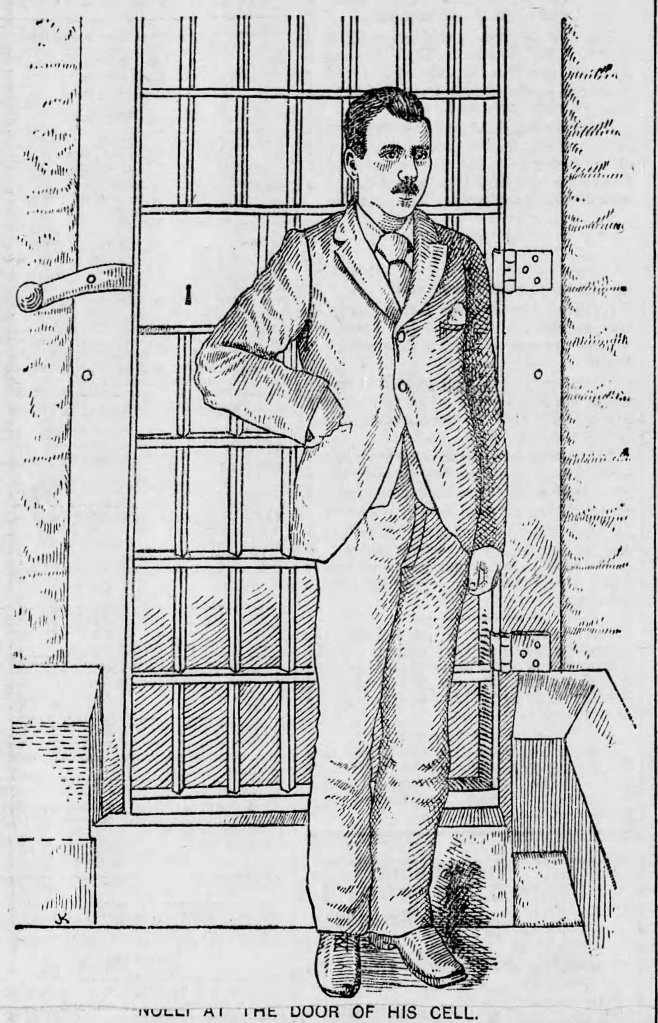
Augustino Nolli at his jail cell Scranton Republican, October 16, 1893
He testified, under oath, that he and Amelia had married in June 1892, that her two children were from an earlier marriage, and that she was pregnant with his child.
Rocco Gentilesco was alive in Manhattan the entire time, and remarried the previous November. Whether Amelia ever told her husband that, or whether he went to Eastern State believing himself a married man, is one of the things I will never be able to answer.
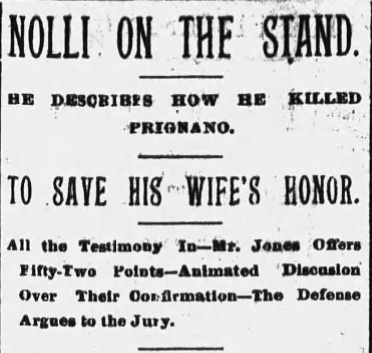
Nolli on the stand. The Times, October 20, 1893
Then he made the claim that every Italian who had taken the stand against him came from a different part of Italy, that all of them were friends of Prignano’s, and that this was why he ran for the Elmhurst depot, not because he was guilty.
Nolli was born in Avigliano. His mother was a Summa, and a Summa testified against him. Gregorio Prignano’s wife was born in Avigliano, and the party she came to American with in 1899 was Aviglianese, including a Pace, and the Commonwealth’s first witness was a Pace. And Concordio Prignano was not lodging with strangers either. He was boarding with Donato Mecca, whose mother, thirty years later, would be recorded on a Pennsylvania death certificate as Angela Maria Nolè. It seemed they were all related, whether by blood or region.
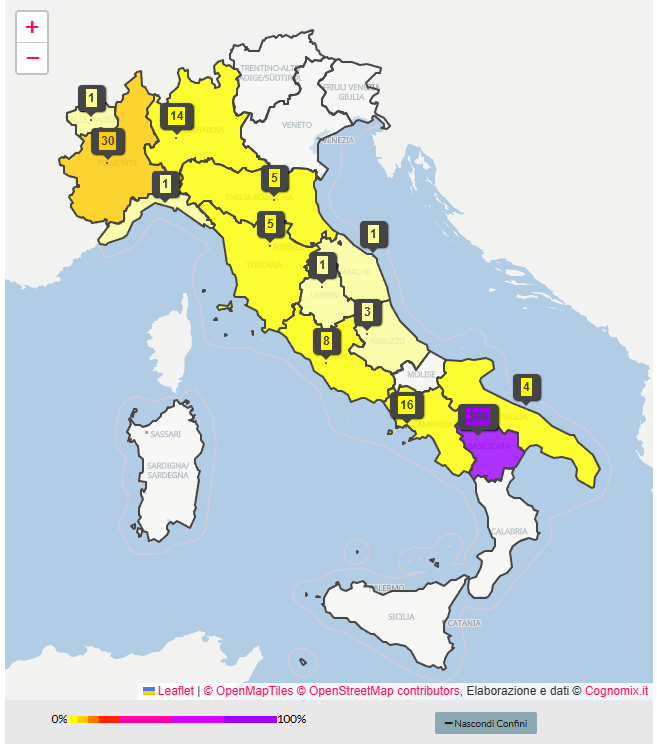
There are about three hundred and ninety-five Nolè families in all of Italy today. Three hundred and six of them are in Basilicata, clustered around Potenza, Avigliano, Filiano, and Ruoti. In a town the size of Avigliano the Nolè households would have numbered a handful, and they would have been related to one another.
That was not a courtroom full of strangers. That was one Basilicata town, transplanted onto a Dunmore street, and Nolli was inside it, not outside it. The man he shot had been sleeping under a roof that belonged to his own extended family.
Which leaves a better question than the one the trial answered. The jury had to decide whether Nolli was lying about the witnesses. He was. But nobody in that courtroom ever asked the thing I keep coming back to: why did his own people, his neighbors, his countrymen, in some cases very probably his extended family, line up one after another to testify against him?
With that, the defense rested.
Fifty-One Points
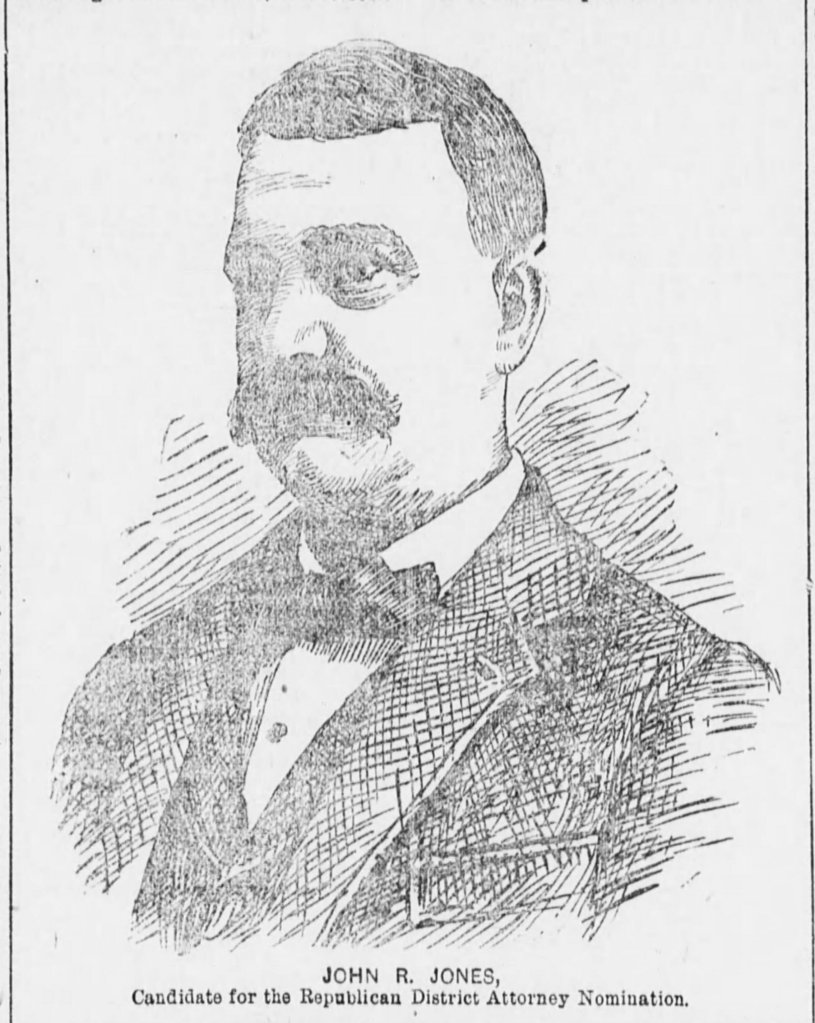
Jones closed for the defense that same Thursday afternoon, and the Tribune called it one of the most forcible arguments ever heard in the courthouse. It ran three hours, and it was built on fifty-one separate points of law submitted to the court, fifty-two, by one paper’s count, each one a request that Judge Gunster instruct the jury in a particular way.
Attorney John Jones (from his run for District Attorney) The Tribune, July 6, 1894
Most of them were routine. Two were not, and they decided the case.
Point 40 asked the court to tell the jury there was no presumption of malice. In Pennsylvania in 1893 that was an assault on settled law: under Commonwealth v. Drum, an intentional killing with a deadly weapon was presumed malicious, and the burden fell on the defendant to show provocation. Jones was asking the judge to look the other way.
Point 41 asked the court to tell the jury that going upstairs for the revolver did not break the heat of passion. This was the harder ask and Jones knew it. Hear a scream, see the assault, walk into the house, climb the stairs, take a gun off a nail, come back down, fire. That is the sequence courts have always used to find that a man had time to cool. Jones needed the jury instructed that it wasn’t.
Some other interesting points were established. In Point 39, Jones asked the court to instruct the jury on a husband’s “legal and religious duty” to defend his wife. Point 37 went further still, arguing that under the law of the day a wife’s person was legally merged into her husband’s, so defending her was defending himself.
That was the unwritten law of the 1890s, submitted in writing, as a request for a jury charge. It is also what his closing statement came down to:
“There is no greater blow you can strike to a civil community. There is no greater blow you can strike to virtue than to convict this man for protecting his wife.” – Attorney John Jones.
John R. Jones stood in the courtroom and asked twelve men to honor the sacred duty of a husband, on behalf of a man who, as neither he nor Gunster nor Kelly nor possibly Nolli himself had any way of knowing, was not legally married to the woman at the center of the dispute.
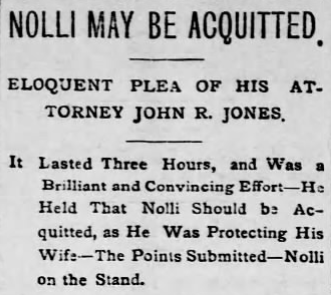
It worked, at least for a night. Two days earlier the Republican had run the headline “It looks bad for Nolli.” On the morning of October 20 the same paper told its readers that Nolli may be acquitted.
Nolli may be acquitted. Scranton Republican, October 20, 1893
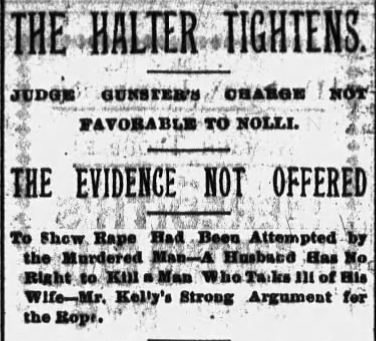
The Halter Tightens
Kelly had begun his closing on Thursday. He picked it up again at ten on Friday morning and spoke until twenty minutes to one, with one recess in the middle because a juror named Van Wert had been taken ill.
He started somewhere unexpected, with who was not in the room. There were no relatives of the dead man at the Commonwealth’s table demanding a life for a life. Prignano’s wife and children were four thousand miles away in Italy. This case, Kelly told the jury, was being tried calmly, by the officers of the Commonwealth under their oaths, and not by an aggrieved family.
Then he went after the defense. Jones and Olver had spent four days suggesting that the Italians who testified for the Commonwealth had conspired against Nolli. Kelly answered with the old rule: false in one thing, false in all. If the jury believed those witnesses had lied about one part, they should throw it all out.
His argument for premeditation came from what Nolli did after the shot rather than before it. A man in terror for his wife’s life does not, Kelly said, calmly set his axe back in the woodshed, put his revolver in his pocket, and walk away down the hill. Those were the movements of a man finishing a job he set out to do.
He held up the ten dollars. Nolli had been dressed in his work clothes and carrying ten dollars in cash, and Kelly told the jury what that meant: a boarder might carry money like that, but a man with a family does not. The money was train fare, and it was in his pocket before the shot was fired.
Kelly does not appear to have mentioned the other place that figure turns up. Leonard Summa had testified that Nolli told him, “As soon as I get $10 I will fix Prignano.” I haven’t found any report of anyone in that courtroom correlating those two facts.
Then he produced the knife. Amelia had told the jury the day before that it was something her husband used for cutting dandelions. Kelly held it up and said: “That knife was made for one purpose and one only. It was not made for cutting dandelions.”
The Halter Tightens The Times, October 21, 1893
And then he went at the heart of the defense. It was broad daylight. It was the open yard of a crowded boarding house with a dozen people within earshot. No man of sound mind, Kelly argued, attempts a rape under those conditions.
On top of that, nobody had said a word about a rape when it might have counted. “Where was the story of the outrage when he was arrested? Where was that crime then?” Nolli had talked to Sheriff Fahey, to Deputy Bortree, to Detective Shea, and to Charles Daniels on the day of the shooting, and to all four of them he had said his wife was being beaten. It was only later, Kelly told the jury, when he found the rope tightening about his neck, that this man conjured up an imaginary offense to save it.
He brought up the “six months” too. Kelly said no man would ever say he would get six months for saving his wife from being “outraged” when he knows the law is on his side.
He finished on what the whole case had been quietly fought over for four days. Nolli’s defense had painted Prignano as a bad man bound for a disgraced grave. Kelly told the jury that the killing of Concordio Prignano was the same offense in the eyes of the law as the killing of the most prominent men in the land.
He sat down at 12:40. Judge Gunster began his charge.
Not Favorable to Nolli
Gunster began his charge just after Kelly sat down, and had to stop almost immediately. Van Wert was ill again. Court recessed until two.
When he resumed, he began where Kelly had ended, on the question of who the law was for. The defendant’s nationality, he told the jury, should not weigh either against the prisoner or in his favor. “The law does not set up one standard by which one man shall be tried and another standard for others to be gauged.”
Both the prosecution and the judge, on the same afternoon, made it a point to tell the jury that an Italian laborer’s life counted the same as anyone’s.
Then he turned to the evidence, and to Jones’s fifty-one points.
Point 40 had asked him to instruct the jury that there was no presumption of malice. What Gunster told them was that “the presumption of the law is that the shooting was done maliciously.” He added, “If you find that this was so, your verdict should be murder in the first degree.”
On the defense theory, he was equally direct. “An attempt to ravish would be sufficient [to defend], but there was no evidence of such a thing.” This required the jury to determine whether Mrs. Nolli was in actual danger or if it was imaginary. If she was not in danger of life or limb, then Nolli had no right to fire, because an ordinary assault did not justify a killing.
If Nolli killed Prignano because the man had talked about his wife, Gunster said, then he should be convicted of murder in the first degree, because no man has a right to take a life over talk.
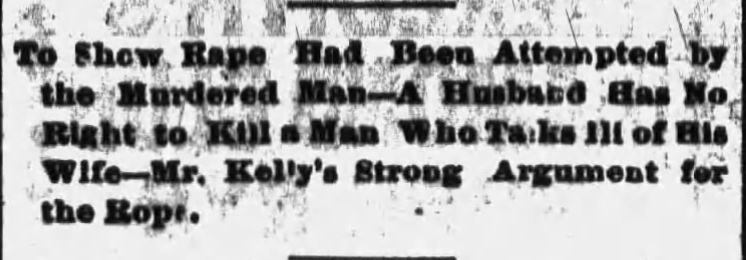
A husband has no right to kill a man who talks ill of his wife. Scranton Times, October 21, 1893
And he made a distinction that was at the heart of the self-defense claim. A man who truly believes his wife is in mortal danger might run to her. A man who goes upstairs to fetch a gun has done something different.
Which brought him to Point 41, the instruction Jones needed most, that going up those stairs did not break the heat of passion. Gunster told the jury the opposite. He instructed them that they had evidence that he had sufficient time to think of what he was doing from the fact that he went upstairs, and then came down and shot the man. He had gone in, climbed the stairs, looked out the window, lit his pipe, come back down, walked out, and fired. That, the judge contended, was not heat of passion.
The direction was not in doubt. Gunster had laid out two paths. If the jury found malice, the verdict was murder in the first degree. If they found a man acting in a frenzy of passion, the verdict was manslaughter. He had told them the presumption was malice, that there was no evidence of an attempted rape, and that the trip upstairs was evidence of a man with time to think.
The case went to the jury at a quarter past three on Friday afternoon.
They did not come back that day. Gunster adjourned the court, and twelve men argued about the fate of Augustino Nolli through the night.
Fifteen Long Years
On the morning of Saturday, October 21, 1893, the jury had their verdict.
Second-degree murder.
The verdict is in. Harrisburg Telegraph, October 21, 1893
It was not what Gunster had pointed them toward, and it wasn’t either of the two roads he had laid out. He had told them that if they found malice, the verdict was murder in the first degree, and if they found a frenzy of passion, the verdict was manslaughter. They found something in between, and it’s worth looking at closely, because those twelve men had picked their way through Jones’s fifty-one points and came out with a split decision.
Point 40 had asked the court to tell them there was no presumption of malice. Gunster charged malice, and the jury agreed. That is why this was not manslaughter.
Point 41 had asked the court to tell them that going upstairs for the revolver did not break the heat of passion. Gunster charged that it did, that the trip up those stairs was evidence of a man with time to think. The jury disagreed with the judge. That is why this was not murder in the first degree.
Second degree is murder with malice but without deliberation. The verdict is the two points, one each way.
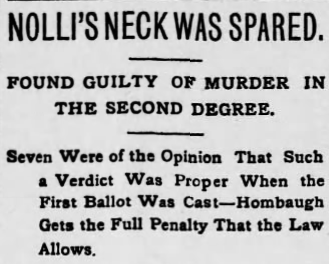
Nolli’s Neck Was Spared Scranton Republican, October 23, 1893
There is one more thing about that jury. During selection, Daniel Dunn of Jermyn had been struck from the panel because he opposed capital punishment and said he could not return a verdict of first-degree murder. The Commonwealth got him removed. It didn’t matter. The twelve men who replaced him refused to convict Nolli of first-degree murder anyway.
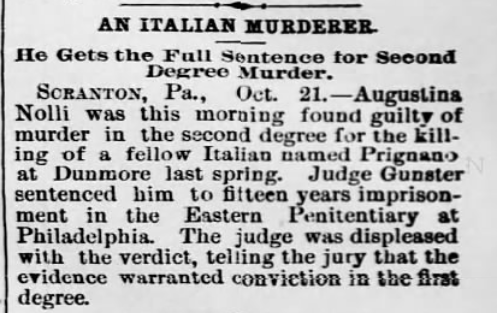
Judge Gunster issued the sentence immediately after. Fifteen years at Eastern State Penitentiary in Philadelphia. It was reported as the harshest second-degree sentence ever handed down in Lackawanna County, which had been a county for fifteen years at that point.
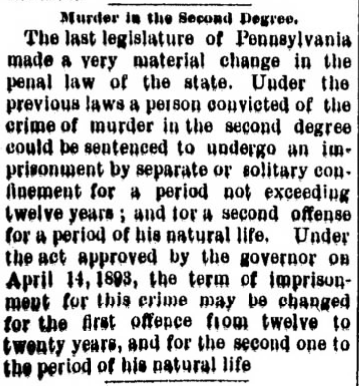
And Nolli had very bad timing. The papers reported that he was the first defendant in Lackawanna County affected by a change in the state’s penal law. Under the previous statute, a man convicted of second-degree murder could be sentenced to no more than twelve years. Under an act approved by the governor on April 14, 1893, the term for a first offense was twelve to twenty years. Prignano was killed on May 22. The law was five weeks old. Had Nolli fired that revolver in March, the most Gunster could have given him was twelve years.
Tyrone Daily Herald November 20, 1893
The papers praised Jones and Olver. It was reported that this was the first significant case for either young lawyer. They had done what they were hired to do. The Commonwealth had asked for death, and the jury had refused.
What they did not do was appeal. Fifty-one points of law is how a defense builds a record for a higher court, and as far as I can find, none of it was ever used.
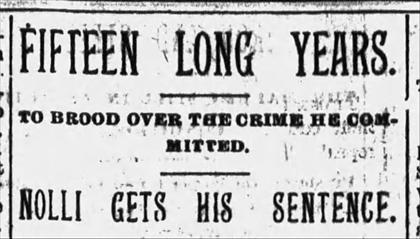
Fifteen Long Years The Times-Tribune, October 23, 1893
On October 25, 1893, Sheriff Fahey put Nolli on a train to Eastern State Penitentiary.
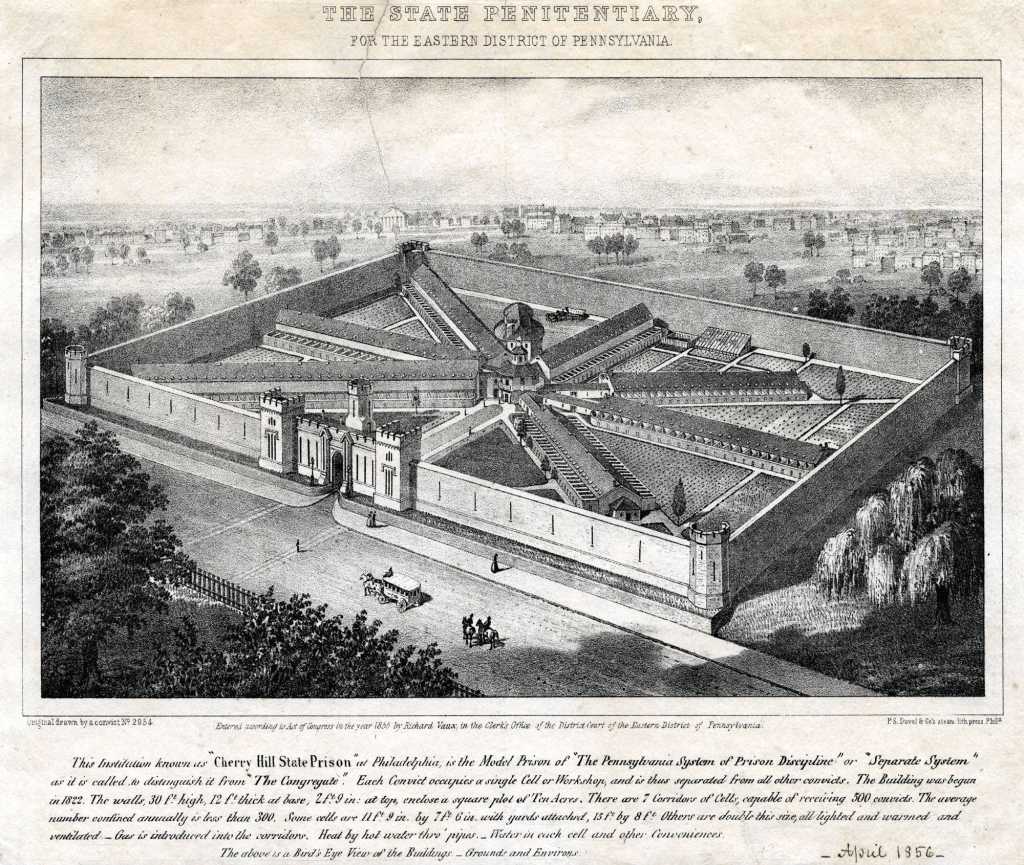
Eastern State Penitentiary
A Group of Criminals
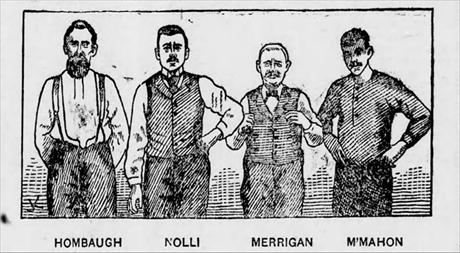
Two weeks after Nolli went to Philadelphia, the Tribune ran a feature called “A Group of Criminals,” four portraits of Lackawanna County men lately sent to prison. Peter Hombaugh, who burned the Elm Park church. John Merrigan, a barn burner. Augustino Nolli. And Barney McMahon.
“A Group of Criminals” Hombaugh, Nolli, Merrigan, and McMahon, four Lackawanna County men profiled together after being sent to prison. The Tribune, November 6, 1893
The piece noted in passing that Nolli’s sentence “was thought severe by many,” and gave the reason: the jury itself had found the killing was not premeditated.
It is McMahon, though, who I have not been able to stop thinking about.
Eight weeks before Prignano was shot, Barney McMahon beat his pregnant wife in the Providence section of Scranton. She died. So did the child. The Tribune headlined it “Crime of a Brute” and called it what appeared to be a double murder, and he was held on a charge of homicide and possibly infanticide.
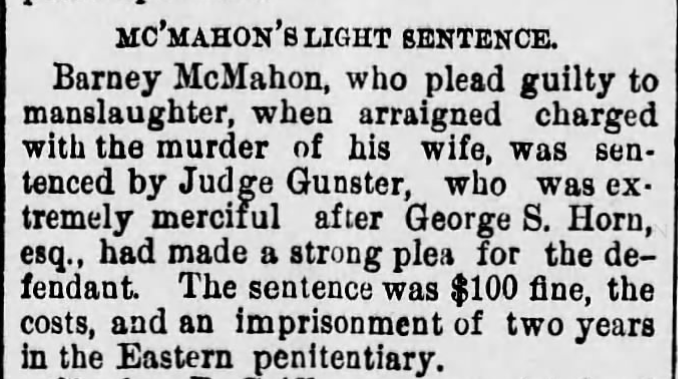
He pleaded guilty to manslaughter. Judge Gunster sentenced him to a hundred-dollar fine, court costs, and two years in the Eastern State penitentiary.
On the morning of October 23, 1893, the Scranton Republican printed both sentences. Over one, it ran the headline “Nolli’s Neck Was Spared.” Over the other, “McMahon’s Light Sentence.”
Two years for killing your wife and unborn child, from the same judge who two days earlier had given Augustino Nolli fifteen for killing a man who was allegedly attacking his wife.
The paper noticed. The Republican pointed out that Gunster had been “extremely merciful.” Three weeks later the Tribune wrote that Nolli’s sentence “was thought severe by many.”
McMahon’s light sentence. Tribune, October 23, 1893
I understand that McMahon’s plea of manslaughter is not the same as a conviction of second-degree murder. But just days before those headlines ran, in that same courthouse, John P. Kelly had told a jury that the death of Concordio Prignano was the same offense in the eyes of the law as the death of the most prominent men in the land. And Judge Gunster instructed them that the law does not establish one standard by which one man shall be tried and another for others to be gauged.
They were right about what the law said. What they did is another story.
The Woman Left Behind
Augustino went to Philadelphia on October 25. Three weeks later, Amelia stood before the Lackawanna County poor board and asked for help.
She wanted money to get to Philadelphia herself. She told the board she had friends there.
Eastern State Penitentiary is in Philadelphia, and her husband had been in it for twenty-four days. I can’t prove that was what she meant, and it is possible she really did have friends in the city. But she was asking the county board to send her to the place they had just sent him.
The board refused. What it offered instead was admission to the poor house. She told them she would rather starve, and she cried as she left the room.
Amelia asks for assistance. Scranton Republican, November 18, 1893
She was eight months pregnant when she pled her case. Canio Nolli was born on January 1, 1894.
She came back in March with a newborn and two small children, and this time the board granted her $3 a month for three months. In June, they gave her $5 a month for three more months.
If you recall, the same board had seen these children before. Just last summer, when Amelia was in the county jail, the board agreed to pay an Italian woman $5 a week to keep Frank and Angelina. That is about $20 a month. The county paid a stranger $20 a month to keep her children, and paid her $3 to keep them herself.
Granted $3 per month for three months The Times, March 3, 1894
By 1895, the Scranton city directory lists a Mille Nolli at 213 Willow Street in Dunmore, a couple of blocks from the house on Center Street.
Scranton City Directory, 1895
“Mille'” is what you would expect someone to write down if the woman at the door said ‘Mela.
Note what else that entry says. She was still in Dunmore, still on the same hill, still using the surname of a man serving fifteen years for shooting a neighbor in a garden two blocks away.
An August Nolli appears at the same Willow Street address in the 1902 directory, which made it look like he came home early. He didn’t. Directories were canvassed the year before they were printed, so the 1902 book reflects roughly 1901, and Nolli was not discharged from Eastern State until February 1903. The likeliest explanation is the simplest one: the household was listed under the husband’s name because that is how households were listed, and the woman answering the door was Amelia.
Scranton City Directory, 1902
Nine Years and Four Months
In 1900, seven years after the trial, Charles Olver went to Harrisburg and asked the state Board of Pardons to release his client. Nolli, he argued, had already been sufficiently punished. The board took the petition under advisement, and nothing came of it.
Olver’s co-counsel, John R. Jones, ran for district attorney just months after the trial. Seven years later, Olver was still filing papers for an Italian laborer in Eastern State, a man who couldn’t pay him.
What finally opened the gate was not Olver.
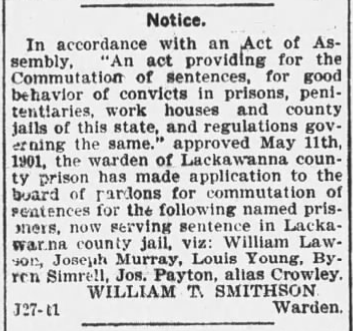
On May 11, 1901, while Nolli was eight years into his sentence, the legislature approved “An act providing for the Commutation of sentences, for good behavior of convicts in prisons, penitentiaries, work houses and county jails of this state.” Under it, the warden could apply to the Board of Pardons on a prisoner’s behalf, and the applications were published as public notices in the newspapers.
Legal notice from the warden of the Lackawanna County prison, listing prisoners recommended for commutation under the Act of May 11, 1901. The Times, January 27, 1902
So Charles Olver had gone to the Board of Pardons in 1900 and struck out. Then a law was passed that let the warden ask instead, as a matter of routine, and the answer came back differently. Nothing about Augustino Nolli or his case had changed. What changed was who was permitted to make the request.
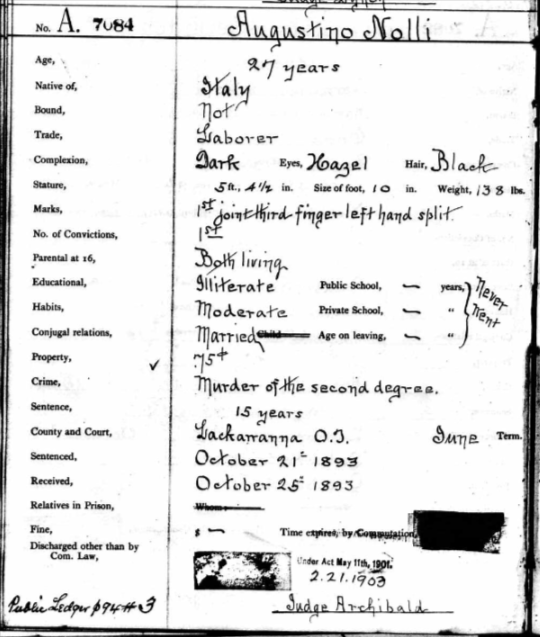
His Eastern State intake record shows him discharged on February 21, 1903, “Under Act May 11th, 1901.”
Augostino Nolli’s Intake Record Eastern State Penitentiary
Sentenced to fifteen years on October 21, 1893. Out on February 21, 1903. Nine years and four months, about sixty percent of it.
Two legislative acts bracket Nolli’s time in prison, and he had nothing to do with either one. The first, approved April 14, 1893, raised the maximum for second-degree murder from twelve years to twenty, five weeks before he took the revolver off the nail. Without it, a fifteen-year sentence could not have been given. The second, approved May 11, 1901, is why he did not serve the full term.
He didn’t go back to Dunmore, and it is not hard to understand why. Every Italian who had testified against him lived on the same hill. The woman next door, the man he worked beside, the neighbors whose names the papers couldn’t spell. The man he shot had been boarding in a house belonging to his own extended family. There was nothing on Spencer’s Hill for him to go back to.
Less than six months after being released from prison, Nolli was in New York City petitioning to become an American citizen.
Cherry Street
Around June 1, 1905, the census for New York State was taken. It shows Amelia, documented as Mary, living at 95 Cherry St with all four of her children, but no husband in the house. She also gave her maiden name, Spadola, which was phonetically butchered. The census shows Mary, 40, as the head of the household, with Annie (16), Frank (14), Charles (12), and Joseph (2). Charles is Canio.
1905 New York State Census Ancestry.com
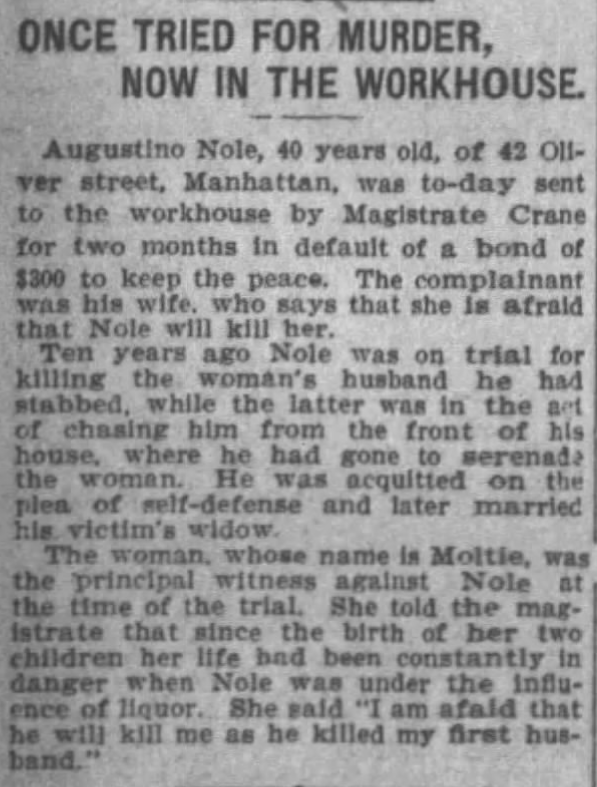
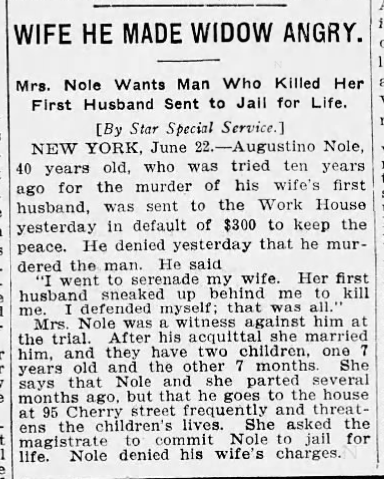
Just weeks later, on June 20, 1905, the Daily Standard Union reported that a man named Augustino Nole had been sent to the workhouse in default of a three-hundred-dollar bond. His wife had accused him of threatening her and their two children at her home on Cherry Street in Manhattan. The two were separated and living apart. The paper gave his age as forty. He was thirty-eight.
The two children were their two children, Canio and Joseph. Frank and Angelina were in that house too, but they weren’t his.
Augustino appears in New York City. Daily Standard Union, June 20, 1905
The paper called her Moltie and said Nole had been “tried ten years ago for the murder of his wife’s first husband,” and acquitted after pleading self-defense. They got four things wrong.
It was not ten years; it was twelve. He was not acquitted; he was convicted of second-degree murder and served nine years and four months for it. The man he killed was not a husband of Amelia’s at all, but a laborer who boarded in the same house. And her name was Spadola.
And her first husband was alive. Rocco Gentilesco, who married Carmela Spadola in Manhattan on December 15, 1880, remarried in 1891, raised a second family, and lived until 1917. In June of 1905, while a reporter was writing that Augustino Nole had murdered him, Rocco Gentilesco was somewhere in New York City going about his day.
Two children. Indianapolis Star, June 25, 1905
So what was the reporter talking about?
I think he was doing what reporters do on deadline with a secondhand story. Everything in that sentence exists somewhere in the record, just not attached to each other. There was a murder trial. There was a wife at the center of it. And there really was a first husband living in New York, which the Scranton papers reported in 1893 alongside the rumor that Amelia and Nolli were never properly married. Twelve years and a hundred and thirty miles later, someone compressed it, and it came out as murder.
I can’t say if Nolli told it that way himself. A man explaining his prison record to a station-house sergeant has reasons to make it a story about a husband and an acquittal rather than a live-in lover and prison time. But I don’t think there is a second killing hidden in this family’s past. There is a reporter, in a hurry, working from a story that had been passed through several mouths and two languages before it reached him.
Twenty-Eight Months
The June 1905 arrest didn’t end things between the couple. It’s unclear how much time Augustino actually served, but sometime in the following year they were back under the same roof.
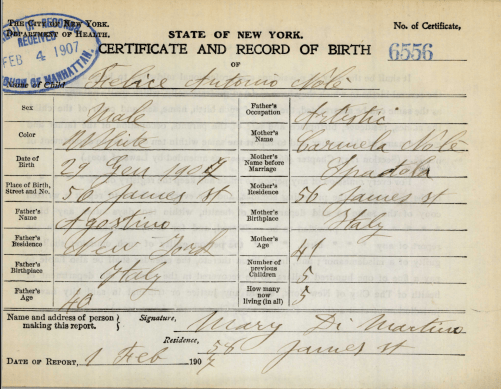
I can date it, roughly. On January 19, 1907, Carmela gave birth to their son, Felice Antonio.
Birth Record of Felice Antonio Nolè January 19, 1907
Then it all collapsed very quickly.
Carmela died in October 1907, just nine months after Felice was born. She was forty-one years old. I haven’t found her death record, and I can’t tell you what caused her death.
Felice appears to have died that December, at eleven months old, though I haven’t been able to confirm it.
So in the space of twenty-eight months, the household the census taker documented at 95 Cherry Street in June of 1905 ceased to exist. The woman at the head of it was dead. A child who had not yet been born when the census-taker came through was born, died, and buried.
Augustino then remarried Teresa Frasca on October 12, 1908. The two appear together, childless, in the 1910 census. It lists this as Augustino’s second marriage.
1910 Census shows only Augustino and Teresa Ancestry.com
What Became of the Children
By 1910, the household had scattered completely.
Joseph was six years old and living at St. Agnes Convent Children’s Orphanage in Rockland County. Canio was sixteen, and was an inmate at the New York City Reformatory on Hart Island.
I don’t know why he was there. It could have been an arrest, or truancy, or simply that there was nowhere else to put a boy whose mother had died, whose infant brother had died, and whose father had a new wife and, by the census taker’s account, no children in the house.
To summarize, in 1910, young Felice was dead. Frank and Angelina are grown and gone. Joseph in an orphanage. Canio in a reformatory. Augustino and Teresa in New York, alone.
Attempt to Become an American Citizen
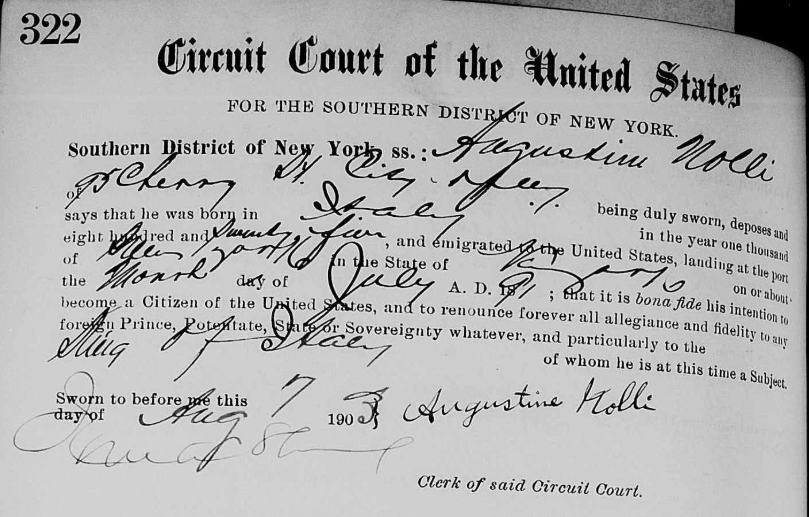
Augustino took the first step toward citizenship in August 1903.
Augustino Nolli’s Declaration of Intention August 7, 1903
A declaration was only the first step. I can’t find that he ever took the second.
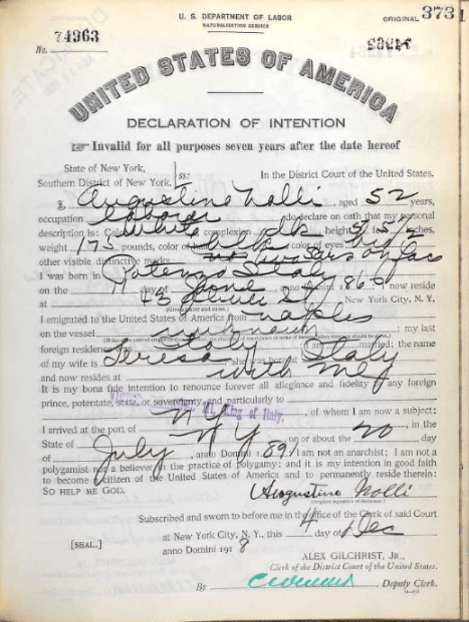
In December 1918, then fifty-two, Augustino Nolli reapplied for citizenship.
He gave his age as fifty-two, his birthplace generically as Potenza, and his wife as Teresa, born in Italy and living with him in New York.
Declaration of Intention, U.S. District Court, Southern District of New York, filed December 1918.
Once again, I can’t confirm his status. I have not been able to locate the next set of paperwork required to become a citizen.
The First Day of the Year
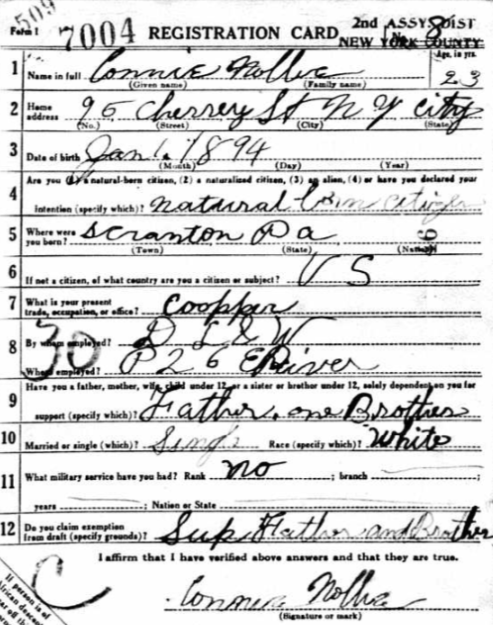
In the summer of 1917, Canio Nolli registered for the draft. He was twenty-three, and he gave his address as Cherry Street, the same block his mother had been enumerated on twelve years before.
For place of birth, he wrote Scranton, Pennsylvania.
95 Cherry Street, New York, New York Canio Nolli WWI Registration Card
He was born there on January 1, 1894, just weeks after his father was sent to prison. Canio was a small child when Amelia took the family to New York. Whatever he remembered of Scranton, it couldn’t have been much, yet he knew he was born there.
That card was also how I knew what the Tribune was looking at in October 1893. Counting back from January 1, Amelia was six months along when she was described as “a most pitiable sight.”
By 1920, Canio was back to living with his father and Teresa in New York. Whatever put him on Hart Island at sixteen didn’t last long. Joseph, I lost for a while. He would have been sixteen that year, but he was not reunited with his father.
1920 Census
Frank and Angelina Rossi moved with Amelia to New York, where they lived in that Cherry Street flat in June 1905, aged fourteen and sixteen. Amelia died two years later. By then they were seventeen and nineteen, old enough to be gone, which is why they were not in the 1910 census with Augustino and Teresa. They were no longer children, and he was not their father.
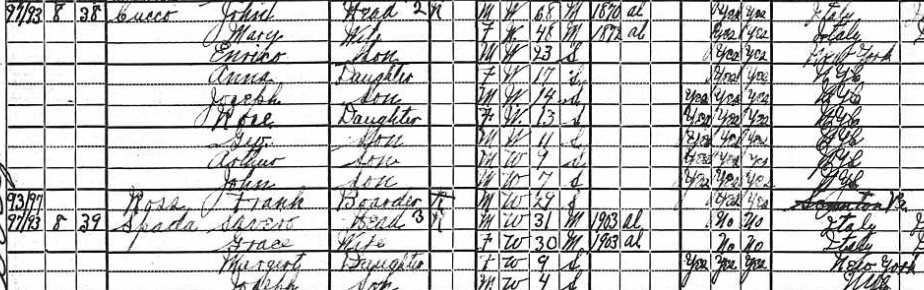
Frank appears in the 1920 census, living at “93/97” Cherry Street, as Frank Ross. Thankfully, the census taker wrote Scranton in the “Where Born” box before scratching it out. He corrected it with PA, the state, not the city, as per protocol.
Frank Ross 1920 Census
He’s living with John Cucco and his wife Mary nee Spadola. Mary is Frank’s aunt, Amelia’s sister. Just below Frank is a Savero Spada. Could this be another cousin with a butchered surname?
I still don’t know where Angelina went after 1907. I’m left wondering if Frank and Angelina ever stayed connected to Canio, Giuseppe, and their respective families.
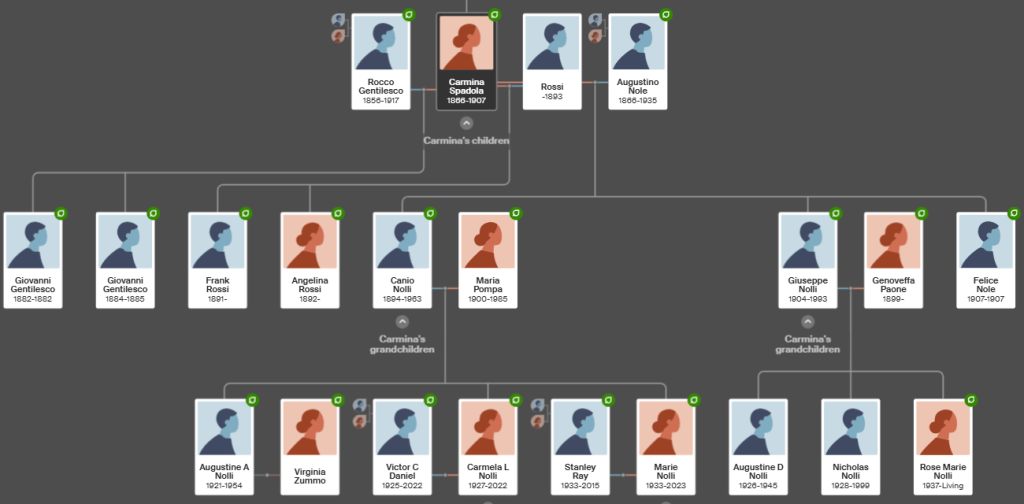
Canio married in 1920 and Joseph in 1925.
And both men named their firstborn son Augustine. These two men, one of whom grew up in a reformatory on Hart Island and the other in an orphanage in Rockland County, both honored the tradition and their father.
Somebody had taught them the rule. They kept it.
The tradition runs through the daughters too. The first girl takes her father’s mother’s name.
Canio named his first daughter Carmela.
Joseph did not. He kept the rule for his sons, naming his first Augustine and his second for his wife’s father. But when his first daughter was born, he passed over his own mother and named her after his wife’s mother instead.
Canio was thirteen when Carmela died. Joseph was three.
Carmela Spadola Family Tree
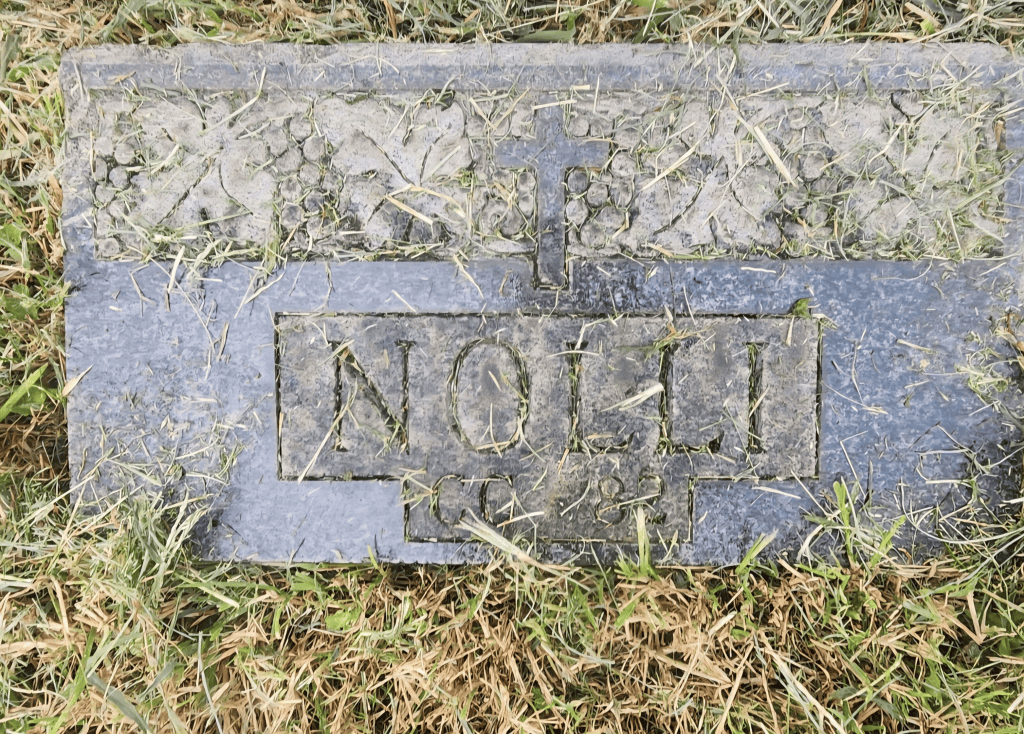
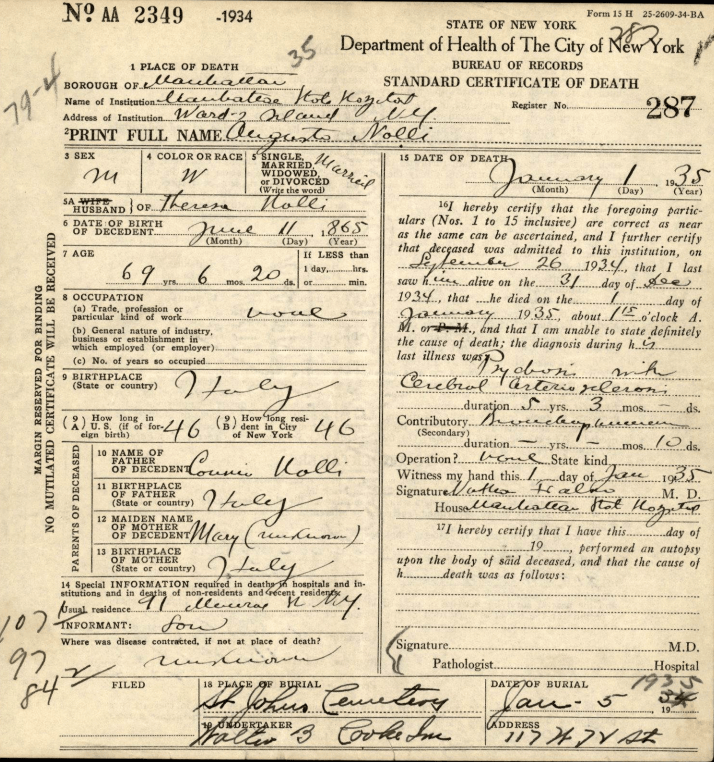
Augustino Nolli died on January 1, 1935 and is buried in Middle Village, Queens, New York.
Augstino Nolli’s Headstone
The information was provided by his son Canio, and it just so happened to be Canio’s forty-first birthday.
Death Certificate of Augustino Nolli
Concordio Prignano
This is tough.
Here is everything I can tell you about the man who died in that garden. He was about thirty-seven years old and born in San Gregorio Magno, Salerno on February 18, 1856. His parents were Pasquale Prignano and Rosa Duca.
Concordio Prignano’s Birth Record
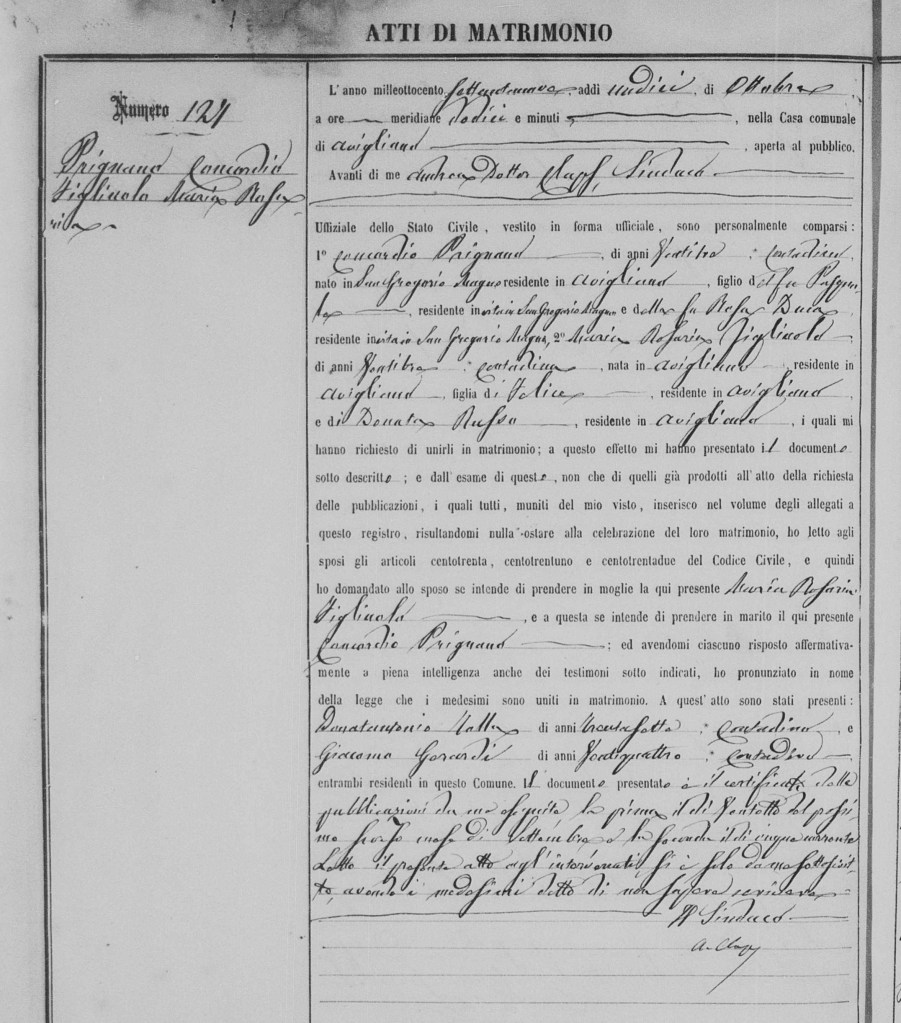
He married Maria Rosa Figlinolo in Avigliano on October 11, 1879. Her parents were Felice Figlinolo and Donata Russo.
Prignano and Figlinolo Marriage Record October 11, 1879
He arrived at the port of New York in 1887. The manifest recorded his name as Concordio Prignaro with his destination as nothing more specific than New York.
His brother Gregorio followed him to America in 1888 and settled in Dunmore. Gregorio’s wife, Donata Maria Gerardi, was born in Avigliano and arrived in 1899 with a group from Avigliano, including her daughter Rosa and her son-in-law, Angelo Vito Pace. That Pace family still thrives in the area and is the only connection to Concordio I have found so far.
Concordio worked for the Scranton Gas and Water Company. He boarded with Donato Mecca in a multi-family house on Center Street. He had a wife and several children in Italy, and he was working to bring them over.
I’ve looked. There should be a Lackawanna County death record for May 1893, the first year the county was keeping them, and a burial somewhere. Gregorio should be in the 1900 census, in the Scranton directories, and in a naturalization file.
That’s all I can find about the man who died that day. And it sucks. I don’t know who survives and what, if anything, they know about his death.
A Twist I Didn’t Anticipate
This story was initially about preserving the memory of a man who was killed, but it turned into so much more. It revealed Amelia Spadola’s challenging life. She was married at 14 and lost two children. She “remarried” only to lose her husband. “Remarried” a third time. She was allegedly attacked by a man. Her husband came to her aid but was put in prison. Two months pregnant during the murder, her two young children were briefly taken away from her while she sat in a jail cell. Then, six months pregnant, she was called “a most pitiable sight” as she testified to spare her husband from certain death. Afterward, she pleaded her case to the Poor Board, only to be denied assistance.
When she was finally reunited with her husband, he threatened her and their children. They reconciled and had another child, but she died before she could see her family blossom. Truly a tragic life story.
What Really Happened?
I’m left to wonder what happened in that garden on the morning of May 22, 1893. Did Concordio attack Amelia? Was Augustino defending her, or finishing something he had been promising for weeks? Twelve men argued about it through the night and came back with an answer that split the difference, and I don’t think I can do better than they did.
But there is a second question, and it is the one this research actually produced.
Augustino Nolli told that jury he was surrounded by strangers. Every Italian who testified against him, he said, came from a different part of Italy, and all of them were Prignano’s friends.
He was born in Avigliano. His mother was a Summa, and a Summa testified against him. The Commonwealth’s first witness was a Pace, and a Pace had married a Prignano. And Concordio Prignano was boarding in a house kept by Donato Mecca, whose mother was born Angela Maria Nolè.
Those were not strangers. That was one small town in Basilicata, moved onto one hill in Dunmore, and Augustino Nolli was inside it. What I keep coming back to is not why strangers testified against him. It is why his own people did, one after another, knowing what it would cost him while the other man was already dead.
Nobody in that courtroom asked. I can’t answer it either.
Concordio Prignano was the man who died that morning, and the records have very nearly erased him. His name survives in newspapers, and even that name is probably wrong. His wife and children didn’t disappear from the American record. They were never in it. Not a single mention of their names.
Somebody had to write to Avigliano that summer, to tell a woman that her husband had been shot in Pennsylvania over a quarrel she may never have heard the truth about, and that she and the children were not coming to America after all. I would like to know who wrote that letter. I would very much like to know what became of the people who read it.
Amelia’s story survived for a different reason. She lived. She stayed, had children here, and turned up in directories, court records, poor-board minutes, and censuses, and left descendants who are alive today. Every one of those documents exists because she kept going.
We know far more about the woman at the center of it than about the man whose death created it.
If you have Prignano, or Nolè, or Nolli in your tree, I would love to hear what has been passed down. And if you are a Prignano from Avigliano, I have been looking for you for a while.
A Note on the Evidence
Two things in this article I believe but cannot prove. First, that Caterina Pace, the Commonwealth’s first witness, was related to the Pace family that married into the Prignanos. Second, that Donato Mecca’s mother, Angela Maria Nolè, was related to Augustino’s family. Nolè is rare enough in Basilicata to make it likely, but likely isn’t proven.
Everything else here involved a judgment call at some point: names, ages, arrival dates, even the victim’s first name. I went with what the evidence best supported. If you have records I haven’t seen, or you think I got one wrong, please comment or contact me. I’ll update the article and say what changed.










Leave a comment