
A newsboy found him first.
On the morning of Sunday, November 15, 1874, a boy walking along Mifflin Avenue in Scranton, at the foot of Linden Street, spotted something lying in the grass at the base of a steep, eighty-foot embankment. It was a man, badly cut and bloodied, breathing but unconscious. The boy ran for his father.
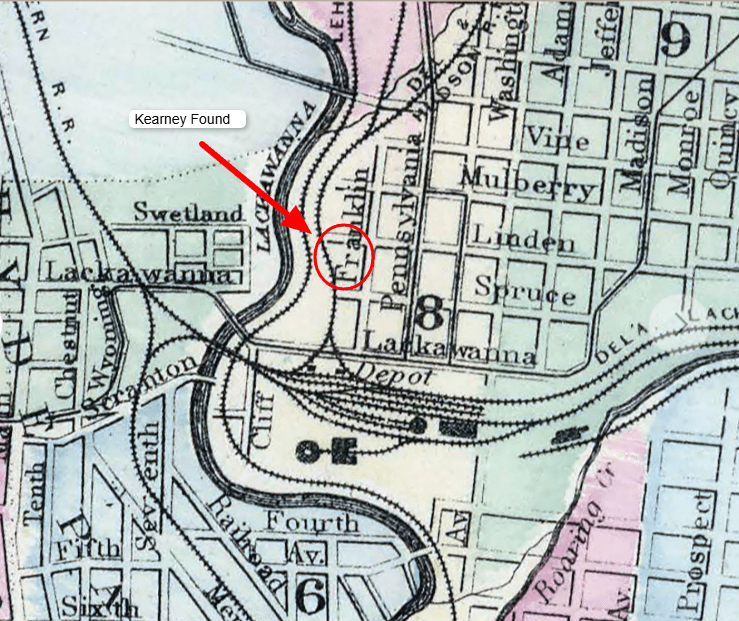
Kearney Body Found in Red Circle
Kearney lived in the 6th Ward (Blue)
Word reached Chief of Police August Ferber, who hurried to the scene and had the man carried to Lackawanna Hospital. He died within minutes of being laid on a bed. His name was Michael Kearney, forty-six years old, unmarried, a boarder at the Heneghan house in the Sixth Ward.
The Tribune covered it the next day under a headline that asked the question everyone in Scranton was already asking.
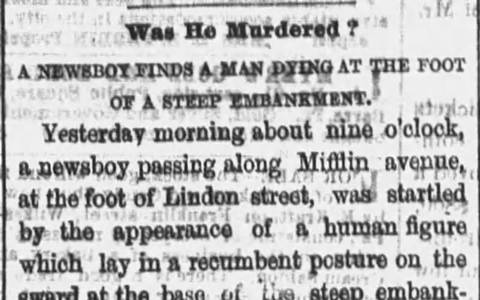
The paper laid out two possibilities. Kearney might simply have been drunk and tumbled over the embankment on his own. Or, as the Tribune put it, he might have been “foully dealt with,” his body dumped over the bank afterward to make the fall look like an accident.
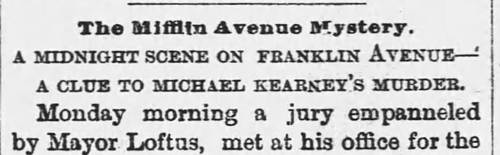
Scranton had no deputy coroner at the time, and the paper used the case to call for one. Kearney’s friends, for their part, didn’t want an inquest at all. They got one anyway, once a jury was empanelled by Mayor Loftus.
A Witness
The break in the case came from a black teamster named James Smith, who worked for I. T. Keene & Co. on Lackawanna Avenue. Smith, who lived on Center St between Franklin and Mifflin, told the initial jury that around midnight on the night Kearney died, he was woken by cries of “murder” near the corner of Center Street and Franklin Avenue. He opened his window and saw a large crowd.
He quickly went outside and saw what he described as a mob beating a man in the street. By his count, there were twenty to thirty men, all kicking at someone lying on the ground, dragging him along Franklin Avenue when he couldn’t walk. Smith said he heard someone in the crowd shout, “If the fellow can’t walk, pick him up and carry him.”
Then, someone in the crowd saw Smith. The man said, “Who is this black son of a ——?” Afraid, Smith ducked behind some barrels before retreating to his house. He was compelled to return. After grabbing a coat, he went back outside. The crowd was still at it, and finally carried the man off toward Mifflin Avenue, in the direction of the embankment where he’d be found dead the next morning.
Smith said he was too frightened to go looking for a policeman on his own.
A Friend Investigates
Dennis Sullivan was a friend of Kearney’s. He was with him earlier in the evening the night before he died. He learned of Smith’s testimony and wanted to meet with him to learn what he had witnessed. The two men met for a cigar at Leighton’s Saloon.
As the two were talking, Chief Ferber and Officer Capp joined. Ferber called Smith a “black son of a ——” and a liar. Then swung at him three times, hitting him in the head. Then Ferber detained Smith and held him in the city jail
When Sullivan tried to support Smith, the Chief told him to shut up, or he would receive the same.
Ferber would later testify that he locked Smith up only to make sure he wouldn’t disappear before the inquest, and that Smith had been drinking. Sullivan disagreed that Smith was drunk.
The Inquest
The coroner’s jury heard from a long list of witnesses over several sessions at the Mayor’s office in late November. Kearney had spent Saturday evening drinking at Noll’s saloon on Lackawanna Avenue with friends Thomas Conlon and Dennis Sullivan. He was, by their account, “pretty well on towards being intoxicated” but able to walk and talk sensibly when they parted around eleven o’clock.
Mrs. Winkleman, who lived near Tripp’s barn on the alley between Penn and Franklin avenues, testified she heard a man holler “murder” three times just after midnight. Charlotte McPherson, at the corner of Penn Avenue and Center Street, said she was woken from sleep by cries of murder that sounded near enough to be alarming. George Graves, out walking on Spruce Street, said a man came out of an alley shouting “here comes another loafer, I’ll have his heart’s blood,” and that the man, whom he judged by his voice to be an Irishman, looked more crazed than drunk.
A neighbor named Ida Cook testified to hearing men quarreling around three in the morning, a man struck, and then the words, “My God, I can’t see my brother struck.” Two pistol shots followed. She heard someone cry “Police” three times and thought the police should easily have heard it.
The physician who examined Kearney’s body, Dr. Everhart, found a cut above his right ear, wounds on both cheeks and both knees. He testified the head wound could have come from a billy club, a stone, or a boot, and that he couldn’t rule out a fall down the embankment, though he wasn’t satisfied that Kearney got all his injuries that way.
Chief Ferber testified he’d heard no noise that night and knew nothing of Kearney’s death until it was reported to him the next morning. He said that he and Officer Capp were together that evening. And the Chief’s brother, Jacob Ferber, testified that he was also with his brother that night, but the two were home before midnight.
The jury ultimately returned a verdict that Kearney “met his death by violence at the hands of some party or parties unknown to the jurors,” and added a rebuke of the city council for what they considered inadequate police protection in Scranton.
The Chief Is Arrested
A week later, the case took a turn nobody expected. On December 1, 1874, Chief Ferber himself, along with two special officers, his brother Jacob Ferber and Jacob H. Schlager, were arrested and charged with Kearney’s murder.
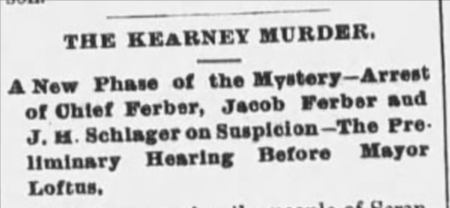
The complaint came from Michael McGill, Kearney’s brother-in-law, who swore before Mayor Loftus that the three men had assaulted and beaten Kearney with malice. McGill’s account rested heavily on witness George Smith (no relation to James Smith), who told the hearing he’d recognized Chief Ferber in the mob on Center Street that night, and had watched him step up to a man lying on the ground and kick at him.
Chief Ferber didn’t ask for a hearing. “I decline to have a hearing,” he said. “I will go to Wilkes-Barre for trial.” The other two men wanted a hearing, so the Mayor took testimony anyway.
Under cross-examination, the case against the two special officers began to look thin. Schlager claimed he’d been forty-seven miles away in Hawley at the time of the murder. Jacob Ferber said he’d been with his brother until half past eleven that night and had an alibi witness in his wife.
Mayor Loftus, growing impatient with the defense attorneys challenging his authority to even hold the hearing, snapped, “If ye keep on questioning my rights, I’ll have no rights at all by-and-by.”
In the end, the Mayor committed all three men, and they were taken in custody to Wilkes-Barre.
A Grudge?
During the testimony, it was discovered that the day before the October election, Kearney had been arrested and jailed by Officer Capp. After several hours in jail, Kearney offered Capp five dollars in exchange for his release. Capp agreed.
Later, McGill ran into Capp. Capp told him that he would “have it out with him [Kearney]” if he didn’t pay. Then, McGill told him that Kearney was his brother-in-law and not to say anything because Kearney was trying to secure a loan to pay him.
Until his death, Kearney hadn’t paid the debt. It was a detail that hinted at a grudge, though nothing tying Capp directly to the killing was ever produced – only that Chief Ferber testified that he was with Capp that night.
The Police Report for October 1874 showed 39 people were arrested and fifteen were discharged without a fine.
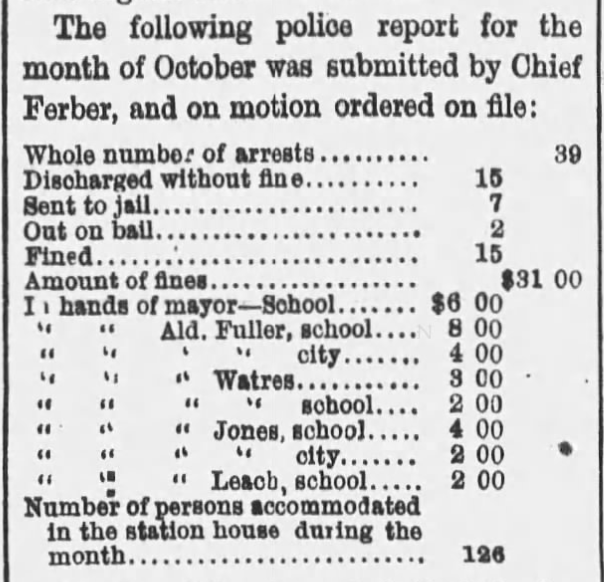
Morning Republican, November 9, 1874
Released From Custody
The three didn’t stay in custody long. Judge Dana in Wilkes-Barre released Chief Ferber on bail, and Jacob Ferber and Schlager were discharged outright for lack of evidence.
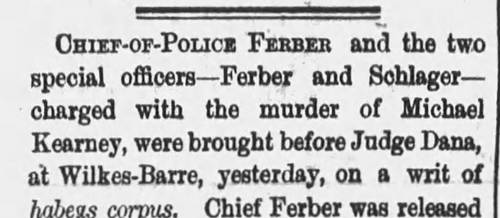
The Tribune, which had been skeptical of the arrests from the start, didn’t hide its opinion. In an earlier piece, the paper had called the whole episode “a very serious piece of business,” noting that the only real evidence against Chief Ferber was one witness who saw him kick a man in a crowd, with no proof that man was Kearney at all. The paper argued the case revealed “a peculiar recklessness in the administration of justice” in Scranton, where, in its words, notorious criminals sometimes roamed free as other men were arrested on the thinnest of evidence.
Ferber Discharged
Chief Ferber’s case dragged into the new year. In January 1875, the grand jury at Wilkes-Barre took up the matter and, just as the Tribune had predicted weeks earlier, declined to return an indictment. Chief Ferber was discharged in open court.
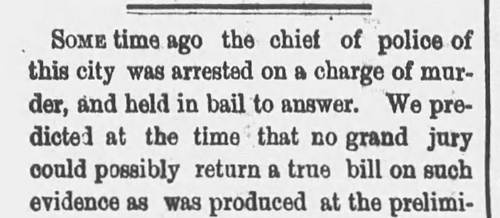
“It is needless to say,” the Tribune wrote, “that few, if any, for a moment believed Mr. Ferber had anything to do with the death of Michael Kearney.”
Chief Ferber’s Controversial End
A.C. Ferber was appointed Chief of Police on September 7, 1870. Among his first duties was the monthly police report.
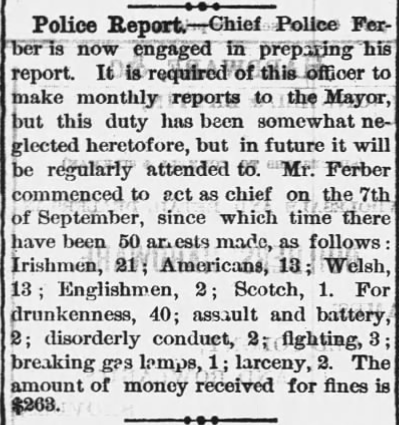
Morning Republican, November 16, 1870
Over his six-year stint as Chief, he survived the murder charge and a couple of incidents of alleged abuse of power. What eventually ended his tenure was something entirely different: politics.
It started with a bribe. In June 1875, incoming Mayor Robert McKune wanted to nominate a new Chief of Police, but sitting Mayor Loftus’s term didn’t expire until October, and Loftus had the right to block him. So McKune paid Loftus $100 to step aside early and hand over mayoral duties. Loftus, claiming illness, agreed.
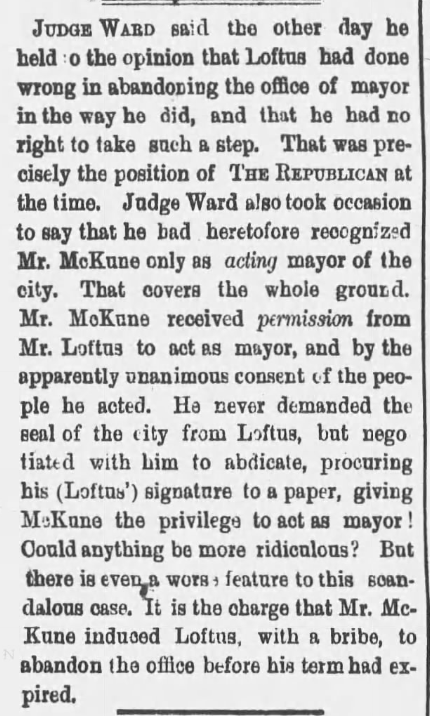
Morning Republican, September 10, 1875
Acting as Mayor, McKune tried to nominate a new Chief that July. Select Council rejected every name he offered, then claimed it had the authority to elect a Chief on its own. On July 3, they elected Officer J. W. Boice. Ferber refused to accept it, insisting he still answered only to the Mayor, and the city suddenly had two Chiefs. The police force took its orders from Boice, but Ferber padlocked the Eighth Ward station house and kept the only key. This was apparently the one piece of the department he could still physically control.
The two men coexisted for a few weeks with what the papers called “a degree of patience that would have been creditable to the Siamese twins,” until a small test of authority broke the peace. Ferber ordered a woman held at the depot lockup; Officer Bates released her instead, on Boice’s order. Ferber, the paper noted, “felt somewhat indignant that his order was not obeyed.”
It got stranger from there. In August, Scranton’s Common Council elected a third man, John B. Fish, rather than confirm Boice, giving the city three simultaneous Chiefs to one office. The papers weren’t impressed, handing out a gold star to Ferber, a silver star to Boice, and a wooden one to Fish. Fish never took the job.
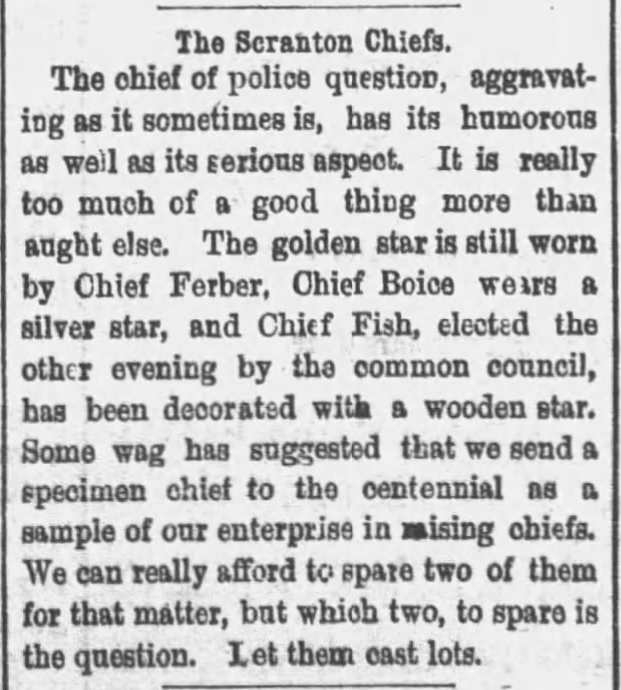
The Morning Republican, Friday, August 27, 1875
Then in September, having spent his $100, Former Mayor Loftus reappeared, declared he’d never actually abandoned the office, and reasserted his claim to be Mayor, on top of the still-unsettled chief question. For a stretch, Scranton had two Mayors and two Chiefs at once, and it landed both Mayors in Judge Ward’s courtroom, where they reportedly had to be cleared from the bench.
In October, word spread that Judge Ward had ruled Boice’s appointment unlawful and Ferber the rightful chief; McKune ordered Boice to hand the station house keys back. But weeks later, council members were saying they’d never heard anything official from Judge Ward at all, only rumor “from the schoolchildren on the street.” Whatever had actually happened, Ferber was back in the chief’s chair by early November, and it didn’t go well for him. On November 13, one of his own officers arrested him on a criminal warrant for assault and battery, for excessive force used in arresting a man on Franklin Avenue, the same street where Michael Kearney’s mob attack happened a year earlier. Ferber denied any wrongdoing and said he’d used no more force than necessary.
On January 10, 1876, Common Council finally settled it, despite some opposition. One councilman voted against recognizing Boice and said flatly that Boice “had dared them.” But the vote carried, Ferber’s claim to the office was over, and he returned to civilian life.
Ferber sued the city for wages and expenses, but failed. He would continue working as a “well-known drayman,” delivering products for businesses on his horse-drawn cart.
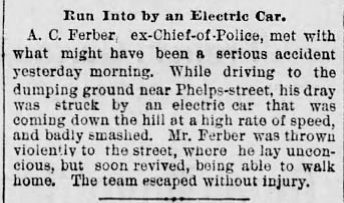
Scranton Republican, September 23, 1890
August C. Ferber died in 1893 at age sixty-nine. A German-born immigrant and Civil War veteran, he was remembered in his obituary this way: “When in his prime it is to be doubted if there could be found in the State, a man of greater brawn, nerve, and muscle than he.”
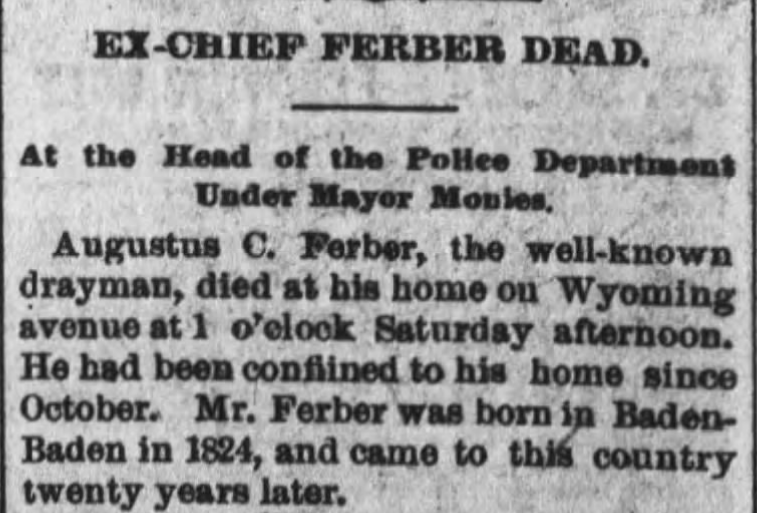
The Times, May 8, 1893
He left behind at least six daughters and two sons, spread across the country.
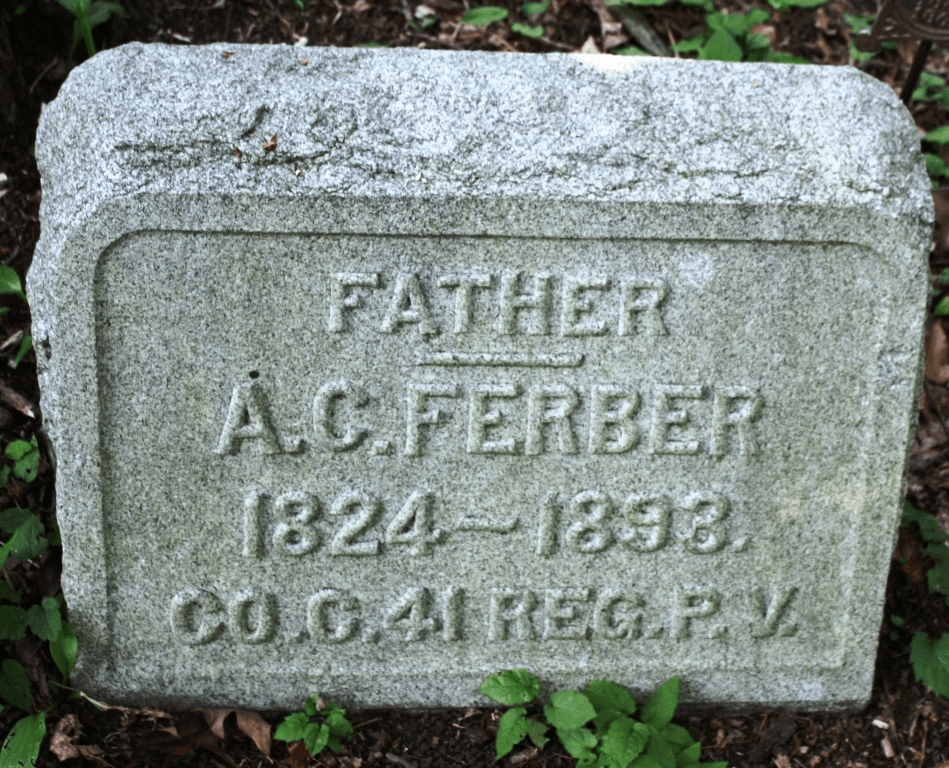
find-a-grave.com
Forest Hill Cemetery, Dunmore, PA
A Legacy of Service
August’s son, Henry F. Ferber (1853-1934), would serve as a volunteer firefighter for the city as early as 1867 and continued to serve the city for decades. He became Scranton’s Fire Chief in 1893 and retired in 1916.
Henry’s son, Harry, served from 1902 to 1927 and rose to Battalion Chief before retiring as a Lieutenant. And Henry’s grandson, Harry’s son, Probert, served from 1921 to 1958 and retired as a Battalion Chief.
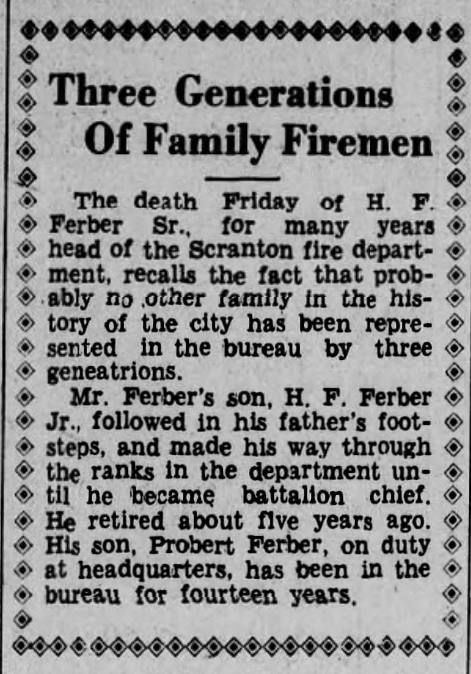
(contradicting dates)
Scranton Republican, February 19, 1934
What Actually Happened to Michael Kearney
The testimony made it clear that Kearney was almost certainly the prime target of a street fight on Center Street and Franklin Avenue sometime after midnight on November 15, 1874. He was dragged in the direction of Mifflin Avenue by a crowd, beaten and thrown over the embankment, and left for dead until the newsboy found him hours later, barely alive.
Whether Chief Ferber was part of that crowd, as George Smith swore under oath, or whether Smith mistook someone else for the Chief in a dim, chaotic scene two hundred feet away, is a question that will remain unanswered. What the record does show is a police department investigated an accusation against its own Chief. They arrested him, and then watched the case collapse for lack of evidence. The city’s newspapers were already questioning the justice in Scranton.
No one was ever convicted, and the case disappears from the papers after Ferber’s discharge: no new suspect, no further arrest, no resolution. The coroner’s jury verdict stands as the last official word: Michael Kearney died at the hands of parties unknown.
Michael Kearney was buried without the answer he was owed. A hundred and fifty years later, Franklin Avenue and Mifflin Avenue are still there. The embankment is still there. The mystery, mostly, still is too.

