
I previously wrote about the unsolved murder of James Monaghan at Fellows’ Corners. Near the end of that story, I mentioned the violent weeks that followed. Constable Thomas McNamara was beaten to death in Taylor on November 16, and eight days later, a man was found along Leggett’s Creek with his skull crushed by a stone. That man was John Garrity, and I only gave him a paragraph. When I started investigating his case, I discovered the newspapers had told only part of the story.
What began as a straightforward murder investigation eventually uncovered an entirely different story. This first article covers the murder, investigation, and sentencing. Part II explores the unexpected family connections I found while tracing the people involved.
Scene of the Crime
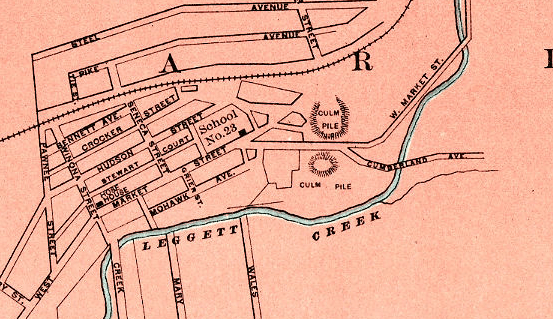
On a cold Sunday morning on November 24, 1872, a man named John O’Boyle set out to help a friend fix a stove pipe. It was between six and seven o’clock in the morning. O’Boyle cut through a small path near Leggett’s Creek, in North Scranton, then known as the Notch. Today, the area lies just south of where the Scranton Expressway splits near Chinchilla, heading toward what I had always known as the Notch.
The rarely used path was described as little more than a rough gully.
Lackawanna County PaGenWeb
It’s hard to pinpoint exactly where, but as O’Boyle passed through the area on his way to Clover Hill, he found the bloodied, cold body of John Garrity.
O’Boyle later testified that he was on his way to help Teddy Haley when he made the discovery. Remarkably, he left the body where it lay and continued on to Haley’s house.
After finishing the repairs, the two men made their way back to the scene. Along the way, they met John Highland, and the three men eventually reported the discovery.

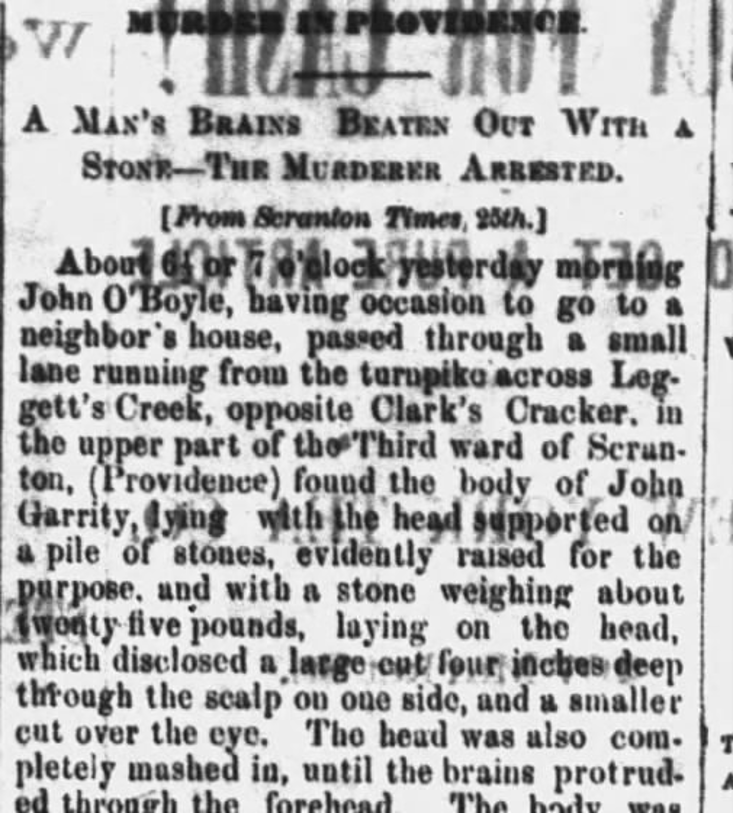
Garrity was lying with his head on a pile of stones. The Scranton Times reported the stones appeared to have been deliberately placed. One stone, weighing about twenty-five pounds, sat on his head. His scalp was cut four inches deep on one side, with a smaller cut over the eye, and his forehead had been crushed. The body was cold and stiff, his hands crossed, and his clothes covered with frost. Garrity had been there a while.
His hat was a short distance from his feet. And a cap that didn’t belong to him was near his head.
That cap was the critical clue that would send someone to prison. Its significance didn’t end there.
The Victim
John Garrity was a laborer in one of the local mines. He was reported to be a solid citizen. The Scranton Republican said he “bore a good character in the neighborhood,” and the Times called him “a peaceable man who drank at times” but was never known to quarrel, even when alcohol was involved. He had recently purchased a home on Leggett’s Creek from Dr. Throop. John left behind a wife and four children.
The Night of the Murder
Piecing together the inquest testimony, Garrity’s last night alive went something like this.
Saturday evening, November 23, started with whisky. James McNamara testified that Patrick Gavin, a young unmarried miner, came into Pat Moore’s place on Vinegar Hill (likely on Pawnee St.). It was around seven-thirty in the evening when he announced, “We ought to have a little whisky.” A few men joined in the party. McNamara, Teddy Conway, Patrick Moore, and Michael Gillen split a pint with him. The group finished the pint by nine-thirty, and Gavin left Moore’s home with Gillen, Conway, and Conway’s wife.
Later that evening, Gavin met up with John Garrity. John Kearney testified that he passed the two men on the road. He asked Gavin whether he was coming home. Gavin replied, not yet, not for a little while. Later that night, Gavin and Garrity showed up at Kearney’s door wanting to come in. Kearney didn’t allow the two drunk men to enter. After arguing for a bit, they left his house at about ten minutes after eleven.
John Richardson was walking home about ten-thirty that evening. He heard what sounded like drunk men ahead of him on the road, talking near Mr. Mahon’s home. He recognized Garrity’s voice, but not the others’. He said a young man named James Kearny was there but left to go home, leaving the two men behind.
Henry Travellean lived in the house nearest the spot where the body was found. He went to bed at eight-thirty that evening and was woken between eleven and midnight by a noise. He heard Garrity and Gavin arguing, but they weren’t loud enough to understand what they were saying. Edward Lambert, who boarded with Travellean, heard the same thing. He estimated that it was about eleven o’clock. The arguing lasted about fifteen minutes.
After that, silence. Until John O’Boyle came through the area at dawn and reported the crimes to the authorities. Word spread quickly in the small Irish neighborhood.
The Evidence
Patrick Gavin was arrested almost immediately. When questioned, he gave such a confusing account that he was arrested on the spot.
He claimed that he and Garrity had parted ways before the lane. Garrity wanted to go to Martin Garrity’s, but Martin had moved away, so they tried to send him home. Gavin said he watched Garrity fall down, get up, and walk off, and that was the last he saw of him. Gavin then went into the Jennings house, where he boarded. He insisted he never went down the lane at all.
The physical evidence said otherwise. The clothes Gavin wore that night were found the next day hanging on the fence at his boarding house, sprinkled with blood, some of the blotches still fresh. His boots were bloody around the soles and up the legs. The blood was smeared as though someone tried to scrape the stains off with a knife. There was still a long streak of blood on one of his arms above his wrist, and blood around and under his fingernails. The blood on the toe of one boot reportedly looked as if the boot had been kicked into blood.
Gavin’s explanation was a nosebleed. His landlord, John Jennings, testified that he had never known Gavin to have a nosebleed in his life.
Sarah Jennings, John’s wife, testified that Gavin came to her door about one-fifteen in the morning, bareheaded, saying nothing. He pulled off one boot, fell asleep in a chair, then fell onto the floor, where he slept for forty-five minutes before going to bed.
When Sarah came home from church Sunday morning, apparently aware of the murder, she asked Patrick where his cap was. He said he didn’t know. She then asked if he had killed John Garrity. According to her testimony, he replied, “It is me.” When Alderman Fitch arrived at the house, her husband told Gavin, “Get up, you bloody murderer, you.”
As officers walked Gavin to the justice’s office, he tried to step into the mud to cover the blood on his boots.
The Inquest
With Coroner Dr. Seamans absent, E. Leach, Esq. of Providence acted as coroner and empaneled a jury: N. Fitch as foreman, Dr. S. B. Sturdevant, J. Staples, M. Leach, E. Botsford, and C. Van Storch. After viewing both the body and the scene, they heard testimony at Leach’s office.
The Times reconstructed the scene of the crime. Blood on stones and dirt about thirty feet from where the body was suggested a first blow there. Garrity apparently got up and moved on before being knocked down again. Then the stones were piled, his head laid on them, and the head crushed by one blow from the large stone. Two feet from the body was a smoothed depression in the ground, suggesting someone had lain there long enough to warm the earth. The cap sat where it might have fallen off a man’s head who lay there.
The Inquest Verdict
John Garrity died from a blow or blows from a stone, and that stone was in the hands of Patrick Gavin.
Gavin was described as about 22 years old, five feet two or three inches, with light curly hair and a “downcast, surly look.” The Republican said he was a “short, curly-haired young man of twenty-four.” Gavin’s age was either not known or accuracy wasn’t a priority. As later newspaper accounts show, even the victim’s name changed from paper to paper.
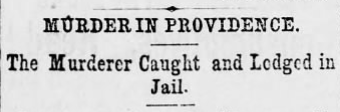
The emotions in Providence ran hot. The Times reporter wrote that if the friends of the murdered man had gotten hold of Gavin, there would be no need for a trial. Gavin was committed to the Scranton jail and moved to the county jail in Wilkes-Barre Monday morning for safekeeping. Remember, Lackawanna County didn’t exist yet. It was formed a few years later in 1878.
The Plea
There was no dramatic trial. On January 28, 1873, the Pittston Gazette reported in a single paragraph that Pat Gavin, indicted for the Providence murder, had pled guilty to manslaughter. The court had not yet sentenced Gavin.
The newspaper even got the victim’s first name wrong, calling him Michael Garrity. Every other account says John.
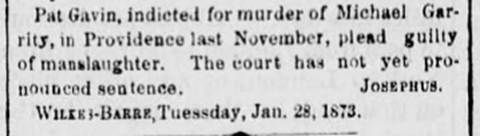
Note the victim misnamed as “Michael Garrity.”
It was a shrewd plea. Despite a coroner’s verdict that put the stone in his hands, and blood evidence that read like a confession, a first-degree murder conviction meant hanging. A guilty plea to voluntary manslaughter took death off the table entirely. To be fair, nineteenth-century drunken fights that turned deadly were often resolved by guilty pleas to voluntary manslaughter rather than murder.

Hard labor at Eastern Penitentiary
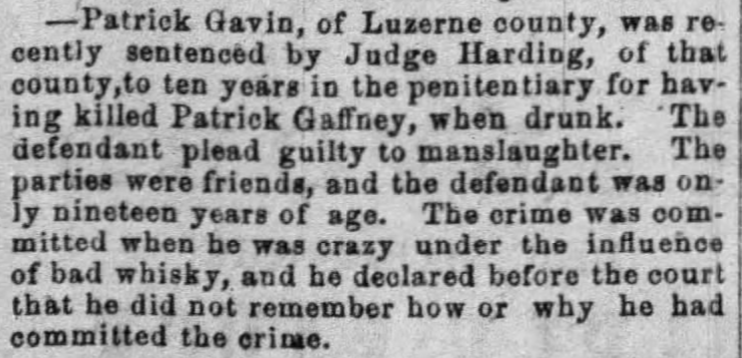
A paper a hundred miles away preserved the only account of what Gavin said in court. The Sunbury Gazette reported that the parties were friends, that the defendant was only nineteen years of age, and that the crime was committed while he was “crazy under the influence of bad whisky.”
Gavin declared before the court that he did not remember how or why he had committed the crime. The Gazette then kept the era’s tradition alive by calling the victim Patrick Gaffney and the sentence a flat ten years.
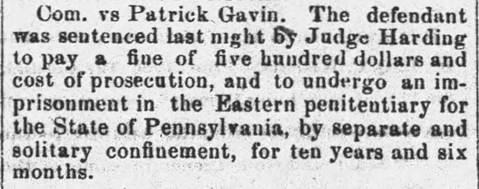
Sentencing came within days. Judge Harding ordered Gavin to pay a fine of five hundred dollars plus the costs of prosecution, and to serve ten years and six months in the Eastern Penitentiary in Philadelphia, by separate and solitary confinement.
Ten and a half years for beating a man’s head in with a twenty-five-pound stone. John Garrity’s widow and four children received some justice, but it won’t bring back their husband and father.
The Prisoner
The intake register at Eastern State Penitentiary picks up where the newspapers leave off. Patrick Gavin entered prison on February 5, 1873, and was registered as prisoner number 7349. He was sentenced to 10-1/2 years for voluntary manslaughter.
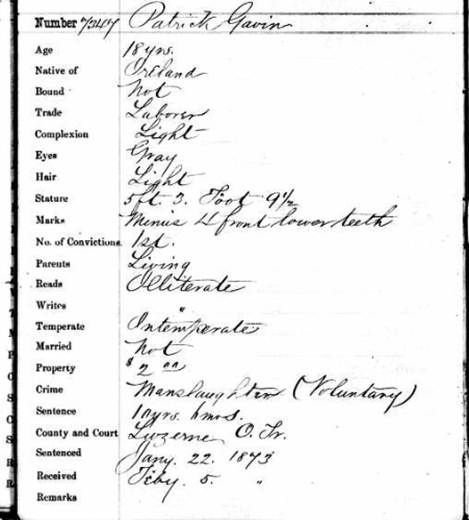
The clerk recorded a young man five feet three inches tall, with light hair, light complexion, and gray eyes, matching the newspaper descriptions. It also recorded things the papers never mentioned. He was born in Ireland. He could neither read nor write. He was unmarried, his parents were living, and he was listed as intemperate. Under distinguishing marks: missing four front lower teeth. His entire property at intake amounted to just two dollars.
His age was recorded as eighteen. Remember that the Times had called him about twenty-two, the Republican twenty-four. Intake ages were self-reported, and it was not uncommon for an illiterate young immigrant to be unaware of his own age.
The Grieving Widow
There is one glaring omission from the newspaper coverage. John Garrity’s widow. The papers described her husband’s wounds in gory detail, but never once mentioned her name. She was “a wife with four children,” and then she was gone.
The $500 fine went to the county, not to her. Somewhere in the records her name is waiting, along with what happened to the house on Leggett’s Creek and the four children who grew up without their father. What happened to her and her children? Has her story been handed down through generations?
The Story Wasn’t Over
The newspapers considered the case closed. A man had been convicted. A sentence had been handed down. John Garrity’s widow and four children were left to rebuild their lives without him.
Or so the papers thought.
As I began tracing Patrick Gavin through prison records, census schedules, city directories, and probate files, I realized the murder had exposed something much larger than a drunken killing along Leggett’s Creek.
I discovered that many of the people who testified at the inquest were connected in ways the newspapers never realized or acknowledged. Those connections led to an Irish immigrant family whose tragedies extended far beyond John Garrity’s murder.
That story deserves its own article.
Read Part II: The Gavin Family: The Story the Newspapers Never Told.
While researching this case, I discovered that many of the witnesses, neighbors, and even the killer were connected in ways no nineteenth-century newspaper ever reported. Read Part II here.
A note on accuracy. Everything in this story comes from newspapers, census pages, city directories, and courthouse records, and I’ve tried to flag the spots where those sources disagree or where I’m making my best guess. But researching historic crimes is difficult. The newspapers couldn’t agree on Patrick’s age, his own prison record couldn’t spell out his birth year, and one correspondent got the victim’s first name wrong. If you find an error or have records that fill a gap, please send it my way so I can correct it. I’d rather be corrected than be wrong. historicnepacrimes@gmail.com
 Exploring historic crimes in NEPA
Great work
LikeLike
Thank you!
LikeLiked by 1 person
WOW. I moved from School Street in Scranton when I was 10 years old and a student at Holy Rosary. I remember the area pretty well and it was sad for me to have to leave. Before living on School Street we had lived in Providence and I remember the Notch. My father had been in the Navy with Cyril Murphy. His daughter Janet and I became great friends.
It’s a small world. Behind the Murphy home on Oak Street there was a smaller home. My sister discovered from her best friend, in high school, ( Elizabeth Seton in Maryland) Mauri Smith, that a relative of hers had lived in the rear of the Murphy home.
Mauri also had an aunt who was an IHM Sster whi lived in the Holy Rosary Convent
James Gavin was in my class. I moved to the Washington DC area where I eventually attended The Catholic University of America. My mother later got a job there where she met Ann Garrity, mother of my high school classmate Ellen Garrity. Ann was from Scranton!
LikeLiked by 1 person
It is a small world. I’m glad the article brought back some memories for you.
LikeLike