
When Patrick Gavin entered the Eastern Penitentiary in February 1873, every newspaper considered the case closed.
For me, the story was just beginning.
Not because they arrested the wrong man, but because they never understood how the people in the case were connected.
While researching this case, I discovered that witnesses, neighbors, and family members formed a web of relationships hidden in plain sight.
This is that story.
New here? Read Part I of this story first: The 1872 Murder of John Garrity.
The Families of the Notch
The more records I pulled, the clearer it became that there was a hidden story here. It appeared that the killer and the victim were not just friends or neighbors. Nearly everyone in that inquest room seemed to be connected to everyone else.
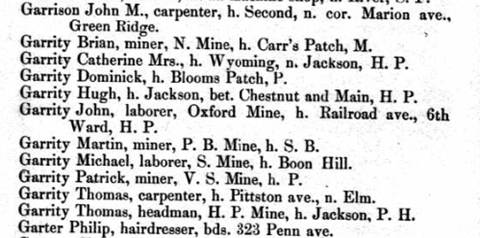
Start with the 1870 Scranton city directory. It listed only three Gavins in the city: John, Patrick, and Michael. The Patrick Gavin listed was a laborer at the G. R. Mine and had no home address listed. My initial thought was that this was the killer. But further research led me to believe that it was probably not the young Patrick Gavin; however, this Patrick was still connected to the story. Just below him sits Michael Gavin, a miner in the Second Ward, in the old Providence section. Remember those two names.

The same directory lists several Garritys, spread across Hyde Park, Providence, and the mining camps. There is a John Garrity listed. While it was reported that he recently bought a home in Providence, it’s not confirmed that this is the same person. Likely, but not confirmed.
Among the others was Martin Garrity, another miner. Remember Gavin’s inquest statement that the drunken John Garrity wanted to go to Martin Garrity’s house and was told Martin had moved away. Well, in the 1867 directory, Martin was listed as living in the 3rd Ward, in Providence. By 1870, he was still a Scranton resident, but living in the Sandy Banks area near Capouse Avenue and Olive Street. The testimony and the directory seem to align.
It turned out that the documented relationship between the Garritys and the Gavins dates back to 1866. That’s when Martin Garrity and Austin Gavin were arrested and found guilty of assault and battery. Based on the article, it appears the two may have been fighting each other.

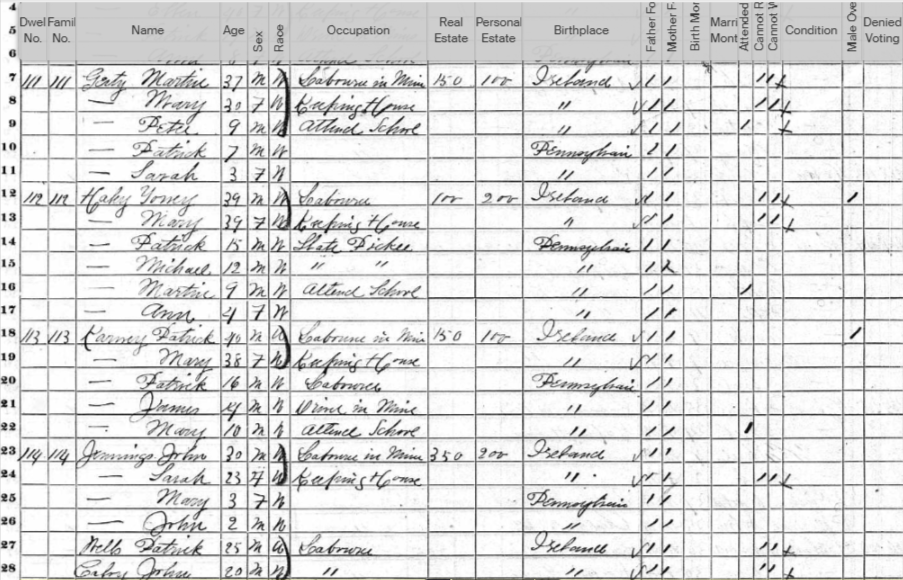
The 1870 census, taken that June in Providence, revealed more information. John Jennings, thirty, a mine laborer born in Ireland, with his wife Sarah, twenty-three, and two toddlers, lived in Providence. These are the inquest witnesses, the couple Gavin would board with. Gavin himself is not in the household yet. Their boarders that summer were two other single Irish laborers. Boarders churned constantly in these houses, and sometime over the next two years young Patrick Gavin took one of those beds.
And look at the home above the Jennings. Patrick Kearney, forty, with sons Patrick, sixteen, and James, fourteen. James Kearney, about sixteen years old on the night of the murder, is the boy who was with Gavin and Garrity in their last hours and, by Gavin’s own account, went to the house and locked the door. Richardson’s testimony calls him “the little boy Kearney.”
The Kearney and Jennings houses shared a fence line – likely the same fence where Gavin hung his bloodied clothes. The geography of the testimony snaps together: the boy walked next door and locked up while the two drunk men stumbled on.
Ten years later, another census provided the clue that changed everything. In the 1880 census, Martin Garrity is back in the neighborhood. He’s a forty-five-year-old miner born in Ireland. Living with him are his wife Mary and a house full of children. Living next door, once again: the Kearney household, now led by Patrick Jr, including his brother James, now twenty-four.
And there, on the last line of Martin Garrity’s household, is the entry that cracked this case open for me. Ann Gavin, seventy-two, born in Ireland. Relationship to the head of household: mother-in-law.
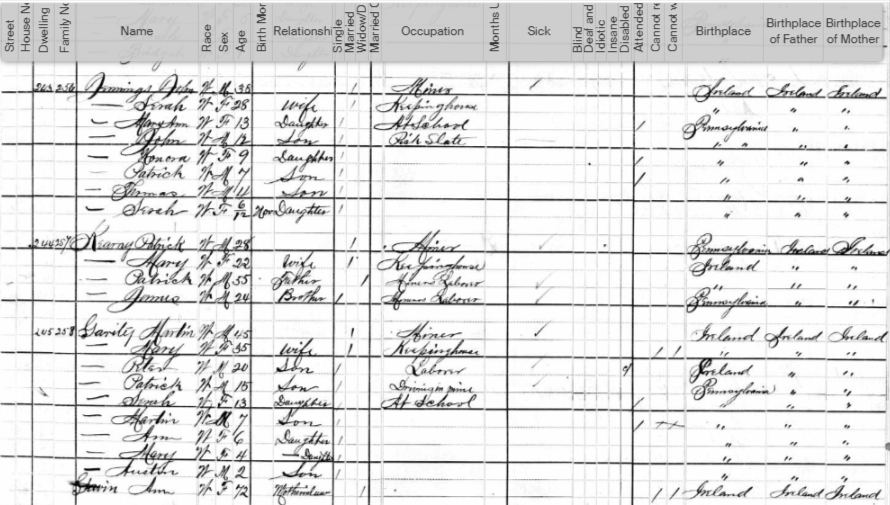
Martin Garrity’s wife Mary was born a Gavin. The records never explicitly identify the relationship between John and Martin or between John and Mary Garrity. Given the surname, the neighborhood, and John’s desire to go to Martin’s house that night, they were almost certainly related, but the exact relationship remains unproven.
Although the exact relationship remains unproven, the records strongly suggest the Garritys and Gavins were closely connected.
Sarah Jennings
Another connection runs through the Jennings house. The papers said Patrick Gavin boarded with his aunt, Mrs. Jennings. But on which side, and how?
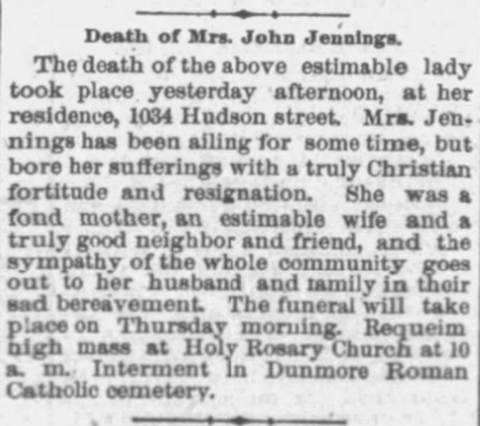
Sarah Jennings died in 1891 at her home on Hudson Street (now Oak St).
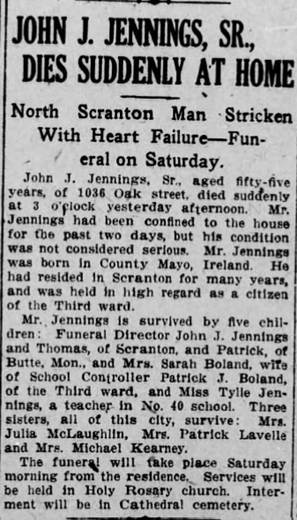
Her husband John J. Jennings Sr. died suddenly at home on Oak Street in 1911. His obituary revealed more clues. It says he was born in County Mayo, Ireland, and was a citizen of the 3rd Ward.
It names his five surviving children and three sisters, one of them married to a Michael Kearney. The printed age of fifty-five is another misprint or error. The children line up with the 1870 and 1880 census households, and the census puts his birth around 1840. Obituary ages are often wrong, but not that wrong. The family and the location are the best indicators, and the family matches.
The document that closes the loop is the 1966 death certificate of his daughter, Tylle Jennings, the schoolteacher named in the 1911 obituary. She died at 302 Oak Street, in the family home, seventy-nine years old and never married. Father: John J. Jennings. Mother’s maiden name: Sarah Gavin.
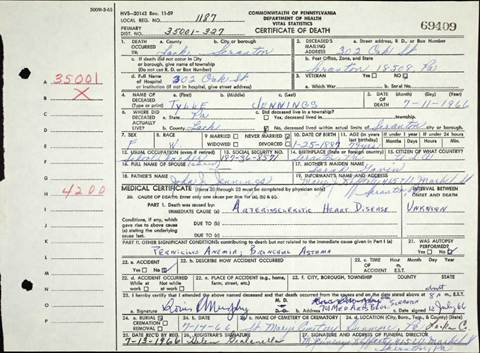
Sarah Jennings was born Sarah Gavin. Patrick Gavin, the killer, was her nephew. When she opened her door that morning to a bareheaded, silent young man, she was looking at her nephew. And when she repeated her husband’s words under oath, “get up, you bloody murderer,” she was testifying against her own blood, in a town where the mob would have happily saved the courts the trouble.
The Gavins’ Terrible Year
To understand what the murder did to this family, you have to know what 1872 had already done to them.
In January of that year, Austin Gavin of Providence, Sarah’s brother, was bitten on the wrist by a rabid dog. The dog was killed, the wound healed in a week, and Austin went back to work. In April, the hydrophobia surfaced. The newspapers covered his illness in awful detail. They said he seized with spasms at every attempt to drink, and that he was calm only when there was no water in the room. His physicians had no hope of his recovery. Father Whittey suggested he be watched so that he wouldn’t hurt himself or others. The paper claimed it was the first case of rabies in the Valley, and the doctors all took an interest in the case.
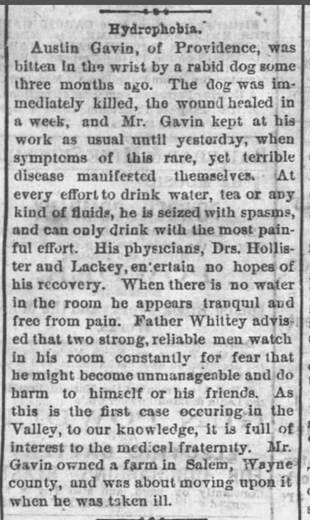
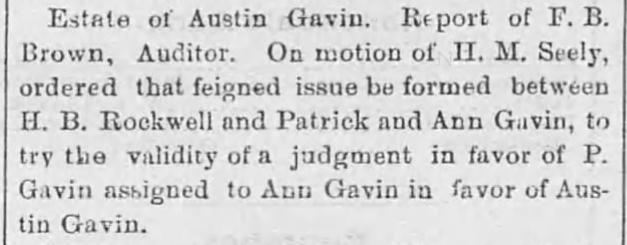
Austin owned a farm in Salem, Wayne County, and was about to move his family onto it when he became ill. He never made it. He died that spring, and on May 9, 1872, a Wayne County sheriff’s deed passed over the farm he never lived on. The sale was likely due to unpaid bills to H.B. Rockwell. Patrick and Ann Gavin later argued claims to the proceeds.
So count the Gavin family’s year. January: Austin is bitten. April: he dies the worst death as a public medical spectacle. May: his farm goes to sheriff’s sale. And in November, his nephew beats a neighbor/relative to death, with a lynch mob in the streets and the family name in every paper in the valley. All of it inside eleven months.
What Ann Knew
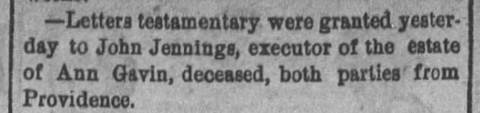
At the center of this family stood Ann Gavin, the woman the 1880 census found living in Martin Garrity’s household. She died on March 12, 1884. That August, letters testamentary were granted to John Jennings as executor of her estate.
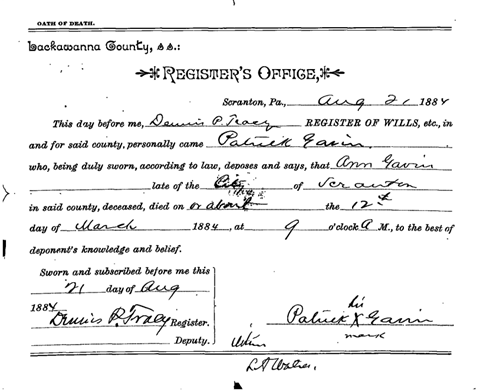
First came the oath of death, sworn before the Register on August 21, 1884, by Ann’s widower. That’s when we find out that Ann’s husband was Patrick Gavin. This is likely the Patrick Gavin mentioned in the 1870 city directory. He could not write. He signed with his mark between his first and last names, written for him by the clerk.
Patrick and Ann appeared to be contesting Austin’s property together in 1873, but according to the 1880 census, only Ann was living with her daughter and son-in-law.
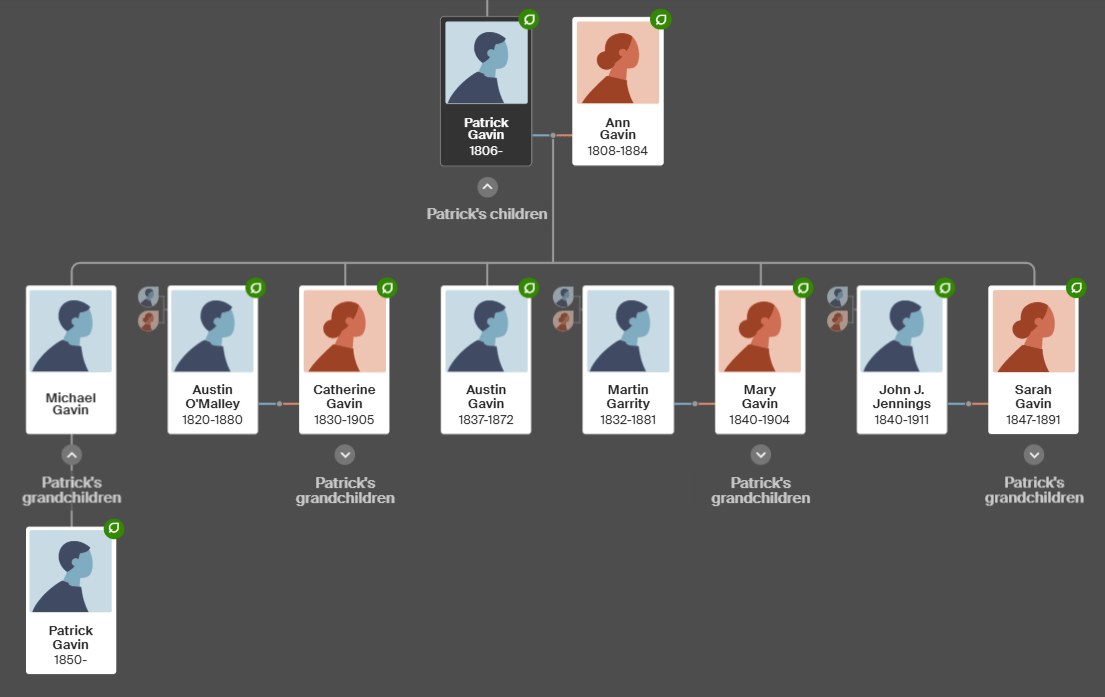
Then the executor’s oath, in which John Jennings swore out the family in a single sentence: the decedent left a husband, Patrick Gavin, and children Catherine, Mary, Sarah and Michael.
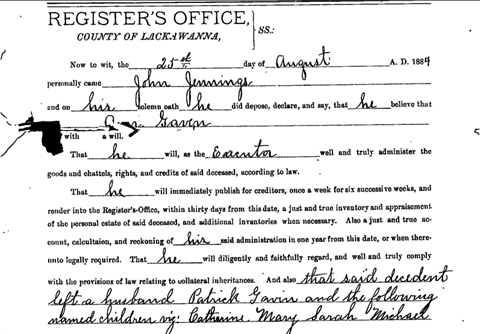
That places Michael Gavin as the only living son. Since the newspapers consistently describe the killer as Sarah Jennings’ nephew, Michael is the only documented son who fits that relationship.
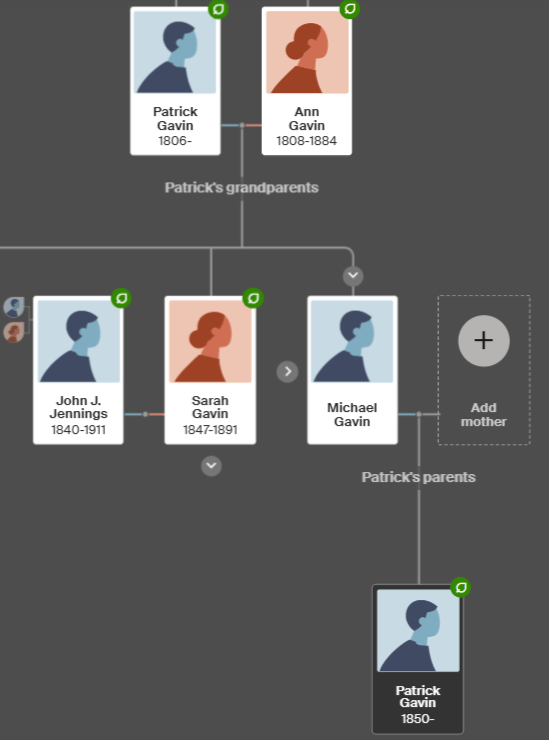
The will itself shows Ann Gavin knew what she was doing. It calls out a deed of settlement and conveyance with her husband in September 1868, meaning that Ann held property in her own right, along with interest in property from that Wayne County sheriff’s deed of May 1872, Austin’s farm, held by John Jennings in trust.
And then the bequests. Read them carefully. A mother’s will can sometimes tell us as much more about a family than any census or newspaper.
“I give and bequeath to my son Michael Gavin, or his heirs forever, the sum of two dollars.”
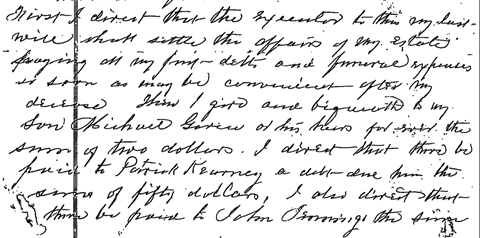
A two-dollar bequest in a nineteenth-century will was not a gift. It was a legal maneuver. You name the child and leave a token sum so the will can’t be contested by claiming the person was inadvertently forgotten. It is the formal, courthouse-recorded way of saying: I remembered you, and this is what I chose to give you. And the phrase “or his heirs forever” extends past Michael to his entire branch.
The rest of the will is generous. Ann directed that a debt of fifty dollars be paid to Patrick Kearney, the patriarch next door, and up to two hundred dollars to John Jennings if so much was owed to him. To her granddaughter, the heir of her son Austin, the girl orphaned by the rabid dog, she left three hundred dollars. Her husband Patrick received the use of the estate for life. And after his death, everything remaining went to her three daughters, Catharine Malia, Mary Garrity, and Sarah Jennings.
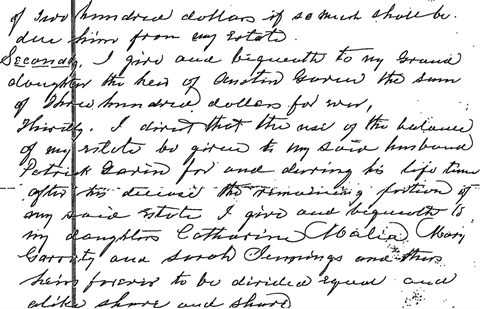
So here is the family, assembled from various documents. Ann and Patrick Gavin, of County Mayo, had children Catharine, who married a Malia (a form of O’Malley); Mary, who married Martin Garrity; Sarah, who married John Jennings; Michael, wife or partner unknown; and Austin, who died of hydrophobia, leaving a daughter. The young Patrick Gavin, who swung the stone, nephew of Sarah, was a grandson of Patrick and Ann, and the most likely story is that he is Michael’s son.
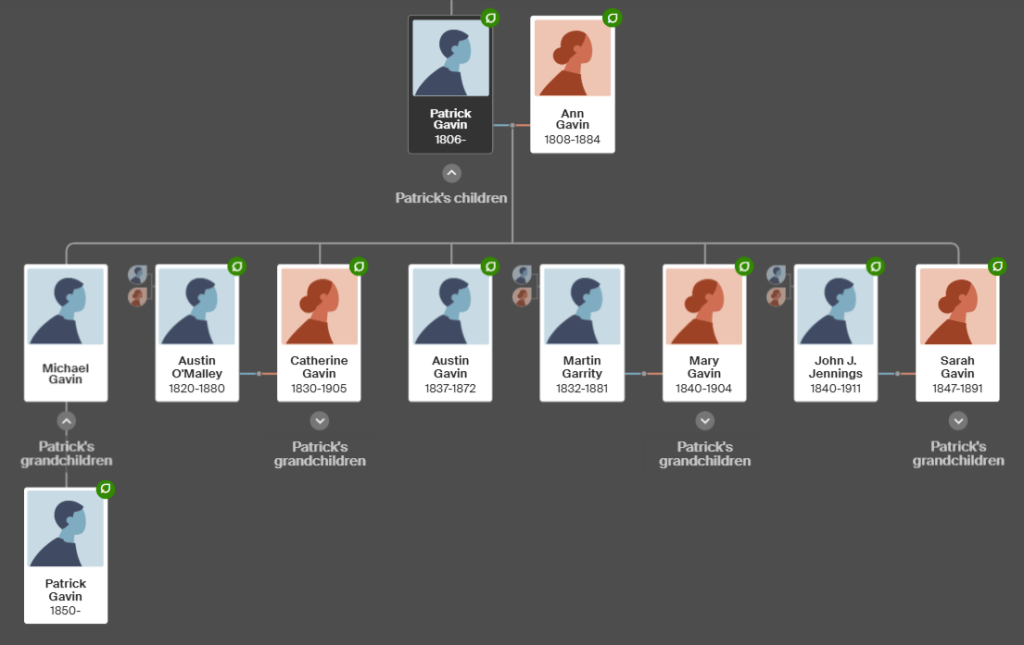
I cannot prove from the will why Ann left only two dollars to Michael and his heirs. Estrangements have many causes: money, alcohol, a marriage she disapproved of. But I keep coming back to the math. Three hundred dollars to the orphaned granddaughter. A full third of the estate to each daughter. Two dollars, forever, to Michael’s branch. It seems that Ann established her own verdict. And it came with no possibility of appeal.
Two dollars. The same amount that Patrick Gavin carried into Eastern State in his pocket. Whether coincidence or not, it is difficult to overlook the irony.
The Widower’s War
Ann’s death revealed more family turmoil. It pitted her widower against her executor.
In June 1884, three months after Ann died and two months before her will was even probated, Patrick Gavin Sr. appeared before the county poor board asking for relief. The reporter covering the hearings was not kind to Patrick.
Patrick told the board he had once held a deed to two hundred and eight acres of land at the Notch. When asked what happened to it, he answered, “Because I let me son-in-law, John Jennings, put his name down wid mine. I was that innocent I didn’t know the law no more than a child, but now I do.”
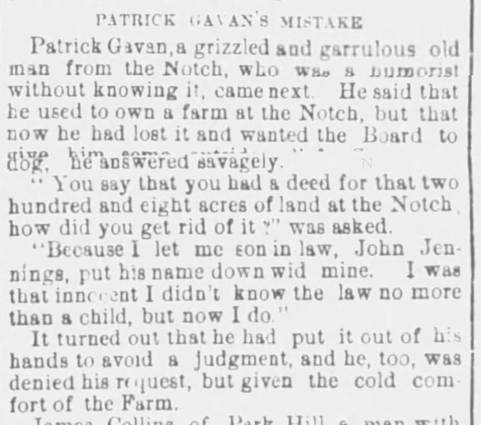
The board found that Patrick had actually transferred the land to avoid a judgment. His request for assistance was denied, and he was given, in the reporter’s words, “the cold comfort of the Farm,” meaning the county poorhouse. Two months later he stood in the Register’s office making his X on the oath of death for Ann, while the son-in-law he had just blamed in a public hearing took charge of the entire estate.
Patrick did not let it go. He found a lawyer. In January 1886, he fought back. Judge Hand overruled Jennings’ attempt to have the suit thrown out on jurisdictional grounds and ordered him to answer the accusation on the merits. An illiterate man the poor board had laughed at survived the defense’s first punch.

The battle lasted more than three years. It ended in April 1889, when the court dismissed the case and ordered Patrick to pay costs to Jennings. Interesting that the suit now refers to “plaintiffs,” plural. Somewhere along the way, either others joined Patrick’s fight or his heirs carried it on. Could it have been Michael? Either way, they lost everything, and ended up owing John Jennings’ legal costs on top of it.

Equity courts have an old rule: he who comes into equity must come with clean hands. A man who shuffles his deed to dodge a creditor cannot later ask the court to shuffle it back. The poor board’s finding in 1884, and the dismissal in 1889, are probably the same finding, five years apart. The court never said John Jennings was a saint. It said Patrick Gavin built his own trap.
The Three Missing Gavins
That is where the documents stand today. Ann’s will left me with questions on three men – and they all have the name Gavin.
Patrick Gavin, the elder, was last seen losing his lawsuit in April 1889, an old man who owed his son-in-law’s court costs and owned the use of things but the title to nothing. Whether he ended at the Hillside poor farm he was once offered, in a daughter’s back room, or in an unmarked row somewhere, I have not yet found the record that says. I have not stopped looking.
Then there’s Michael Gavin. The most likely father of the murderer. He was left just two dollars in the will. Why? Where did he go? If he is the father of the killer, who and where is the mother? Both were recorded as “living” when Patrick was admitted to Eastern Penitentiary.
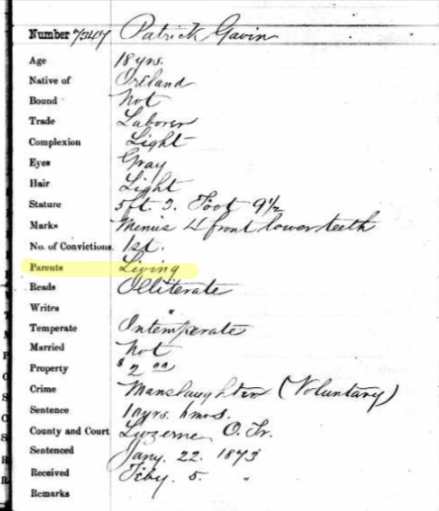
And finally, Patrick Gavin the younger, prisoner 7349. If he served his full ten years and six months, he walked out of Eastern State around August 1883, still in his twenties by his own count, illiterate, with a dead man behind him. If he earned commutation for good behavior, he was out even earlier.
I have chased him through every Patrick Gavin the records offer, and I want to show you how careful this game has to be, because this corner of Scranton was loaded with Gavins and not all of them were related. A Patrick Gavan struck and killed by a trolley near Chinchilla in 1908 looked promising, right area, right kind of hard luck, until his death certificate named his parents: John Gavan and Rose Lavelle. A different line entirely.
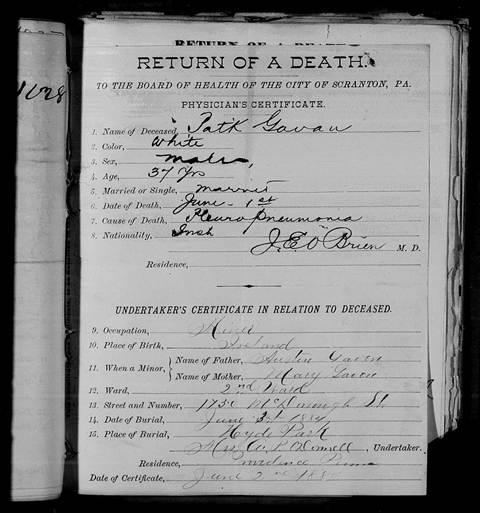
Another Patrick Gavan, a miner born in Ireland, died of pneumonia in Scranton in December 1888. He was married and thirty-seven years old. The age works. But his parents were listed as Austin and Mary Gaven. The articles at the time of the murder called the killer Austin’s nephew, not his son, and Ann names only a granddaughter as Austin’s heir.
This is where my research ends, for now. Patrick Gavin Sr. Michael Gavin. Patrick Gavin Jr. Three men. Three generations. Three unanswered questions.
Did young Patrick come back to the Notch, to a family that had essentially written his branch out of the will? Did he go west to the mines, like some of the Garritys did? Is he buried in a prison ground in Philadelphia, or an unmarked grave at the county farm beside his grandfather? What happened to Michael Gavin? Was he a menace to society who flew below the radar or returned to the old country? Did any of these men turn their lives around? We may never know.
A note on accuracy. Everything in this story comes from newspapers, census pages, city directories, and courthouse records, and I’ve tried to flag the spots where those sources disagree or where I’m making my best guess. But researching historic crimes is difficult. The newspapers couldn’t agree on Patrick’s age, his own prison record couldn’t spell out his birth year, and one correspondent got the victim’s first name wrong. If you find an error or have records that fill a gap, please send it my way so I can correct it. I’d rather be corrected than be wrong. historicnepacrimes@gmail.com
 Exploring historic crimes in NEPA
Leave a comment