On Monday, December 7, 1874, a farmer named Klein was murdered on the road home from Scranton. The Scranton Republican spoke with a witness, Frank Fuller, who described the ordeal. The newspaper treated it as fact and printed it.
The First Reports
On Wednesday, December 9, 1874, two Scranton papers broke the story the same day.
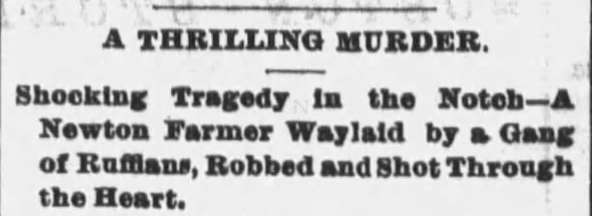
The Scranton Republican ran it in both its Morning and Daily editions under the headline “A Thrilling Murder,” with the subhead “Shocking Tragedy in the Notch, A Newton Farmer Waylaid by a Gang of Ruffians, Robbed and Shot Through the Heart.”
Morning Republican December 9, 1874
The Republican placed the attack in the Notch, shortly after ten o’clock Monday night, a short distance past Cusack’s hotel on the main road to Newton Township. A farmer named Klein, who lived in Newton, was heading home after selling a load of hay and a load of potatoes in the city. He drove one team. His son, about twelve, drove the other.
In the Republican’s account, six men rushed out of the woods. Klein whipped his horses, but two of the men caught them and stopped the wagon. The other four dragged Klein out and threw him to the road. They kicked him and beat him over the head with billy clubs.
Then came the line that newspapers love. Seeing he would get no mercy, Klein cried out, “Oh for God’s sake spare my boy.”
A pistol shot followed. The ball passed through the old man’s heart. The robbers took his money and watch and disappeared into the woods.
The boy sat frozen in the wagon, unable to move or speak. About half an hour later, a young farmer coming home from the city found him there. The boy was shaking so hard the paper said he seemed about to go into a fit. Help was found, and Klein’s body was carried home.
The Republican closed the article by saying Newton’s farming community was deeply moved, and that no effort or expense would be spared to catch the killers.
A Different Version
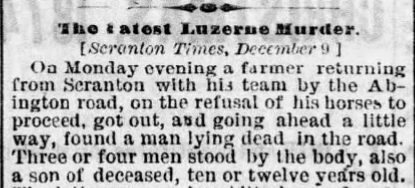
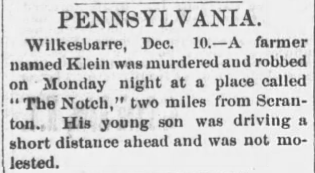
The same day, the Scranton Times carried a shorter piece titled “The Latest Luzerne Murder.” The Harrisburg Daily Patriot reprinted the article two days later. The stories didn’t quite match.
Reprint Harrisburg Daily Patriot December 11, 1874
According to the Times, a farmer returning from Scranton on Monday evening via the Abington road said his horses stopped along the road, refusing to continue. He got out, walked ahead, and found a man lying dead in the road.
Three or four men were standing near the body, along with the dead man’s son, who was crying uncontrollably. The boy said some men had stopped his father’s wagon, dragged him into the road, robbed him of his watch and money, and shot him.
The informant said he and the boy loaded the body into the wagon and drove it home. The dead man was identified as “a Mr. Klien,” who lived on a farm next to the poor house property. He had been shot through the heart.
The Times explained the likely motive. Klein had come to Scranton that day with two teams loaded with hay, potatoes, and other produce. He sold both loads and had the proceeds in his pocket. On the way home, the son’s team led the way and was allowed to pass. The rear wagon, driven by the father, was the one attacked.
The boy was too frightened to give a clear account or describe the killers. The men standing over the body had been alerted by his cries, but they arrived too late. According to the son, the murder happened about half an hour before they came up. Another printing of the same story says an hour.
Word Spreads
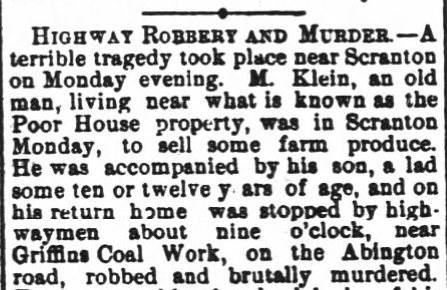
The story of the tragedy quickly spread. Another paper, the Daily Record of the Times (Wilkes-Barre), ran a version saying the attack happened about nine o’clock near Griffin’s coal works on the “Abington road.” That account called the victim “M. Klein, an old man,” and predicted the killers would probably never be caught.
Wilkes-Barre Daily Record of the Times December 10, 1874
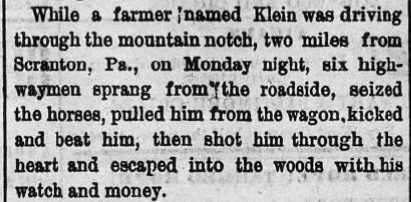
A brief from West Chester, PA, boiled it down to a single (very long) sentence: “While a farmer named Klein was driving through the mountain notch, two miles from Scranton, PA, on Monday night, six highwaymen sprang from the roadside, seized the horses, pulled him from the wagon, kicked and beat him, then shot him through the heart and escaped into the woods with his watch and money.”
Daily Local News (West Chester, PA) December 10, 1874
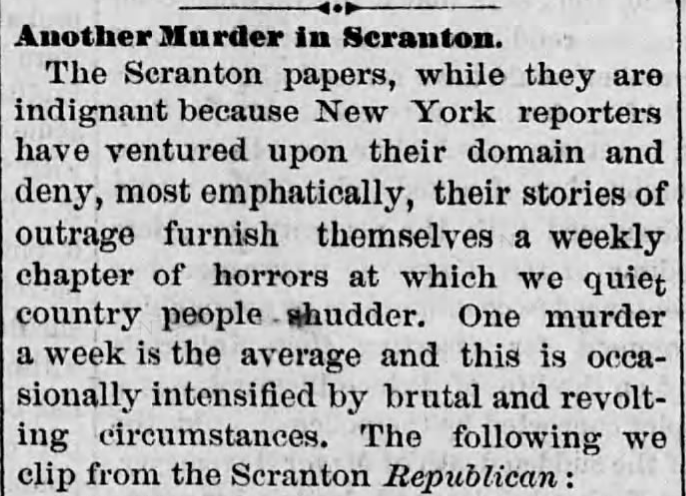
A rural paper, the Wyoming Democrat from Tunkhannock, reprinted the Republican account under the headline “Another Murder in Scranton,” with a jab at the city. The Scranton papers, it said, were indignant when New York reporters described them as violent, yet they handed readers a weekly chapter of horrors. “One murder a week is the average,” the paper sniffed, speaking on behalf of “we quiet country people.”
Wyoming (Tunkhannock) Democrat December 16, 1874
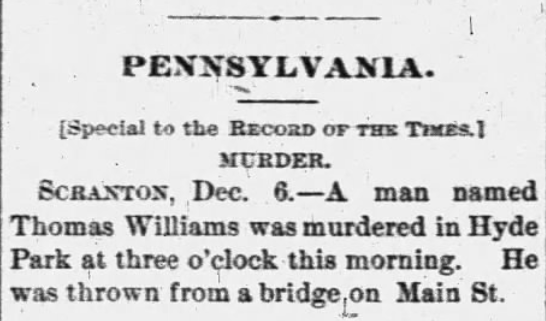
To be fair to the Wyoming Democrat editor, Scranton had given him material. Thomas Williams was brutally beaten to death in Hyde Park the same week.
Daily Record of the Times (Wilkes-Barre) December 7, 1874
Word of this latest murder spread throughout the country. Galveston, Texas, picked up the story on December 10, 1874.
Galveston Daily News December 10, 1874
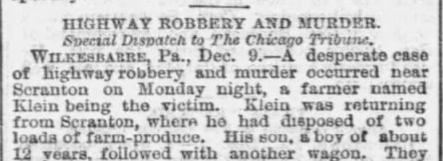
The people of Chicago, Illinois, were notified via “Special Dispatch to the Chicago Tribune.”
Chicago Tribune December 10, 1874
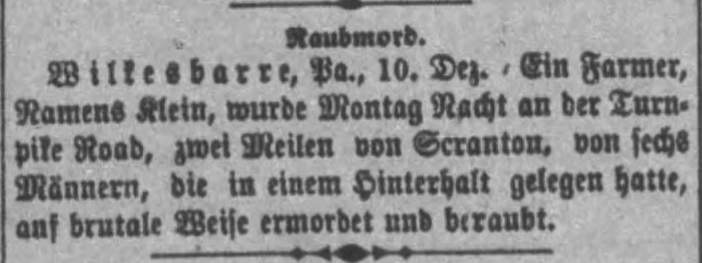
The next day, the New Orleans German population was notified by the New Orleanser Deutsche Zeitung. They printed the announcement in German.
New Orleanser Deutsche Zeitung December 11, 1874
“Wilkesbarre, PA. 10 Dec. A farmer named Klein was brutally murdered and robbed Monday night on Turnpike Road, two miles from Scranton, by six men who had ambushed him.”
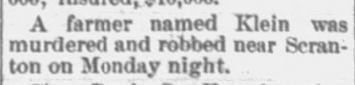
Out in the frontier west, the people of Cheyenne, Wyoming, were notified by The Cheyenne Daily Leader. They published a blurb on Friday, December 11, 1874.
Cheyenne Daily Leader December 11, 1874
And the community of Provo, Utah, received word on December 12, 1874.
Utah County Times December 12, 1874
Other reports were published in Alabama, Tennessee, Nebraska, along with several other states across the country.
“A Pure Fabrication”
Then the Republican took it all back.
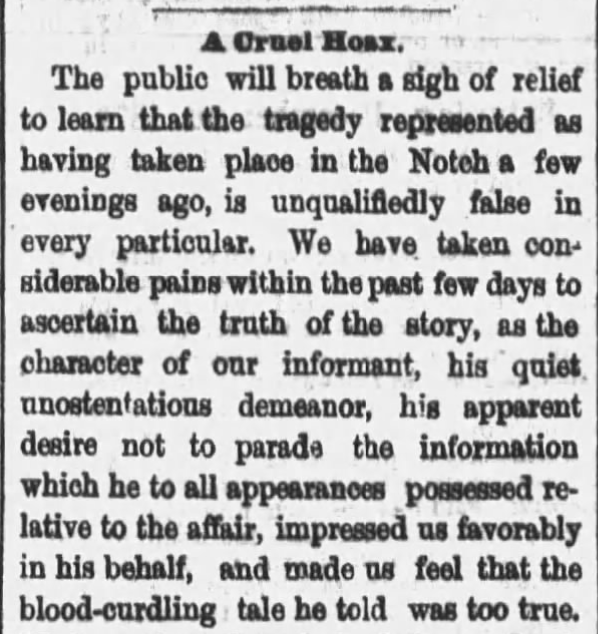
Under the headline “A Cruel Hoax,” the paper told readers they could breathe a sigh of relief. The tragedy in the Notch was “unqualifiedly false in every particular.”
Scranton Morning Republican December 12, 1874
The paper explained how it got fooled. Its source was a young man from the country named Frank Fuller. He hadn’t gone to a reporter. He told the story “with bated breath” to friends at one of the leading business houses on Lackawanna Avenue. A reliable citizen tipped off the Republican, and the paper went to hear the story firsthand.
Fuller’s version was this. Somewhere between nine and ten o’clock, he was driving through the Notch when he found the murdered man in the road and the boy sitting terrified in the wagon. Klein had been shot through the heart. Fuller said he helped carry the body to Klein’s home.
The Republican said Fuller seemed quiet and unassuming, with no apparent wish to show off. He seemed “too serious to lie.” Given his good character, the paper printed the story as news.
After a few days of checking, the paper concluded the story was “a pure fabrication.” It couldn’t resist a pun, saying Fuller was apparently “fuller of something more than the truth” when he told it. The editors called it a grim, cruel, malicious hoax driven by “the most morbid spirit of sensationalism,” and left readers to form their own opinion of its author.
The Aftermath
The retraction was printed locally, but failed to travel as extensively as the original story. By mid-December, the Harrisburg Telegraph reprinted the Republican’s correction under “Luzerne: A Cruel Hoax.”
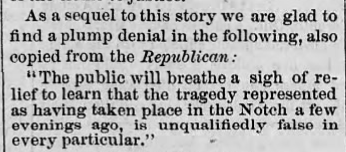
The Wyoming Democrat that mocked Scranton also printed the denial, noting it was glad to find “a plump denial.”
Wyoming Democrat December 16, 1874
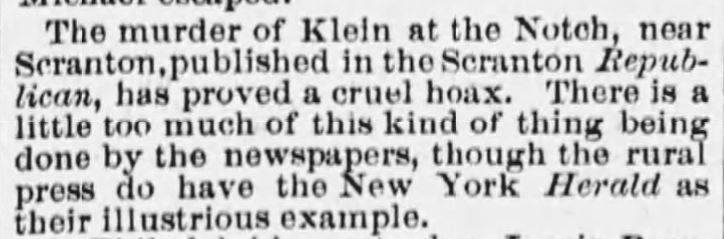
Another paper, the Lancaster Daily Intelligencer, summed it up: the Klein murder “has proved a cruel hoax.” It added that there was a little too much of this sort of thing going on in newspapers, though the rural press did have the New York Herald as their “illustrious example.”
Lancaster Daily Intelligencer December 15, 1874
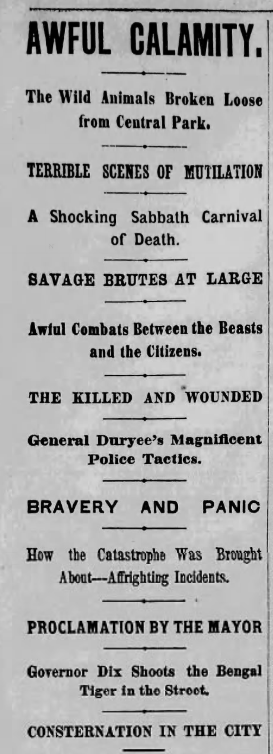
That was likely a reference to the Herald’s infamous full-page story a month earlier, in November 1874, claiming animals had escaped from the Central Park Zoo and were killing people in the streets of Manhattan. That one was a hoax too.
New York Herald November 9, 1874
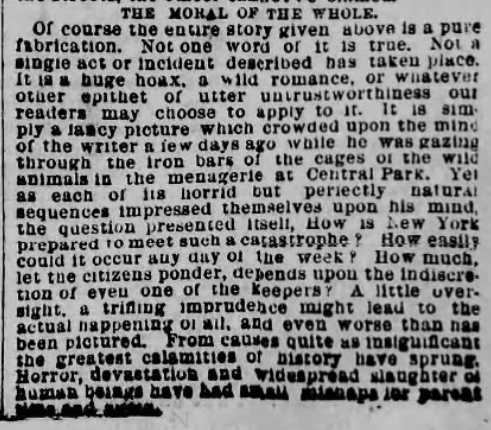
The Herald covered itself in the story’s final paragraph, under the heading “The Moral of the Whole.” It admitted the entire story was “a pure fabrication.” The writer said the idea came to him while gazing through the bars of the cages in the Central Park menagerie. The point, the Herald claimed, was to ask how prepared New York was for such a disaster, and how much depended on the carelessness of a single keeper.
New York Herald November 9, 1874
A month later, the Scranton Republican said the whole Frank Fuller was “a pure fabrication.” Coincidence?
Looking Back
Read side by side, the accounts don’t line up. The time shifts from nine o’clock to after ten. The boy is crying beside the body in one version and frozen silent in the wagon in another. His team is out in front and passes safely in one, and he’s sitting in the attacked wagon in the other. The person who found him is a farmer with frightened horses, or a young farmer half an hour later, or Fuller himself. The location moves between Cusack’s hotel in the Notch, and Griffin’s coal works on the Abington road.
And then there’s “spare my boy.” The only witness was a child who, every version agrees, couldn’t give a coherent account. So who heard Klein say it?
Nobody, it seems. Because it never happened.
Then and Now
A man told a story to his friends on Lackawanna Avenue. Within a week, it was in papers across Pennsylvania and throughout the United States. Each retelling picked up something new. Remember the game Telephone? That’s what happened here. Six highwaymen. Billy clubs. A dying father begging for his son’s life. By the time it was reduced to a single sentence in an out-of-town paper, it read like settled fact.
The correction was printed, but only in a handful of Pennsylvania papers. But it was shorter, it came later, and it had to compete with “Oh for God’s sake spare my boy.” That’s a hard line to retract.
The Republican’s defense was that Fuller seemed honest. He was quiet. He didn’t want attention. That’s how they decided to print it. Not because anyone had found a body, a grave, or a grieving widow in Newton, but because the man telling it seemed like he wouldn’t lie.
We’d like to think we’re past this. We aren’t. Today a story can go from one person’s mouth to millions of screens before lunch. The details still grow with every share. The retraction, if it comes, still reaches fewer people than the original. And we still judge a story by how sure the teller sounds, not by what they can show us.
The country editor at the Wyoming Democrat who mocked Scranton had a point, even if he was enjoying himself a little too much. Papers then needed readers. A thrilling murder sold better than a quiet week in the Notch. That hasn’t changed either. It just moves faster now.
So the next time a story seems too perfect, with the dramatic quote, the helpless child, and the villains who vanish into the woods, it’s worth asking the question nobody asked in December 1874.
Who actually saw it?
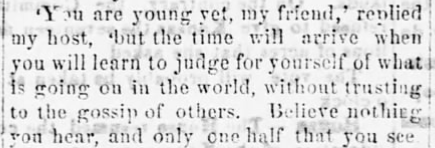
““You are young yet, my friend,” replied my host, “but the time will arrive when you will learn to judge for yourself of what is going on in the world, without trusting to the gossip of others. Believe nothing you hear, and only one half that you see.” Edgar Allan Poe, “The System of Doctor Tarr and Professor Fether,” November 1845




Leave a Reply